GaN Chargers & Wireless Charging Guide 2026 – What to Buy
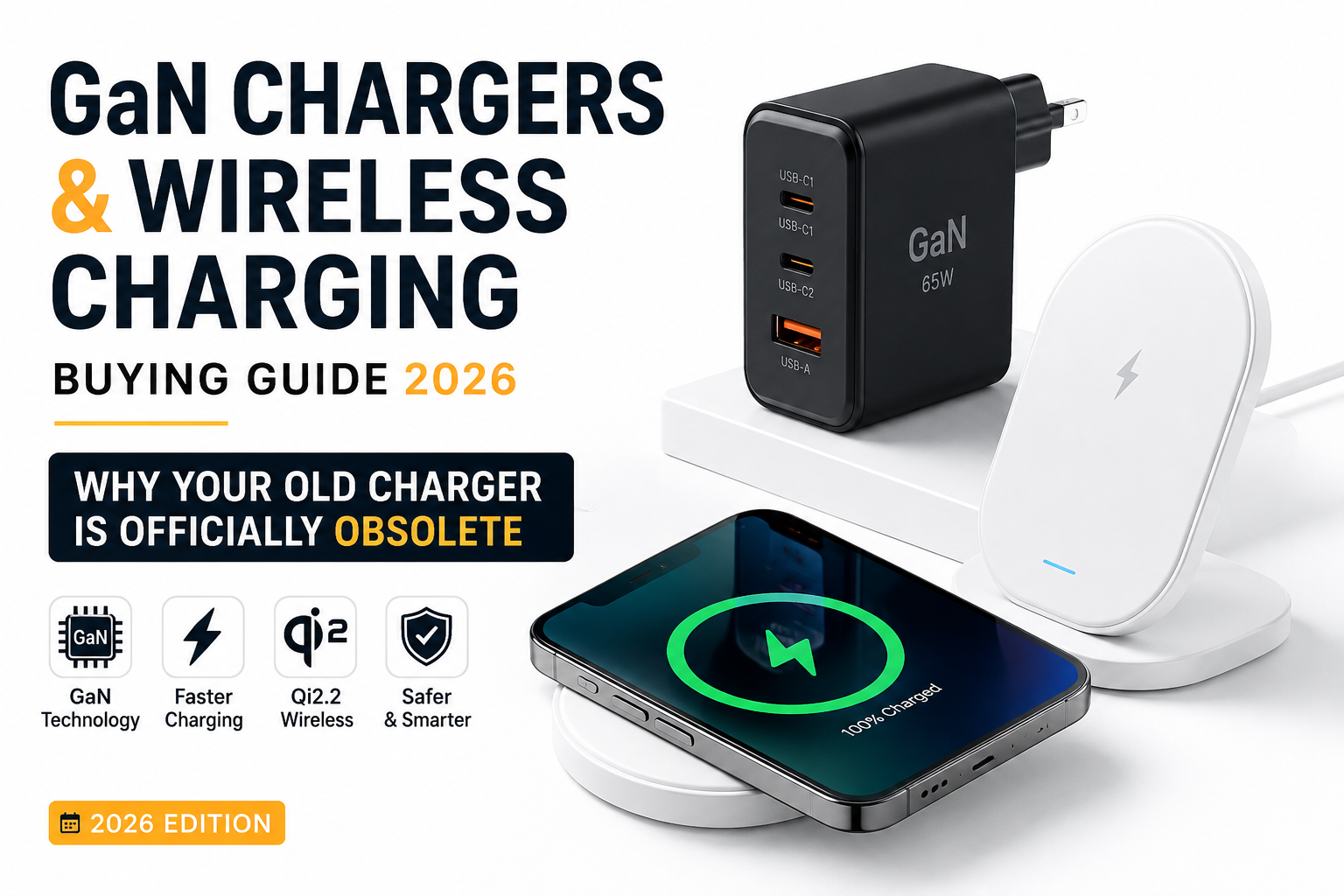
GaN chargers and Qi2.2 wireless charging are rewriting the rules in 2026. Here’s exactly what to buy, what to avoid, and why your charging brick just got an upgrade.
GaN charger 2026, Qi2.2 wireless charger, best GaN charger, wireless charging buying guide, fast charger 2026
If you’ve bought a new phone this year and opened the box expecting a charger, you probably found… nothing. Samsung, Apple, and most flagship Android brands have quietly stopped including one. That single decision has triggered a scramble across the entire charging industry — and it’s why “GaN charger” and “Qi2.2” are suddenly two of the most-searched tech terms of 2026.
Here’s the problem: most buyers don’t actually know what they’re shopping for. They see “65W,” “GaN,” “Qi2,” and “MagSafe-compatible” thrown around interchangeably, assume bigger numbers mean better, and end up with a charger that either underdelivers or actively cooks their phone’s battery over time.
This guide cuts through it. By the end, you’ll know exactly what GaN is, why Qi2.2 changed the wireless charging game, and which specs actually matter versus which ones are just marketing noise.
What Is a GaN Charger, Really?
GaN stands for gallium nitride — a semiconductor material that’s replacing the silicon used in charging bricks for decades. The difference isn’t cosmetic. GaN chips switch power faster and waste far less energy as heat than traditional silicon, which is why GaN chargers can pack 65W, 100W, or even 140W of output into a block roughly the size of a matchbox.
That thermal efficiency matters more than people realize. Less heat means:
- Smaller, lighter chargers you’d actually want to travel with
- Longer battery lifespan on the devices you’re charging, since heat is one of the biggest drivers of battery degradation
- More stable sustained speeds instead of a charger that hits its peak wattage for two minutes and then quietly throttles down
If you’re still using the charger that shipped with a phone from three or four years ago, you’re very likely on outdated silicon tech — and probably charging slower and hotter than you need to.
Qi2.2: The Wireless Charging Upgrade Everyone’s Talking About
For years, wireless charging topped out at 15W and felt like a convenience trade-off — nice for a nightstand, too slow for anything urgent. That changed with Qi2.2, the updated wireless standard that pushes magnetic wireless charging up to 25W on supported phones, including recent iPhone models and select 2026 Android flagships.
Qi2.2 builds on the original Qi2 standard’s magnetic alignment system — the same magnet-ring approach Apple popularized with MagSafe — but nearly doubles the charging speed. The catch: you need three things to line up for it to actually work:
- A Qi2.2-certified charger
- A phone with native Qi2.2 support (not just “Qi2 compatible”)
- A case that doesn’t block or weaken the magnetic connection, if you use one
Skip any of those three and you’ll quietly fall back to old-standard speeds without realizing why your “25W charger” feels no faster than your last one.
The GaN + Qi2.2 Overheating Problem Nobody Mentions
Here’s something most buying guides gloss over: pushing 25W through a wireless coil generates real heat, and heat is the enemy of both charging speed and battery health. A lot of budget Qi2.2 chargers can technically hit 25W — for the first few minutes. Then internal temperatures climb, and the charger throttles itself back down to 15W or lower for the rest of the session.
This is where GaN’s efficiency advantage actually shows up in daily use. GaN-based wireless chargers run meaningfully cooler than silicon-based ones at the same wattage, which means they’re far more likely to sustain their advertised speed for the entire charging cycle instead of just the marketing photo. Some premium models go further with active cooling fans or metal chassis that double as passive heat sinks, specifically to hold that 25W ceiling for longer sessions.
The takeaway: don’t just check the wattage number on the box. Look for GaN construction and, ideally, independent thermal testing before assuming a charger will actually deliver its rated speed.
What to Actually Look For (5 Criteria That Matter)
1. Certification, Not Just Claims
Look for genuine Qi2 or Qi2.2 certification from the Wireless Power Consortium, and USB-C PD certification for wired GaN chargers. “Compatible with Qi2” printed on packaging isn’t the same as certified — plenty of uncertified chargers cap out well below their advertised wattage.
2. GaN Generation
Not all GaN is equal. Newer GaN designs pack more power into smaller housings and run cooler than earlier-generation chips. If a product page mentions its GaN generation, that’s a good sign the brand is being specific rather than vague.
3. Programmable Power Supply (PPS) Support
If you own a Samsung device, PPS support is non-negotiable — without it, you’re capped at a fraction of your phone’s actual fast-charging capability, regardless of the charger’s wattage rating.
4. Real-World Thermal Performance
A charger that sustains its rated wattage under load for 30+ minutes is doing something a cheaper competitor with the same spec sheet probably isn’t. This is the single biggest differentiator between a $20 charger and a $50 one.
5. Match the Charger to Your Actual Use Case
- Traveling constantly? Prioritize a compact single-port GaN adapter under 100g.
- Permanent desk setup? A 3-in-1 Qi2.2 station that charges your phone, watch, and earbuds from one cable eliminates the most clutter.
- Charging 3+ devices regularly? Look at multi-port GaN hubs with smart power distribution rather than buying separate bricks for everything.
Do You Actually Need Qi2.2, or Is Qi2 (15W) Enough?
Honestly? For a lot of people, the extra 10W doesn’t change daily life much. If you charge overnight, 15W and 25W both get you to 100% before your alarm goes off. Qi2.2 matters most if you:
- Top up quickly between meetings or during the day
- Fast-charge overnight in short windows rather than a full 8 hours
- Own one of the newer phones that actually supports the higher wireless speed
If none of that describes you, a well-built 15W Qi2 charger is still a completely reasonable — and usually cheaper — choice.
Common Mistakes to Avoid
- Buying wattage without checking device compatibility. A 140W charger does nothing extra for a phone that maxes out at 25W.
- Ignoring case compatibility with magnetic wireless charging. Thick cases or ones without proper magnet arrays will weaken alignment and quietly cut your charging speed.
- Assuming “MagSafe compatible” means fast charging on Android. Apple’s magnetic charging standard doesn’t extend fast-charging benefits to non-Apple devices, regardless of what a product listing implies.
- Skipping safety certification to save a few dollars. Uncertified high-wattage chargers are a real fire and battery-damage risk — always check for proper regional certification marks.
Frequently Asked Questions
Is a GaN charger worth the extra cost over a regular charger?
For most people, yes — the size reduction and heat management alone justify the modest price difference, and the long-term battery health benefit is a real, if invisible, upside.
Can I use a Qi2.2 charger with an older Qi phone?
Yes, but it will charge at your phone’s maximum supported speed, not the charger’s rated 25W. Compatibility works backward for speed, not forward.
Does wireless charging damage my phone’s battery faster than wired charging?
Heat is the real culprit, not the wireless connection itself. A well-cooled GaN-based wireless charger produces comparable long-term wear to a quality wired charger; a cheap, poorly cooled one is the actual risk.
What’s the difference between Qi2 and MagSafe?
MagSafe is Apple’s proprietary version of magnetic wireless charging. Qi2 is the open industry standard built on the same magnetic-alignment concept, which is why most modern accessories now support both.
Have a charger you swear by, or one that turned out to be all hype? Drop it in the comments — we’re updating this guide as new models launch throughout 2026.