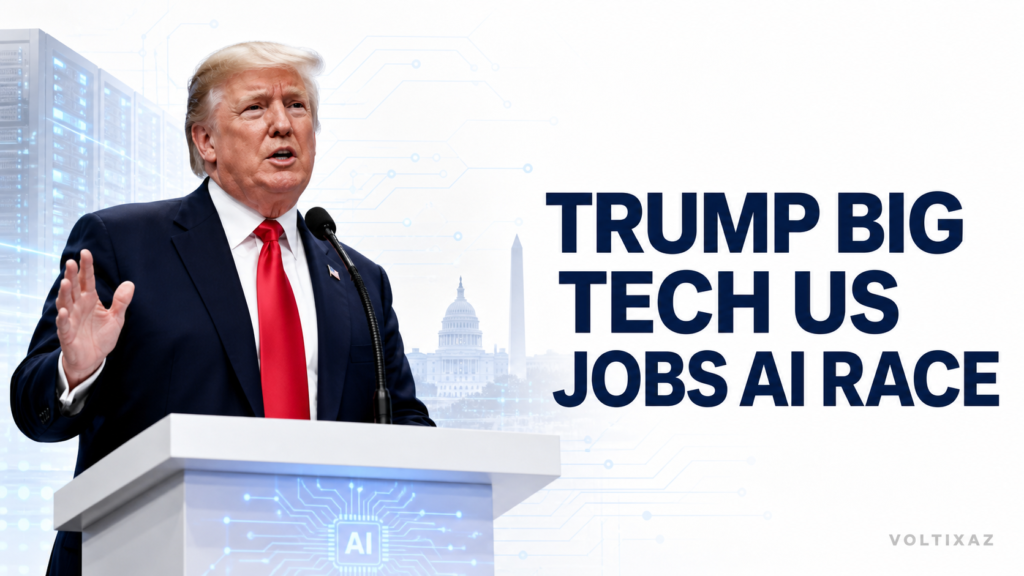
Trump Big Tech US Jobs AI Race became a major political talking point after President Donald Trump urged American technology companies to place domestic workers, investment and innovation at the centre of their artificial intelligence strategies.
Trump Big Tech US Jobs AI Race and the H-1B Visa Debate
Speaking at the “Winning the AI Race” summit in Washington, D.C., on July 23, 2025, Trump criticised what he described as “radical globalism” in the technology industry. He argued that some of the country’s largest companies had benefited from American innovation and economic freedom while building factories in China, hiring workers in India and shifting profits to lower-tax countries.
Trump’s message was clear: the United States should not allow the benefits of the AI boom to flow abroad while American workers feel left behind. He said Silicon Valley and the wider technology sector would need a stronger sense of patriotism and national loyalty if the country was to maintain leadership in artificial intelligence.
The Trump Big Tech US jobs AI race debate is not only about technology. It is also about employment, immigration, industrial policy and competition with China. Artificial intelligence is increasingly viewed by US policymakers as a strategic technology that will influence economic power, military capability and national security in the coming years.
At the summit, Trump also unveiled the administration’s AI Action Plan. The plan proposed a broad set of federal measures designed to accelerate AI development in the United States. These measures included faster permits for data centres and semiconductor facilities, reduced regulatory barriers, support for AI exports and new efforts to expand the skilled workforce needed to build and operate AI infrastructure.
The administration’s policy agenda aims to ensure that American companies remain globally competitive. However, Trump’s remarks about hiring in India were political comments and not a formal legal ban on US firms employing overseas workers or using H-1B visas.
This distinction is important. Many American technology companies operate global workforces, with engineering, support and research teams based in India, Europe and other regions. They also use the H-1B visa programme to bring skilled foreign professionals to the United States for specialised roles in areas such as software engineering, cloud computing, data science and AI research.
Vice President JD Vance added another layer to the Trump Big Tech US jobs AI race discussion by criticising companies that announce layoffs while continuing to seek visas for foreign workers. During the same AI summit, Vance referred to Microsoft’s plan to cut about 9,000 jobs and questioned how large firms could claim that they could not find enough qualified workers in the United States.
Vance argued that companies should not dismiss American employees and then rely on overseas recruitment or work-visa programmes to fill jobs. His remarks reflected a growing concern among some US political leaders that the H-1B visa programme may be used to reduce labour costs rather than address genuine shortages of highly skilled workers.
Microsoft rejected the suggestion that its layoffs were connected to H-1B visa hiring. The company said that many of its visa petitions were extensions for existing employees, not applications for new workers coming to the United States. Microsoft also said that some H-1B employees were affected by the company’s job cuts.
The disagreement highlights a complicated issue for the technology sector. Companies say access to international talent is essential because AI and advanced computing require specialised skills that are in high demand globally. They argue that restricting skilled immigration too sharply could reduce innovation and make it harder for American companies to compete with rivals in China and other countries.
Critics, however, say that technology companies must do more to train, hire and retain American workers. They want firms receiving the benefits of US markets, infrastructure and public policy to demonstrate that they are creating high-quality jobs at home. They also want stronger safeguards to ensure visa programmes are not used to undercut wages or replace qualified domestic workers.
For Indian technology professionals, the political debate carries significant consequences. India is a major source of skilled workers for US technology companies and has long been closely connected to America’s software, engineering and services industries. Any tighter scrutiny of offshore hiring or H-1B visa use could affect employment opportunities, business relationships and investment decisions across the US-India technology corridor.
The Trump Big Tech US jobs AI race debate is therefore likely to continue. As AI investment grows, American policymakers will face difficult questions: How can the United States attract the best global talent while protecting local workers? How can it build AI infrastructure quickly without weakening oversight? And how can it ensure that AI creates broad economic opportunity rather than concentrating benefits among a small number of companies and investors?
Trump and Vance have made their position clear: American leadership in AI should deliver visible benefits for American workers. Whether technology companies, lawmakers and global talent markets can meet that expectation will shape the next phase of the AI race.
For more details,
- offical record official record of Trump’s AI summit remarks,
- the White House’s America’s AI Action Plan,
- the administration’s AI strategy portal,
- the USCIS overview of the H-1B specialty occupations programme,
- Microsoft CEO Satya Nadella’s statement on the company’s recent job eliminations.
Explore More on Voltixaz
Continue exploring the latest technology content with our other categories:
- Artificial Intelligence – Discover AI news, tutorials, tools, and practical guides.
- Windows – Learn Windows tips, troubleshooting, updates, and optimization techniques.
- Linux – Explore Linux tutorials, terminal commands, distributions, and open-source news.
- Smartphones – Read smartphone reviews, buying guides, software updates, and mobile tips.
- Cybersecurity – Stay protected with online security guides, privacy tips, and the latest cyber threat updates.
- Tech News – Keep up with breaking technology news, product launches, and industry trends.
- Reviews & Buying Guides – Make informed decisions with expert product reviews and detailed buying advice.