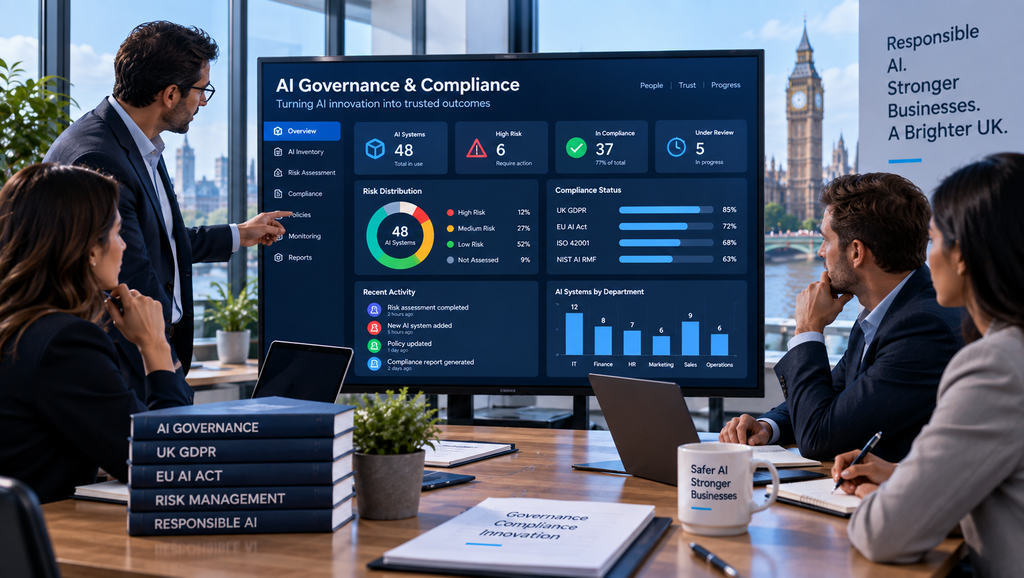
AI compliance tools for UK companies are becoming much more important in 2026 as businesses move from experimenting with artificial intelligence to using AI in customer service, recruitment, marketing, finance, cybersecurity, healthcare and everyday business operations.
The challenge is no longer simply deciding whether employees can use ChatGPT or another AI assistant. Companies increasingly need to know what AI systems are being used, what data they access, what risks they create, who owns them and whether the organisation can demonstrate that appropriate controls are in place.
The UK’s regulatory environment also continues to evolve. The Data (Use and Access) Act 2025 completed its data-protection implementation in June 2026, while the Information Commissioner’s Office continues to develop and update its guidance around AI, automated decision-making and data protection.
At the same time, UK businesses selling into or operating in the European Union may have another major consideration: the EU AI Act. Its enforcement framework and new transparency requirements began applying from 2 August 2026, although some high-risk AI obligations have later transition dates.
That combination is creating demand for software that can turn AI policies and regulatory requirements into practical governance workflows.
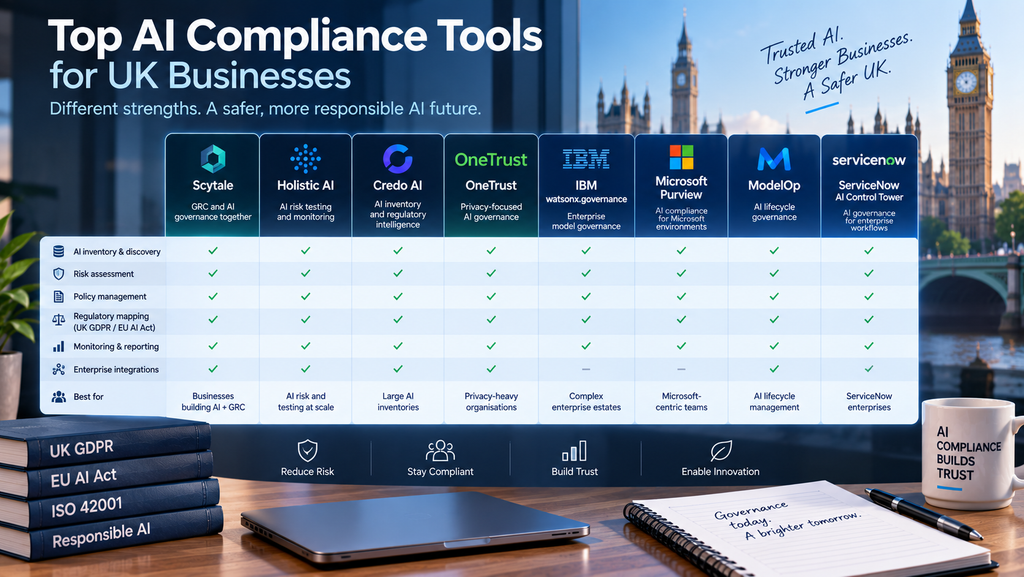
Here are eight AI compliance and governance platforms worth considering in 2026.
What Are AI Compliance Tools?
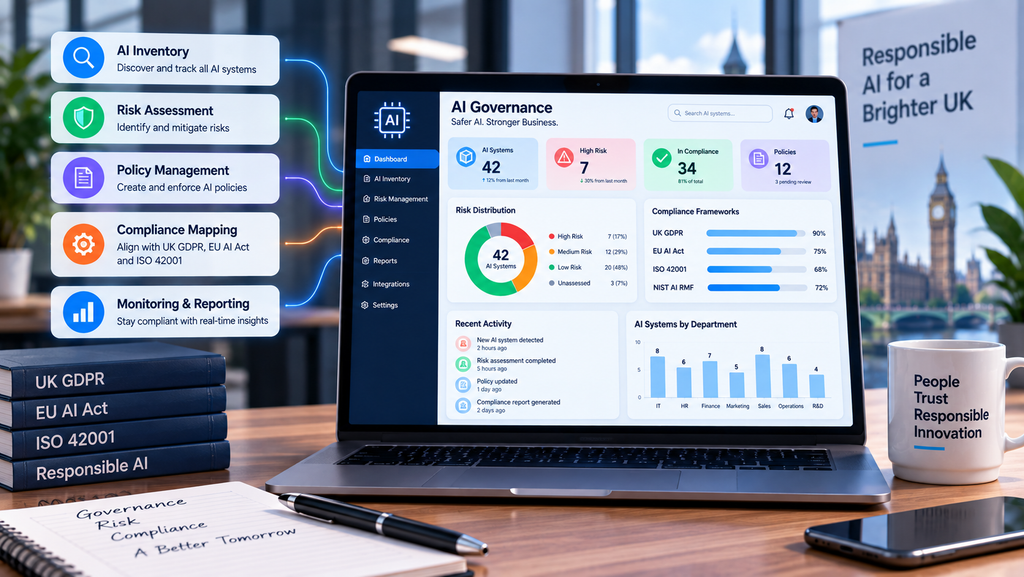
AI compliance tools are software platforms designed to help organisations identify, assess, document and manage the risks associated with artificial intelligence.
The exact capabilities differ significantly between products.
Some platforms concentrate on AI governance and regulatory mapping. Others are built around enterprise GRC, privacy management, model risk, security or runtime controls.
The strongest platforms generally provide some combination of AI inventory, risk classification, policy management, assessments, control mapping, evidence collection, monitoring and reporting.
This matters because an organisation cannot effectively govern AI systems it does not know about.
For example, an employee might introduce an AI-powered SaaS application without involving the security or compliance team. A governance platform can help discover that system, identify its owner, assess the type of data involved and determine what controls should apply.
The ICO’s own AI guidance highlights the importance of accountability, transparency, fairness, security, data minimisation and individual rights when organisations use AI involving personal information. Its AI and data protection risk toolkit is specifically designed to help organisations assess risks to individuals’ rights and freedoms.
How We Ranked These AI Compliance Tools
This is an editorial ranking rather than a legal certification or official industry ranking.
The platforms were assessed based on several practical considerations: AI discovery and inventory, risk assessment, regulatory and framework mapping, governance workflows, evidence generation, monitoring, enterprise integrations and their usefulness for organisations operating in the UK.
We also considered whether a product makes sense for a particular type of business rather than assuming that the largest platform is automatically the best.
That distinction is important because a small UK software company may have completely different requirements from a bank, healthcare organisation or multinational enterprise.
1. Scytale — Best for AI Compliance and Broader GRC
Scytale is one of the strongest choices for organisations that want to manage AI governance alongside their existing security, privacy and compliance programme.
Its platform supports AI governance together with frameworks such as ISO 42001, the EU AI Act, NIST AI RMF and other compliance requirements. It also provides automated evidence collection, continuous control monitoring and governance workflows.
That broader GRC approach is particularly useful for companies that do not want AI governance to become another disconnected compliance project.
Scytale also supports EU AI Act requirements and has positioned its platform around automated risk assessments, evidence collection and ongoing monitoring.
Best for: UK companies building AI governance alongside ISO, GDPR, security and broader GRC programmes.
Why it stands out: It connects AI governance with the compliance processes companies may already have.
2. Holistic AI — Best for AI Risk Testing and Runtime Governance
Holistic AI takes a more AI-specific approach, covering governance, risk assessment, testing and runtime controls.
Its platform supports EU AI Act, ISO 42001 and NIST AI RMF alignment, while also providing risk classification, policy enforcement, audit documentation and continuous assurance.
One of its more interesting areas is agentic AI governance.
As companies begin deploying autonomous AI agents capable of using tools and taking actions, traditional documentation alone may not be enough. Holistic AI focuses on monitoring agent workflows, tool use and decision chains alongside conventional AI governance.
That makes it particularly interesting for organisations moving beyond simple chatbots and copilots.
Best for: Enterprises that need deeper AI risk assessment, testing and agent governance.
Why it stands out: It combines governance with technical enforcement rather than treating compliance as paperwork alone.
3. Credo AI — Best for AI Inventory and Regulatory Intelligence
Credo AI is designed around the idea that companies need a central system of record for their AI environment.
Its platform covers AI inventory, regulatory alignment, risk and compliance dashboards, and governance across the AI lifecycle. Credo says its knowledge graph maps policies and controls to frameworks including the EU AI Act, NIST AI RMF and ISO 42001.
This is particularly valuable for organisations with hundreds of AI use cases spread across departments.
Instead of keeping separate spreadsheets for models, vendors, agents and assessments, the organisation can create a central inventory and connect those assets to governance requirements.
Credo has also been developing its approach around agentic AI governance, which is increasingly relevant as autonomous systems become more common.
Best for: Enterprises that need a detailed AI inventory and regulatory intelligence.
Why it stands out: Strong focus on connecting AI systems with policies, controls and regulatory requirements.
4. OneTrust AI Governance — Best for Privacy-Heavy Organisations
OneTrust is particularly attractive to companies where AI governance and privacy management overlap.
Its AI Governance platform can discover and inventory AI systems, models, agents, datasets, vendors and use cases. It also supports risk assessment, ownership, lifecycle management, policy workflows and monitoring.
For UK organisations, that privacy connection can be important.
Many AI projects involve personal information, employee data, customer records or sensitive business information. In those situations, AI governance cannot be separated completely from data governance.
OneTrust supports frameworks including the EU AI Act, NIST AI RMF and ISO 42001 and also provides policy and runtime governance capabilities.
Best for: Large organisations where AI governance, privacy, data governance and risk management need to work together.
Why it stands out: Strong combination of AI governance and privacy/data governance capabilities.
5. IBM watsonx.governance — Best for Large Enterprise AI Portfolios
IBM watsonx.governance is aimed squarely at large organisations managing complex AI estates.
The platform provides AI visibility, governance controls, policy enforcement, risk management and continuous monitoring. IBM also supports governance across models developed on different platforms, including third-party environments.
That multi-vendor approach is important because large companies rarely run their entire AI strategy on one platform.
A bank, insurer or multinational business could have traditional machine-learning models, generative AI applications, third-party foundation models and internally developed AI agents operating simultaneously.
IBM’s platform is designed to provide a common governance layer across that environment.
Best for: Large enterprises with extensive model portfolios, complex GRC requirements and hybrid AI infrastructure.
Why it stands out: Strong enterprise model governance and integration with broader GRC processes.
6. Microsoft Purview — Best for Microsoft-Centric Companies
For organisations already heavily invested in Microsoft 365, Microsoft Purview deserves serious consideration.
Purview provides security and compliance controls for Microsoft 365 Copilot, Copilot agents and other supported enterprise AI applications. Microsoft also provides Data Security Posture Management for AI, auditing, eDiscovery, retention and information-protection capabilities for supported AI interactions.
This makes Purview particularly useful when the main AI compliance challenge is controlling how employees use AI with corporate information.
For example, a company may need to understand how sensitive information is being used in Copilot interactions, retain AI-related records or identify potential oversharing risks.
However, Purview should not automatically be treated as a complete replacement for a dedicated AI governance platform.
Its strongest advantage is its integration with the Microsoft security, identity, compliance and productivity ecosystem.
Best for: UK organisations deeply invested in Microsoft 365, Copilot, Entra and the Microsoft security ecosystem.
Why it stands out: Strong native integration with Microsoft’s existing data security and compliance controls.
7. ModelOp — Best for Complex AI Lifecycle Governance
ModelOp focuses heavily on governing AI systems throughout their lifecycle.
Its platform can automate intake, approvals, policy-driven workflows and governance documentation. It also maps controls to regulations and frameworks including the EU AI Act, NIST AI RMF, ISO 42001 and GDPR.
This makes it attractive to organisations where AI development is already a formal engineering process.
Rather than simply asking whether a model is compliant, the platform can help organisations establish governance checkpoints from initial intake through deployment and retirement.
That approach becomes increasingly valuable as AI portfolios grow.
Best for: Enterprises with complex AI and machine-learning lifecycles.
Why it stands out: Strong lifecycle and workflow orientation.
8. ServiceNow AI Control Tower — Best for ServiceNow Enterprises
ServiceNow AI Control Tower is an especially logical option for companies already using the ServiceNow ecosystem.
The platform is designed to discover AI assets, manage AI lifecycle activities, govern risk and compliance, monitor AI systems and connect AI governance to ServiceNow workflows and the CMDB.
ServiceNow has also expanded the platform to cover AI agents, models, datasets, identities and systems across multiple enterprise environments.
Its AI Control Tower includes governance content for areas such as the EU AI Act and NIST AI RMF.
The major advantage is workflow integration.
For a large enterprise already using ServiceNow for IT, security, risk and business workflows, putting AI governance into the same environment can reduce fragmentation.
Best for: Large enterprises already committed to ServiceNow.
Why it stands out: Deep integration between AI governance, enterprise workflows, risk and IT operations.
What UK Companies Actually Need to Manage
Buying an AI compliance platform is only one part of the equation.
A UK company first needs to understand what it is actually trying to govern.
The ICO’s AI guidance is particularly important here. Where AI processes personal information, companies need to consider data protection principles such as lawfulness, fairness, transparency, purpose limitation, data minimisation, accuracy, security and accountability.
Companies should also consider whether AI is being used for automated decision-making that could have legal or similarly significant effects on individuals.
The ICO specifically discusses individual rights and meaningful human oversight in relation to AI systems.
That means an AI governance programme should normally cover more than just the model itself.
It should consider the data being used, the purpose of the system, who owns it, how decisions are reviewed, what happens when the system changes and how evidence is retained.
UK AI Regulation vs the EU AI Act
This is one of the most important points for UK businesses in 2026.
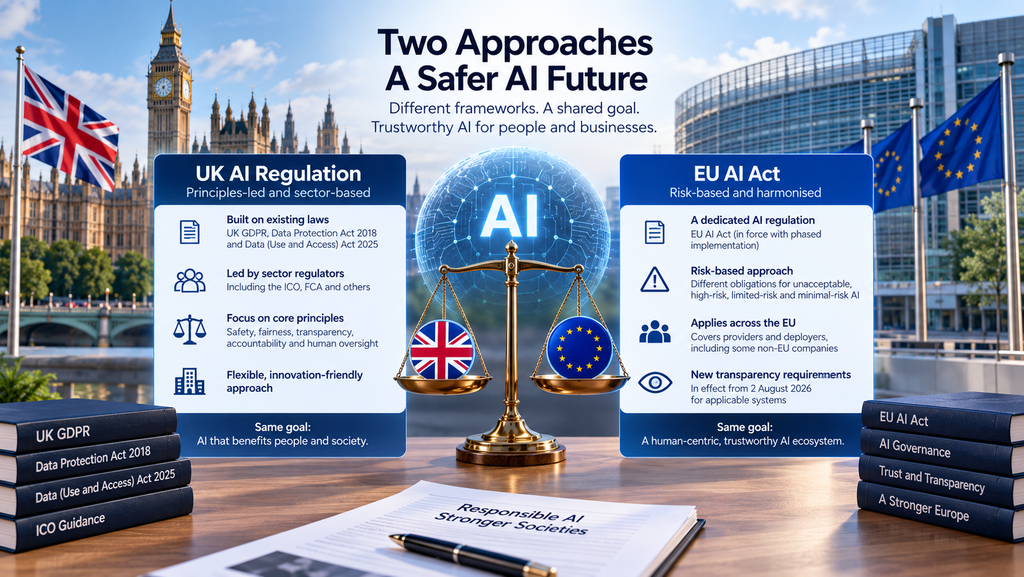
The UK does not simply have a direct equivalent of the EU AI Act.
Instead, the UK’s approach has developed around existing regulators, legislation and sector-specific rules, with AI-related requirements intersecting with areas such as data protection, equality, consumer protection, financial services and other regulated sectors.
The ICO remains particularly important where AI involves personal data. Its AI guidance is intended for businesses across the public, private and third sectors.
The Data (Use and Access) Act also changed aspects of the UK’s data protection framework, with the relevant data-protection provisions coming into force during 2026.
The EU AI Act is different.
It establishes a horizontal, risk-based framework covering prohibited AI practices, high-risk AI systems, transparency requirements and general-purpose AI.
As of 2 August 2026, enforcement powers and new transparency requirements are in application. The European Commission says certain high-risk obligations have later transition dates, including 2 December 2027 for certain high-risk use cases and 2 August 2028 for high-risk systems embedded in regulated products.
For UK companies with European operations, customers or AI products within the EU’s territorial scope, this can make EU AI Act readiness a major consideration.
Article 50 transparency obligations also started applying on 2 August 2026 to relevant AI systems. These include requirements concerning informing people when they interact with AI and identifying certain AI-generated or manipulated content.
Which AI Compliance Tool Is Right for Your Company?
There is no universal winner.
A small software company may find a large enterprise platform excessive.
A multinational financial organisation may find a lightweight compliance product inadequate.
For a UK company that wants AI governance integrated with broader GRC, Scytale is one of the strongest choices.
For deep AI risk testing and agent governance, Holistic AI is compelling.
For AI inventory and regulatory intelligence, Credo AI is worth considering.
For organisations where privacy and AI governance are closely connected, OneTrust has an obvious advantage.
For complex enterprise model portfolios, IBM watsonx.governance and ModelOp are stronger candidates.
For Microsoft-heavy environments, Microsoft Purview can be particularly attractive.
And for organisations already operating heavily on ServiceNow, AI Control Tower is a natural option.
The important thing is to start with the compliance problem rather than the software.
Do Small UK Companies Need AI Compliance Software?
Not necessarily.
A small company using a few low-risk AI tools does not automatically need an expensive enterprise governance platform.
It may be possible to begin with an AI inventory, an acceptable-use policy, vendor assessments, access controls, employee training, data protection reviews and documented risk assessments.
The situation changes when AI becomes business-critical.
If a company uses AI for recruitment, credit decisions, customer eligibility, healthcare, employee monitoring, sensitive personal data or other high-impact activities, governance requirements can become significantly more complicated.
The same is true for companies developing AI products or selling into regulated markets.
In those cases, dedicated software can save substantial administrative effort by turning scattered spreadsheets and documents into repeatable governance workflows.
Final Verdict
The rise of AI compliance software is not simply about preparing for one new regulation.
It reflects a larger change in how companies are using AI.
AI systems are becoming part of business processes, customer interactions and decision-making. At the same time, organisations are deploying AI agents that can access data and perform actions with less human involvement.
That creates a governance problem.
Companies need to know what AI they have, what it does, what data it touches, who is responsible for it and whether the appropriate controls continue to work after deployment.
The best AI compliance tools for UK companies therefore do more than generate a compliance report.
They help create an ongoing governance process.
For many organisations, Scytale is a strong overall starting point. Holistic AI and Credo AI are compelling for AI-specific governance. OneTrust is particularly strong where privacy and AI overlap. IBM and ModelOp suit complex enterprise environments, while Microsoft Purview and ServiceNow become especially attractive when a company already relies heavily on those ecosystems.
The bigger lesson is simple: AI compliance should not be treated as a one-time project.
As AI adoption accelerates, governance needs to become part of the normal lifecycle of building, buying and deploying AI.
Useful official links:
- ICO — Artificial Intelligence guidance
- ICO — AI and data protection risk toolkit
- European Commission — AI Act
- European Commission — AI Act enforcement
- Scytale AI governance
- Holistic AI governance platform
- Credo AI governance
- OneTrust AI Governance
- IBM watsonx.governance
- Microsoft Purview AI compliance
- ModelOp AI governance
- ServiceNow AI Control Tower
Internal Links
- AI News →
/artificial-intelligence/ - Tech News →
/tech-news/ - Reviews →
/reviews-buying-guides/