Microsoft AI Wearables Strategy
The Microsoft AI wearables strategy is taking a very different path from the consumer-focused approaches of Apple, Google and Meta. Instead of rushing to launch another pair of smart glasses or a smartwatch, Microsoft is building Project Solara, a platform designed to bring AI agents into specialized devices used by workers and businesses.
That may sound less exciting than a new consumer gadget. It could, however, turn out to be the more important strategy.
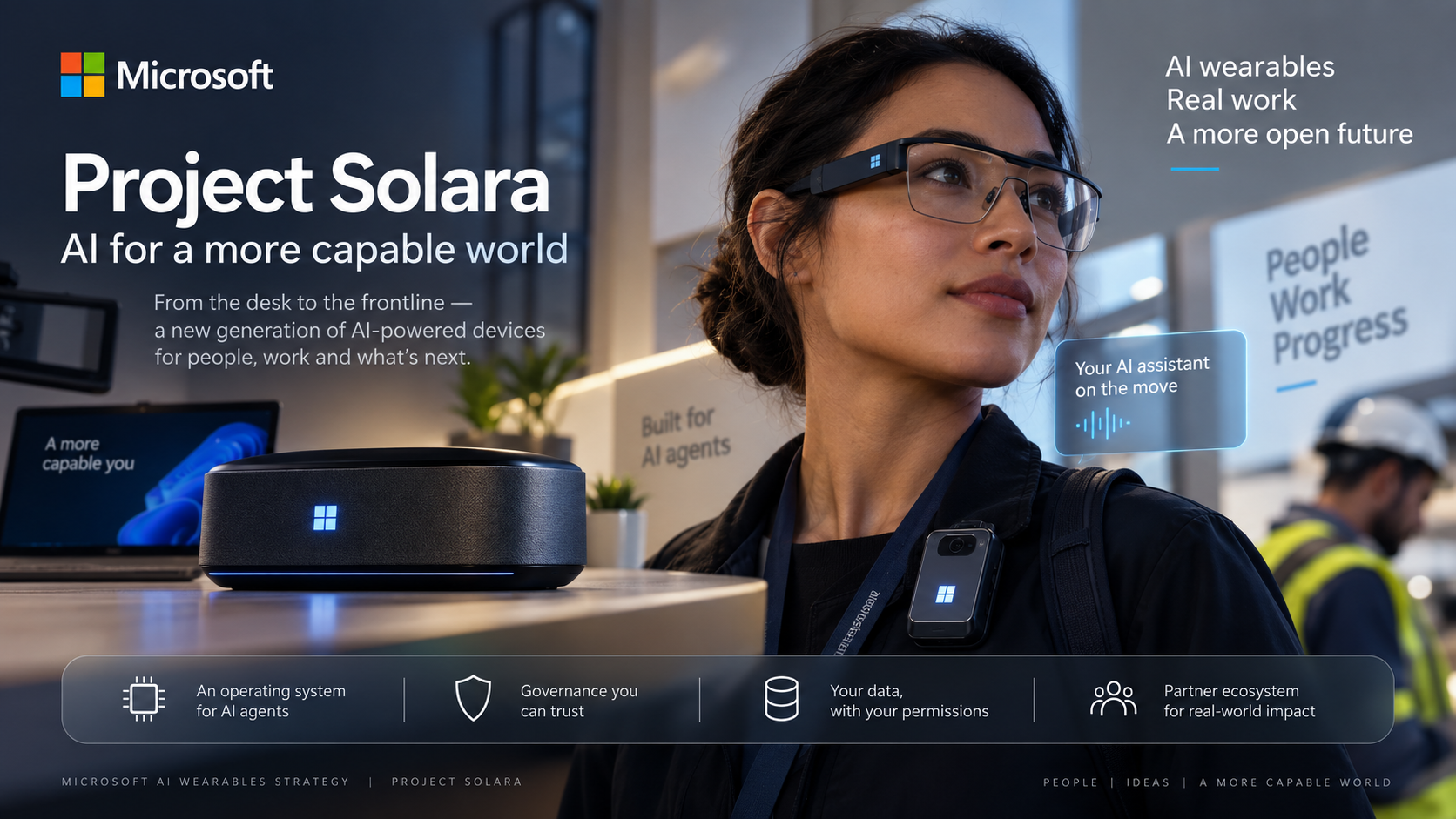
At Microsoft Build 2026, the company introduced Project Solara as a “chip-to-cloud” platform for agent-first devices. Microsoft showed two early concepts: a stationary device designed for shared workplace environments and a portable badge designed for frontline workers. The concepts are not intended to define the final product category. Instead, they demonstrate Microsoft’s broader idea that AI agents could change what computers look like and where they are used. citeturn0search4
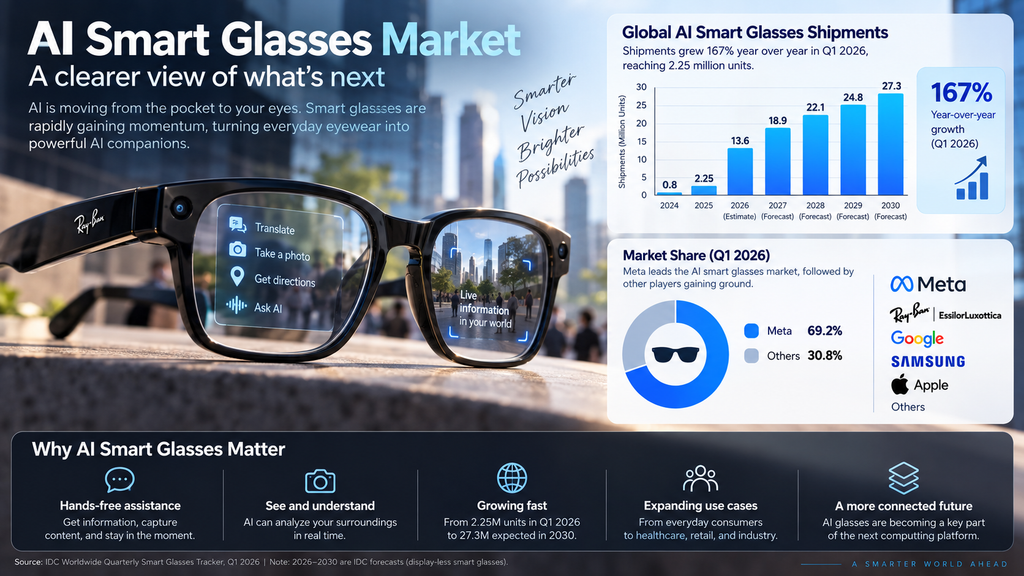
At the same time, the market Microsoft is approaching is moving quickly. IDC says display-less smart-glasses shipments jumped 167% year over year in Q1 2026, reaching about 2.25 million units in one quarter. Meta controlled 69.2% of that market, showing just how quickly AI-enabled eyewear is becoming a serious consumer category. citeturn0search1turn0search6
So the question is not whether wearable computing is coming.
The question is whether Microsoft has chosen the right way to participate.
Project Solara Is Microsoft’s Bigger AI Wearables Bet
Project Solara is more ambitious than a wearable operating system.
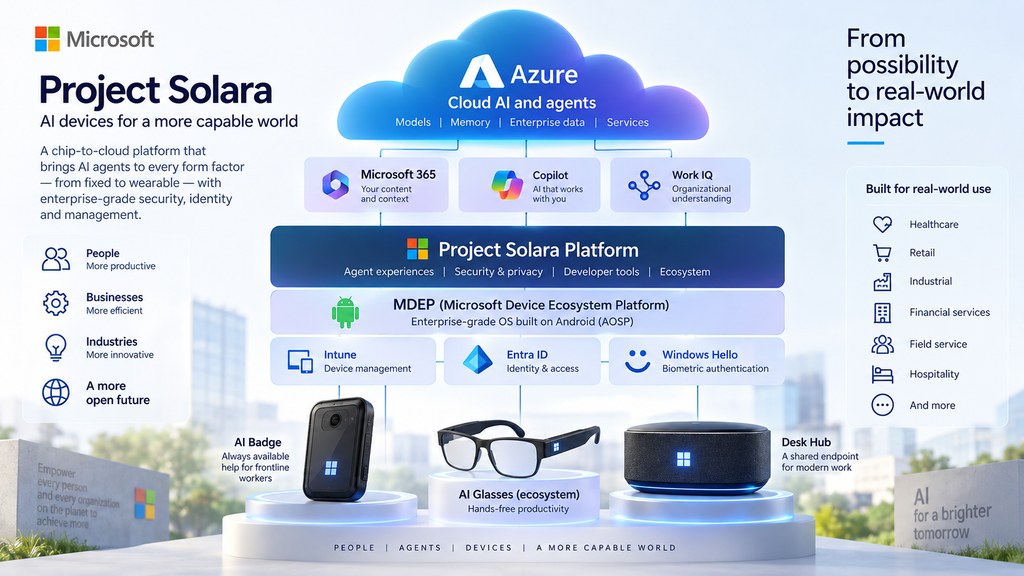
Microsoft describes it as a chip-to-cloud platform built around the idea that the next computing shift could move from applications to agents. Instead of opening individual apps and navigating menus, users could interact with AI agents that understand their tasks, environment and organizational context. citeturn0search4
The platform is built around Microsoft’s Device Ecosystem Platform, or MDEP, an enterprise-grade operating system based on Android Open Source Project. It also incorporates technologies such as Microsoft Intune for device management, Entra ID for identity and authentication, and Windows Hello for Business for biometric access. citeturn0search4
That combination is important.
Microsoft isn’t simply trying to put an AI assistant inside a wearable. It is trying to make the wearable part of an enterprise computing environment.
The company has also partnered with Qualcomm and MediaTek on initial reference designs. Qualcomm is working with Microsoft on a portable-device concept, while MediaTek is supporting a stationary-device concept. Microsoft says those designs are intended to expand into a broader range of form factors. citeturn0search4
That means the badge shown at Build is best understood as a demonstration of a platform rather than Microsoft’s final answer to wearable computing.
Why Microsoft Is Avoiding the Consumer Hardware Fight
Microsoft has a difficult position in consumer hardware.
Apple controls the iPhone, Apple Watch, AirPods and Mac ecosystem. Google controls Android and is building Android XR. Meta has built an early lead in AI-powered smart glasses.
Microsoft no longer has a mainstream consumer smartphone platform that could serve as the natural hub for a new wearable.
That makes a direct consumer hardware battle extremely difficult.
Microsoft’s latest financial results reinforce why the company is looking beyond the traditional PC. In the fourth quarter of fiscal 2026, Windows OEM and Devices revenue fell 7% year over year, while the broader More Personal Computing segment declined 4%. Microsoft’s cloud and AI businesses, by comparison, remain much stronger growth engines. citeturn0search2turn0search7
This does not mean Windows is disappearing.
It does suggest that Microsoft has a powerful incentive to make its cloud, identity, security and AI platforms valuable even when the physical endpoint is something other than a traditional Windows PC.
That is where Project Solara becomes interesting.
The AI Wearables Market Is Moving Fast
The opportunity Microsoft is targeting is real.
IDC reported that display-less smart glasses grew 167% year over year in Q1 2026, reaching approximately 2.25 million units during the quarter. IDC expects about 13.6 million display-less smart glasses to ship during 2026 and forecasts the category to reach approximately 27.3 million units by 2030. citeturn0search1turn0search6
The significance isn’t just the shipment number.
The products are becoming more useful because AI is changing what wearable hardware can do.
A camera can provide visual context. Microphones can capture voice. Speakers can provide responses without requiring a screen. Cloud AI can perform complex reasoning, while local processors can handle some tasks with lower latency and better privacy.
That creates a new type of computing interface.
Instead of looking down at a smartphone, users can potentially ask questions, capture information, receive directions, translate speech or interact with an AI assistant while keeping their hands and attention on the surrounding environment.
The smartwatch market is moving in the same direction.
Counterpoint says global shipments of smartwatches with edge-AI capabilities grew 70% year over year in Q1 2026, and edge AI reached 25% of smartwatch shipments. The research firm expects penetration to approach 32% during 2026. citeturn0search0
That suggests AI is becoming a hardware capability rather than simply another application.
Meta Has Already Established a Major Lead
If Microsoft eventually wants to compete in consumer AI wearables, it has a major problem.
Meta is already there.
IDC estimates that Meta held 69.2% of the global display-less smart-glasses market in Q1 2026. The company’s partnership with EssilorLuxottica and the Ray-Ban brand has given it something that technology companies often struggle to create: a wearable that looks like a normal piece of eyewear. citeturn0search1
Meta has continued expanding its lineup and pushing AI deeper into its wearable strategy. Reuters reported in June that Meta and EssilorLuxottica introduced a lower-priced range of AI glasses starting at $299, reinforcing Meta’s attempt to expand the category beyond early adopters. citeturn0news81
Meta’s advantage is therefore not just technology.
It has distribution, consumer awareness, a social ecosystem and an established relationship with a major eyewear company.
Microsoft would have to build all of that from scratch.
Project Solara suggests Microsoft may have decided not to.
Google Is Building Its Own Wearable AI Platform
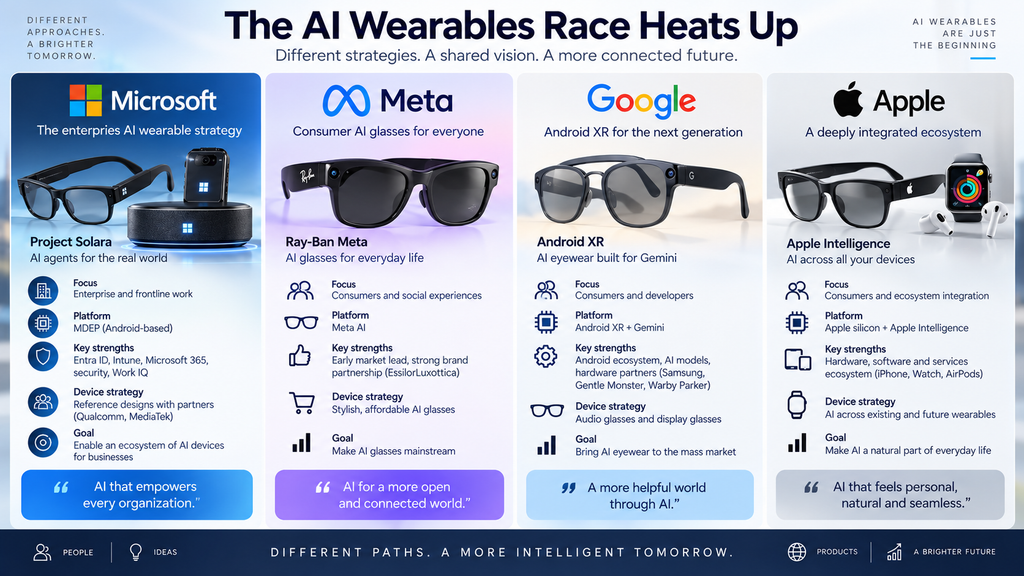
Microsoft isn’t the only company betting that AI will change wearable computing.
Google is developing Android XR with Samsung and Qualcomm and is moving beyond headsets into intelligent eyewear. Google says its upcoming eyewear will come in two broad forms: audio glasses and display glasses. The company has partnered with eyewear brands including Gentle Monster and Warby Parker, with audio glasses scheduled to arrive in fall 2026. citeturn1search0turn1search4
Google’s approach is closer to the traditional consumer platform model.
Android provides the operating-system ecosystem.
Gemini provides the AI.
Samsung and eyewear partners provide the hardware.
Microsoft’s strategy is different.
Instead of trying to establish a universal consumer wearable platform, Microsoft is concentrating on enterprise management, identity, security, agents and organizational context.
That could allow both companies to succeed without directly competing for exactly the same customer.
Why Microsoft Has a Different Advantage
Microsoft’s biggest advantage isn’t a camera, a processor or a fashionable frame.
It is enterprise context.
Microsoft’s Work IQ platform is designed to build a semantic understanding of organizational information by processing data from email, calendars, meetings, chats, files, people, collaboration patterns and business systems. Microsoft announced general availability of Work IQ APIs in June 2026 so agents can interact with Microsoft 365 data and applications. citeturn1search6
Now imagine connecting that organizational intelligence to a wearable.
A worker could potentially ask an agent:
“What is the status of this order?”
“Which customer did we discuss this with?”
“Show me the safety procedure for this machine.”
“Summarize the last meeting with this client.”
The value doesn’t come from the badge itself.
The value comes from the badge having controlled access to the organization’s knowledge.
That is a very different business model from selling smart glasses to consumers.
The Enterprise AI Wearables Opportunity
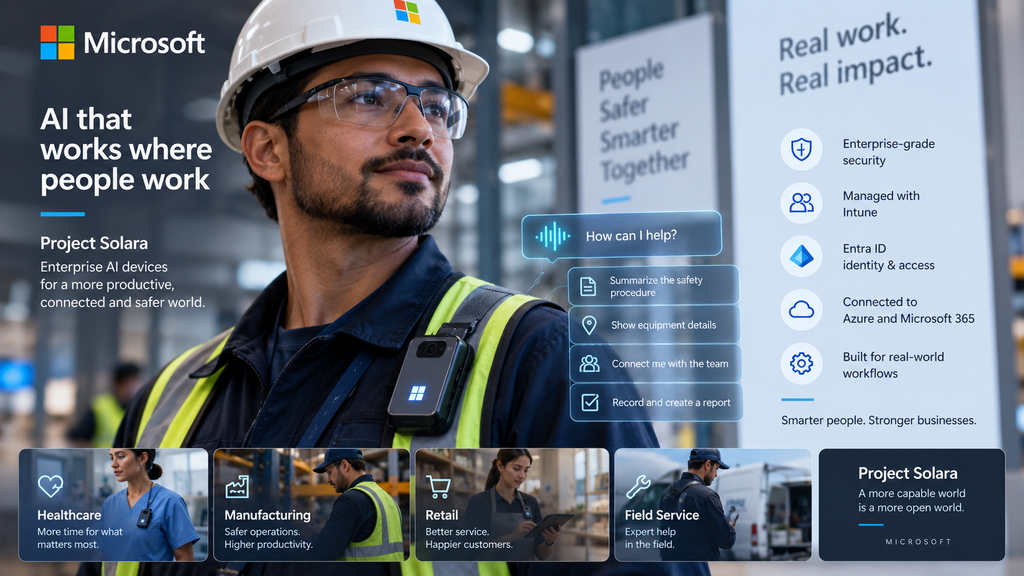
This is where the Microsoft AI wearables strategy may become genuinely powerful.
Consider a hospital.
A wearable could provide access to approved information without requiring a worker to constantly reach for a phone or computer. But the enterprise would also need strict control over identity, permissions, security and data retention.
Or consider a warehouse.
A worker could receive instructions, record information or query inventory while keeping both hands available.
In retail, a wearable could potentially provide product information, inventory context or customer-service assistance.
In field service, the device could provide step-by-step instructions while an AI system understands the equipment being inspected.
These environments have something consumer wearables don’t always have:
A clear return on investment.
A company doesn’t need millions of people to buy the device.
It needs a smaller number of customers to believe the device saves enough time or improves productivity enough to justify deployment.
That plays directly into Microsoft’s enterprise strengths.
The Privacy Problem Microsoft Must Solve
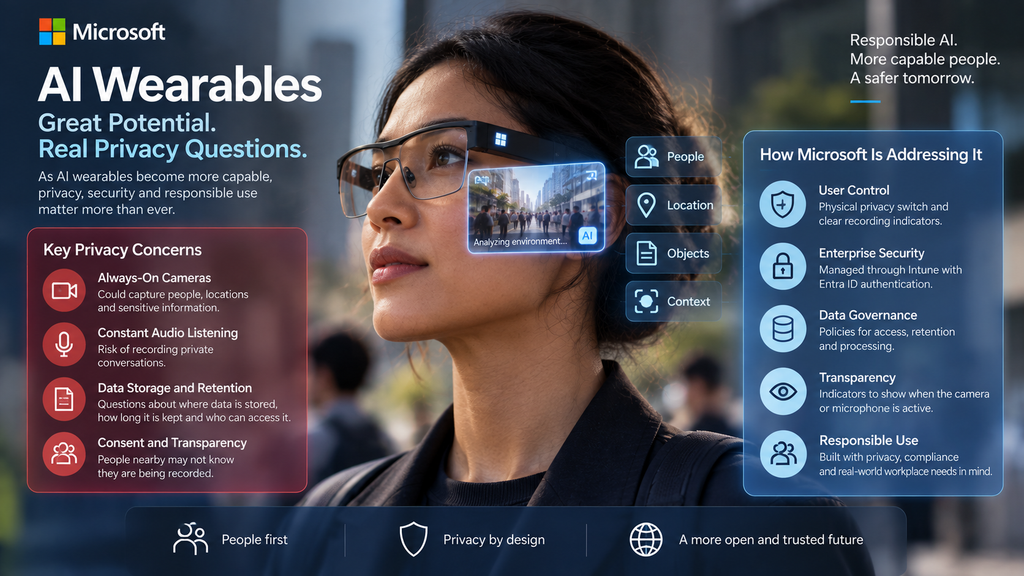
There is also a major obstacle.
Cameras and microphones create privacy risks.
A wearable used in a workplace could potentially capture customers, colleagues, patients, documents or sensitive environments. That makes privacy controls just as important as AI capability.
Microsoft’s Solara concepts include enterprise management, authentication and privacy-related controls, and the portable concept includes a camera and other sensors. citeturn0search4
But technical controls alone won’t solve every problem.
Organizations will still need policies covering:
- when recording is permitted;
- who can access captured information;
- how long information is retained;
- where data is processed;
- whether employees or customers must be notified;
- how sensitive environments are handled.
This could become an advantage for Microsoft if it gets the governance layer right.
Enterprise customers may care less about having the most impressive AI demo and more about knowing exactly what the device can access.
The Biggest Risk: Will Hardware Makers Build It?
This may be Microsoft’s biggest challenge.
Solara depends on an ecosystem of device makers.
Microsoft is providing reference designs, an operating environment and enterprise services, while Qualcomm and MediaTek are supplying silicon platforms for initial concepts. citeturn0search4
But an OEM still has to manufacture and sell the device.
That means dealing with battery life, thermals, cameras, microphones, connectivity, industrial design, certifications, support and enterprise distribution.
The economics therefore matter.
If Microsoft captures most of the software and cloud value while the hardware manufacturer receives only a thin hardware margin, there may not be enough incentive for companies to invest heavily in a new category.
Microsoft will need to make the ecosystem attractive for device manufacturers as well as customers.
The company does have a promising starting point: it says hundreds of employees are already experimenting with Solara concepts, and it has described plans for enterprise pilots involving organizations including AccuWeather, Best Buy, CVS Health, Levi’s and Target. citeturn0search4
Those pilots could reveal whether the technology solves real business problems or simply looks impressive at a developer conference.
Can Microsoft Win Without Owning the Device?
This is the central question.
Microsoft does not necessarily need to manufacture the next great wearable.
It could instead control the layer underneath it.
Think about the stack:
Hardware → MDEP → Identity → Device Management → Agents → Work IQ → Microsoft 365 → Azure
If Microsoft becomes the trusted enterprise layer connecting those components, a Solara device made by another company could still strengthen Microsoft’s position.
That strategy would resemble Microsoft’s broader transformation over the past decade.
The company increasingly makes money from platforms and services that run across hardware it does not manufacture.
Azure runs across enormous computing environments.
Microsoft 365 works across different devices.
Entra manages identities beyond Windows.
Intune manages endpoints beyond traditional PCs.
Project Solara could extend that philosophy into physical AI devices.
The Agent Control Question
Microsoft is also building a broader governance ecosystem for AI agents.
Its Agent Control Specification is an open industry specification designed to provide deterministic safety and security controls at multiple points in an agent’s lifecycle, including inputs, model processing, state, tool execution and outputs. citeturn0search9turn0search10
This should not be treated as simply “the Solara operating system.”
It is a broader Microsoft effort around agent governance.
But the two strategies complement each other.
As AI agents move from screens into physical environments, controlling what an agent can see, access and do becomes more important.
That could turn governance into part of the platform value.
What Happens Next
The next stage of Project Solara will be more important than the concepts Microsoft showed at Build.
The key questions are straightforward.
Will companies actually deploy these devices?
Will employees use them every day?
Will OEMs invest in commercial products?
Can Microsoft prove a measurable productivity benefit?
Can it make privacy and security manageable enough for hospitals, retailers and industrial companies?
And most importantly, can Microsoft become the trusted infrastructure behind agent-first devices before another company establishes that position?
The consumer wearable race may ultimately belong to Meta, Apple or Google.
Microsoft doesn’t necessarily need to win that race.
Its bigger opportunity could be becoming the enterprise control plane for the AI devices that come after the smartphone and PC.
The company has already learned that owning the hardware is not always the only way to control a platform.
Project Solara is effectively testing whether Microsoft can apply that lesson to the next generation of computing.
External links
- Microsoft Project Solara official overview
- Microsoft Work IQ APIs
- IDC smart-glasses market analysis
- Counterpoint smartwatch and edge-AI research
- Google intelligent eyewear announcement
- Microsoft Agent Control Specification
Internal links
- AI News →
/artificial-intelligence/ - Tech News →
/tech-news/ - Reviews →
/reviews-buying-guides/