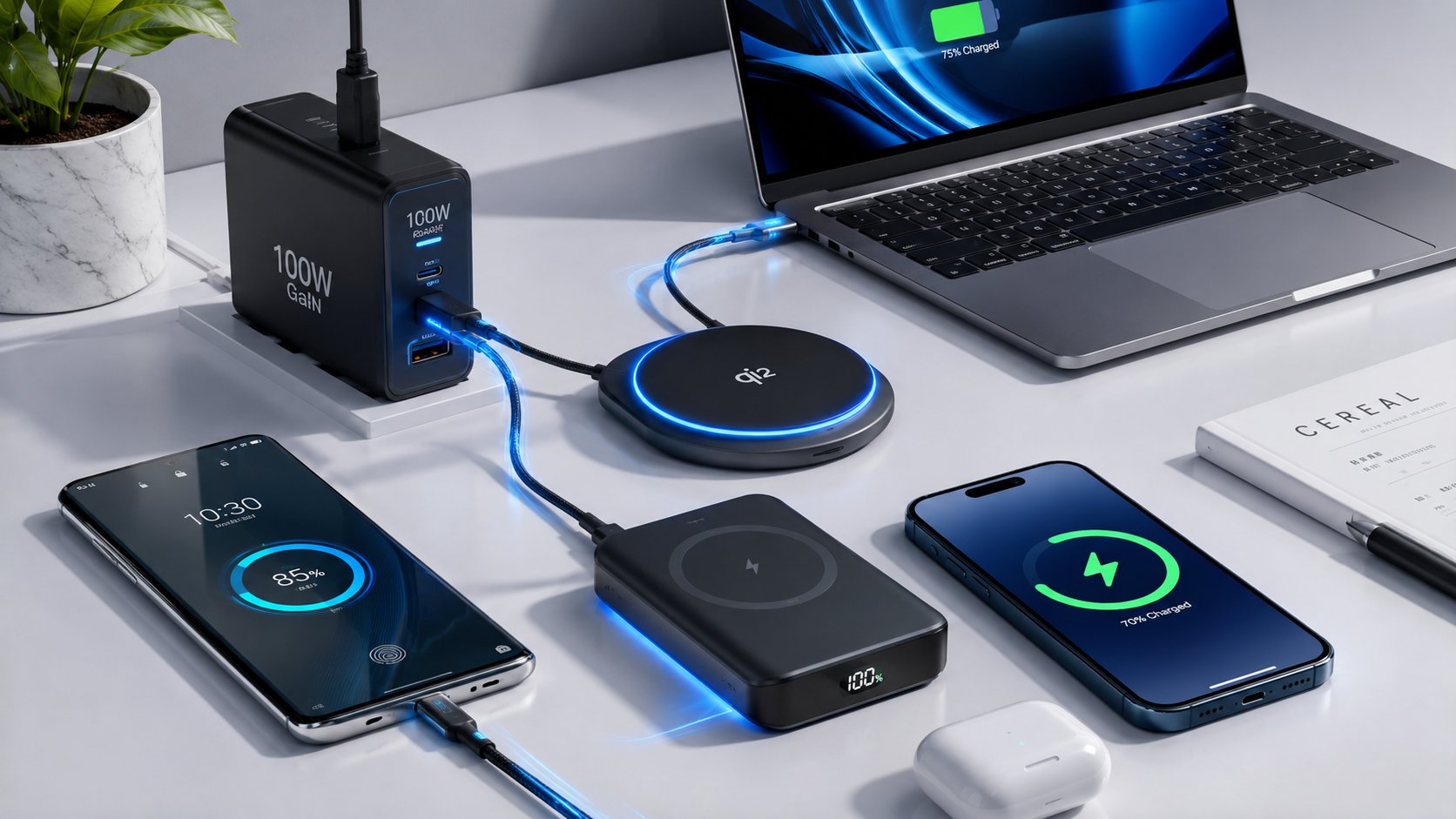
Charging technology has evolved faster in the last three years than it did in the previous decade. Smartphones now support 80W to 120W wired charging, laptops rely almost entirely on USB-C Power Delivery, and wireless charging has become practical for everyday use thanks to Qi2 and improved magnetic alignment.
At the same time, Gallium Nitride (GaN) chargers have become smaller, cooler, and more powerful than traditional silicon chargers. Instead of carrying separate adapters for your phone, laptop, smartwatch, and earbuds, a single multi-port GaN charger can often power everything.
The market, however, is crowded with products that look nearly identical. Wattage claims, charging protocols, USB-C standards, and wireless compatibility can be confusing—even for experienced buyers.
This guide explains exactly what matters in 2026, who should buy which charger, and how newly announced compact wireless power banks from Xiaomi and MagSafe-compatible brands demonstrate where portable charging is heading.
High GaN Chargers & Wireless Charging Buying Guide 2026
Why GaN Chargers Have Become the New Standard
Gallium Nitride is a semiconductor material that allows chargers to operate more efficiently than traditional silicon-based designs.
Because GaN components generate less heat while switching electricity faster, manufacturers can build chargers that are significantly smaller without sacrificing power output.
For consumers, that means one compact charger can replace several bulky adapters.
Typical advantages include:
- Smaller size
- Better thermal efficiency
- Higher charging efficiency
- Multiple USB-C ports
- Support for phones, tablets and laptops simultaneously
For travelers and remote workers, this reduction in size makes a noticeable difference in everyday carry.
Understanding Charging Wattage
One of the biggest misconceptions is that buying the highest wattage charger automatically charges every device faster.
It doesn’t.
Your device determines how much power it accepts.
20W–30W
Ideal for:
- iPhone
- Samsung Galaxy A series
- Google Pixel
- Wireless power banks
45W–65W
Best for:
- Premium smartphones
- Tablets
- Nintendo Switch
- Ultrabooks
This range is the sweet spot for most buyers.
100W–140W
Recommended for:
- MacBook Pro
- Gaming laptops
- Professional creators
- Multi-device charging
These chargers usually include two or more USB-C ports with intelligent power distribution.
USB-C Power Delivery Matters More Than Wattage
A charger advertising 100W means little if it doesn’t support the correct charging protocol.
Look for:
USB Power Delivery (USB PD 3.1)
The global standard for:
- iPhone
- iPad
- MacBook
- Windows laptops
- Steam Deck
PPS (Programmable Power Supply)
Important for:
- Samsung Super Fast Charging
- Google Pixel adaptive charging
Without PPS support, Samsung phones may charge noticeably slower.
Wireless Charging Has Matured in 2026
Wireless charging is no longer simply about convenience.
The latest generation offers:
- Better efficiency
- Stronger magnetic alignment
- Reduced heat
- Improved charging stability
Qi2 is now becoming the preferred standard because it brings magnetic alignment similar to Apple’s MagSafe ecosystem.
For buyers planning to keep accessories for several years, choosing Qi2-compatible products is generally the safer investment.
Real-World Example: New Compact Wireless Power Banks
July 2026 gadget launches highlight how portable charging is becoming both more capable and more compact.
Several newly announced power banks feature combinations such as:
- 15W Qi wireless charging for compatible Android phones, including Xiaomi models.
- 7.5W MagSafe-compatible wireless charging, suitable for iPhones that support Apple’s magnetic ecosystem.
- 22.5W wired USB-C charging, allowing faster charging when a cable is available.
Rather than replacing a wall charger, these products are designed for mobility. For example, a commuter can attach a magnetic power bank to an iPhone during travel, then switch to the USB-C cable to recharge more quickly before reaching the office.
These releases reflect an industry trend: manufacturers are prioritizing portability and versatility over simply increasing peak charging speeds.
Choosing the Right Charger for Your Devices
For iPhone Users
Look for:
- USB-C PD
- Qi2 compatibility
- MagSafe support
- 20W or higher wired charging
Avoid buying extremely high-wattage chargers solely for an iPhone unless you also plan to charge laptops or tablets.
For Android Users
Check whether your phone supports:
- PPS
- USB PD
- Proprietary fast charging
Brands like Samsung, Google, Xiaomi, OnePlus and Honor all have different charging implementations.
Always verify compatibility before purchasing.
For Laptop Users
Choose:
- 65W minimum
- USB PD 3.1
- Two or three USB-C ports
Frequent travelers may benefit from a 100W GaN charger capable of powering both a laptop and smartphone simultaneously.
Multi-Port Chargers Are Worth the Extra Cost
Premium GaN chargers intelligently distribute power.
For example:
- USB-C 1: 65W
- USB-C 2: 30W
- USB-A: 18W
Instead of carrying three separate chargers, one compact adapter can handle an entire workstation.
This becomes particularly valuable for digital nomads, students and professionals working remotely.
Safety Features You Should Never Ignore
Not every inexpensive charger delivers stable power.
Reliable chargers should include:
Over-voltage protection
Protects electronics during power fluctuations.
Over-current protection
Prevents excessive current from damaging batteries.
Temperature monitoring
Reduces charging speed if excessive heat develops.
Short-circuit protection
Adds another layer of electrical safety.
Certified chargers from established manufacturers are generally worth the premium because battery failures often originate from poor-quality accessories rather than the devices themselves.
Wired vs Wireless Charging
| Feature | Wired Charging | Wireless Charging |
|---|---|---|
| Speed | Faster | Moderate |
| Efficiency | Higher | Lower |
| Heat | Lower | Slightly higher |
| Convenience | Requires cable | Cable-free |
| Travel | Excellent | Excellent with magnetic power banks |
Most users benefit from having both.
Wireless charging works well on a desk or bedside table, while wired charging remains the fastest option when time matters.
Common Buying Mistakes
Many buyers focus only on price or advertised wattage.
Instead, avoid these mistakes:
- Buying chargers without USB PD support
- Ignoring PPS compatibility
- Purchasing unknown brands with no safety certifications
- Choosing single-port chargers when multiple devices are used daily
- Assuming every wireless charger supports magnetic alignment
A little research can significantly improve long-term value.
Should You Buy a Wireless Power Bank?
Wireless power banks make sense if you:
- Travel frequently
- Commute daily
- Attend conferences
- Work remotely
- Prefer fewer cables
The newest models combining 15W wireless charging, 7.5W MagSafe compatibility, and 22.5W wired output provide flexibility for users carrying both Android and Apple devices in the same household or workplace.
However, if your priority is the fastest possible recharge, a conventional wired power bank remains the better option.
Pros & Cons
Pros
- Smaller and lighter than traditional chargers
- High efficiency with less heat
- Supports phones, tablets and laptops
- Multi-port charging reduces cable clutter
- Wireless charging is increasingly practical
- Qi2 improves magnetic alignment and charging consistency
Cons
- Premium GaN chargers cost more initially
- Wireless charging remains slower than wired charging
- Charging compatibility varies between smartphone brands
- Cheap uncertified chargers may compromise safety
Expert Tips
- Buy a 65W GaN charger if you use both a smartphone and laptop.
- Look for USB PD 3.1 and PPS support rather than focusing only on wattage.
- Choose Qi2-certified wireless chargers for better long-term compatibility.
- Invest in a quality USB-C cable capable of handling your charger’s maximum output.
- If you travel often, a compact multi-port GaN charger paired with a magnetic wireless power bank offers the most versatile setup.
GaN technology has transformed charging accessories from bulky necessities into compact, high-performance tools. Combined with the growing adoption of Qi2 wireless charging and versatile magnetic power banks, buyers now have more flexibility than ever.
For most people in 2026, a 65W GaN charger with USB-C Power Delivery, paired with a Qi2-compatible wireless charger or magnetic power bank, offers the best balance of speed, portability, and future-proof compatibility.
Rather than chasing the highest advertised wattage, focus on certified safety features, supported charging protocols, and your actual device requirements. That approach will deliver better performance and a longer-lasting investment.
Frequently Asked Questions
1. What is a GaN charger?
A GaN charger uses Gallium Nitride semiconductors instead of silicon, allowing it to be smaller, more efficient, and capable of delivering higher power with less heat.
2. Is a 100W charger safe for a phone?
Yes. Modern devices only draw the amount of power they are designed to accept, provided the charger supports the appropriate charging standards.
3. Is wireless charging bad for battery life?
Not when using certified chargers. Excessive heat from poor-quality chargers is a greater concern than wireless charging itself.
4. What is Qi2?
Qi2 is the latest wireless charging standard that improves magnetic alignment, charging efficiency, and compatibility across supported devices.
5. Do I need PPS support?
If you own a Samsung Galaxy device or certain Android phones, PPS enables the fastest supported charging speeds.
6. Are GaN chargers worth the extra cost?
For users charging multiple devices or traveling frequently, the smaller size, efficiency, and versatility generally justify the higher price.
7. Can one GaN charger charge both a laptop and phone?
Yes. Many 65W to 140W GaN chargers feature multiple USB-C ports with intelligent power distribution.
8. Is 15W wireless charging faster than 7.5W?
Yes. Under compatible conditions, 15W charging can replenish a battery more quickly than 7.5W charging.
9. Should I buy a wireless power bank?
If convenience and cable-free charging are priorities, a wireless power bank is a practical addition, especially for commuters and travelers.
Internal Link Suggestion
- AI News →
/artificial-intelligence/ - Tech News →
/tech-news/ - Reviews →
/reviews-buying-guides/