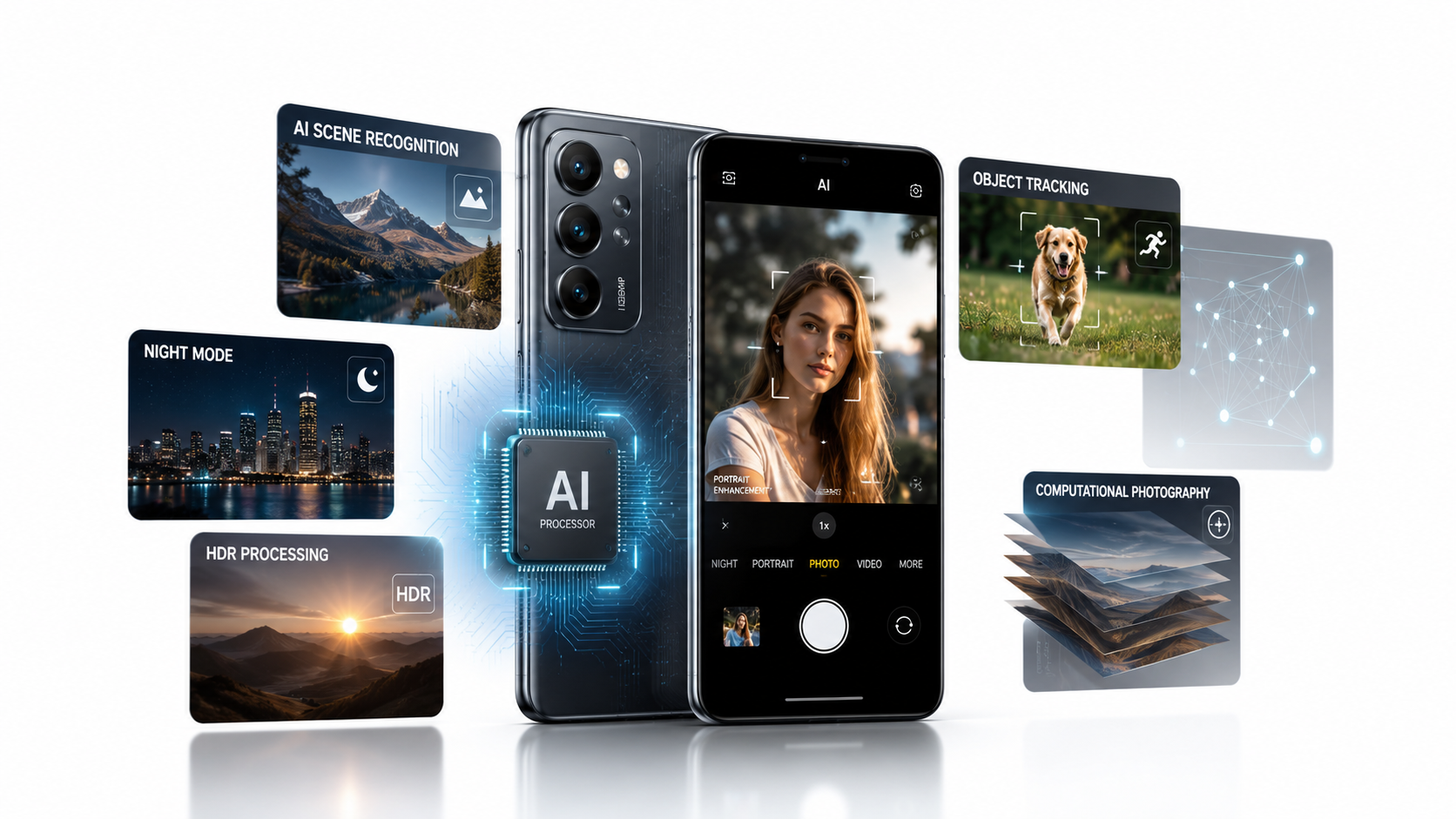
Smartphone cameras have reached a point where hardware improvements alone are no longer enough to deliver dramatic image quality gains. In 2026, artificial intelligence has become the biggest driver of camera innovation, influencing everything from autofocus and low-light photography to video stabilization and photo editing.
Instead of simply adding more megapixels, manufacturers are now relying on AI models running directly on the device to understand scenes, recognize subjects, reduce noise, recover detail, and even predict the best moment to capture a photo.
In this guide, we’ll explore how AI smartphone camera technology works, what has changed in 2026, which features genuinely improve photography, and where AI still has limitations.
Why AI Has Become Essential in Smartphone Cameras
Modern smartphones generate enormous amounts of image data every time the shutter button is pressed. Instead of saving a single exposure, many flagship devices capture multiple frames with different exposure levels and combine them using AI.
This computational photography approach allows phones to overcome the physical limitations of small camera sensors.
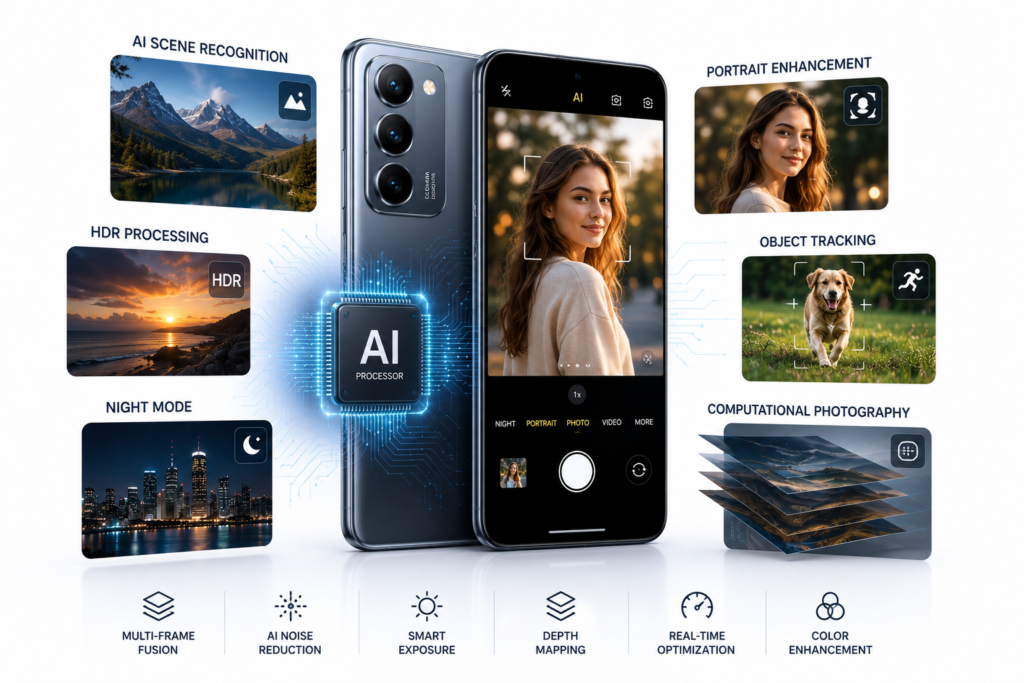
Today’s AI systems can recognize hundreds of scene types, detect faces, estimate depth, reduce blur caused by shaky hands, and intelligently adjust exposure before the user even notices.
Manufacturers are also integrating dedicated Neural Processing Units (NPUs) capable of running billions of AI operations every second without relying on cloud servers.
Voltixaz Analysis
AI is no longer an optional software enhancement—it’s now part of the camera pipeline itself. Buyers comparing smartphones in 2026 should pay more attention to AI image processing quality than megapixel counts, as software increasingly determines the final image.
The Biggest AI Camera Features in 2026
Intelligent Scene Recognition
Modern AI can instantly identify landscapes, pets, food, documents, sunsets, concerts, and hundreds of additional scenarios.
Instead of applying one generic processing style, the camera adjusts white balance, color saturation, exposure, and sharpening specifically for each scene.
The result is more consistent photography without requiring manual settings.
AI Super Resolution Zoom
Digital zoom traditionally reduced image quality because it simply enlarged pixels.
AI now reconstructs missing details using multiple captured frames and learned image patterns, making 10x or even 20x zoom photos significantly sharper than previous generations.
Although optical zoom still produces the best results, AI has narrowed the gap considerably.
Voltixaz Analysis
This improvement matters because most users rely on digital zoom far more often than they realize. AI cannot replace optical lenses, but it makes casual zoom photography much more practical.
Better Low-Light Photography
Night photography remains one of AI’s strongest applications.
Instead of increasing brightness alone, modern AI analyzes multiple exposures, removes noise selectively, restores natural colors, and preserves textures that older algorithms often blurred away.
The difference is particularly noticeable indoors and during evening photography.
AI Portrait Enhancement
Portrait mode has evolved beyond simple background blur.
AI now separates hair strands more accurately, improves skin tones naturally, preserves facial details, and handles difficult edges such as glasses or curly hair much better than earlier systems.
Many smartphones now allow users to adjust lighting direction even after capturing the photo.
Voltixaz Analysis
Portrait photography is becoming less about artificial effects and more about realistic subject separation. While some brands still overprocess skin textures, the overall quality has improved significantly.
Real-Time AI Video Processing
Video recording has benefited almost as much as photography.
AI now helps stabilize footage, reduce rolling shutter, improve HDR, suppress background noise during recording, and automatically track moving subjects.
Some flagship phones can also remove unwanted background sounds while preserving speech.
This makes smartphones increasingly capable content creation tools.
AI vs Traditional Image Processing
| Feature | Traditional Processing | AI Processing (2026) |
|---|---|---|
| Scene Detection | Basic | Hundreds of scene types |
| HDR | Fixed algorithm | Adaptive multi-frame HDR |
| Night Photography | High noise | Intelligent noise reduction |
| Portrait Mode | Simple blur | Accurate subject separation |
| Zoom | Pixel enlargement | AI detail reconstruction |
| Video | Basic stabilization | AI tracking and stabilization |
| Editing | Manual | AI-assisted editing |
Voltixaz Analysis
Traditional image processing follows fixed rules, whereas AI continuously adapts based on the content of each scene. This flexibility explains why software updates can noticeably improve camera performance without changing the hardware.
How AI Improves Everyday Photography
Most smartphone owners are not professional photographers.
They simply want better pictures of family gatherings, vacations, pets, food, and important moments.
AI addresses exactly these situations.
For example:
- Children moving quickly are easier to capture because AI predicts motion.
- Food photos receive more accurate color reproduction.
- Backlit portraits preserve both faces and bright skies.
- Pets remain in focus more consistently.
- Documents become easier to scan with automatic edge correction.
These improvements happen automatically without requiring photography knowledge.
Voltixaz Analysis
The biggest success of AI cameras is not creating dramatic special effects. It is reducing failed photos, allowing users to capture usable images more consistently.
Where AI Still Falls Short
Despite impressive progress, AI is not perfect.
Some smartphones still produce overly saturated colors or excessive sharpening.
Aggressive AI processing may create images that look attractive on small screens but appear artificial when viewed on larger monitors.
Generative AI editing tools can also introduce objects or alter scenes in ways that no longer represent reality.
This raises ethical concerns, particularly for journalism and documentary photography.
Additionally, budget smartphones often advertise AI features that are far less capable than flagship implementations due to weaker processors.
Voltixaz Analysis
Consumers should remember that “AI Camera” has become a marketing term. The quality of implementation matters far more than the label itself.
Pros & Cons
Pros
- Better low-light photography
- Smarter autofocus
- Improved digital zoom
- Enhanced portrait quality
- Faster editing
- Better HDR performance
- Easier photography for beginners
Cons
- Some images appear overprocessed
- AI cannot replace optical hardware
- Editing may reduce image authenticity
- Premium AI features often require flagship chips
Who Should Buy?
An AI-focused smartphone is worth considering if you:
- Frequently take photos while traveling
- Create social media content
- Record videos regularly
- Photograph children or pets
- Prefer point-and-shoot simplicity
- Want excellent night photography without manual settings
Who Should Skip?
You may not need the latest AI camera upgrades if:
- You mostly use your phone for messaging and browsing.
- You already own a recent flagship with strong computational photography.
- You prefer editing RAW images manually.
- Camera performance is not a priority when purchasing a phone.
Expert Tips
- Keep camera software updated, as AI improvements often arrive through updates.
- Clean camera lenses regularly—AI cannot compensate for fingerprints.
- Use optical zoom whenever available before switching to digital zoom.
- Disable beauty filters if you prefer natural portraits.
- Shoot in RAW mode for maximum editing flexibility when supported.
Common Mistakes About AI Smartphone Cameras
“More AI means better photos.”
Not necessarily. Processing quality depends on the manufacturer’s algorithms and hardware.
“AI replaces good camera hardware.”
False. Large sensors and quality lenses remain essential.
“AI photos are fake.”
AI enhances images but usually works by improving captured data rather than generating entirely new scenes. However, generative editing features blur this distinction.
“Megapixels matter most.”
Image processing, sensor size, optics, and AI often have a greater impact than resolution alone.
Artificial intelligence has become the defining technology behind smartphone photography in 2026. While camera hardware continues to evolve, AI is responsible for many of the improvements users notice every day—from cleaner night photos and sharper zoom images to smarter autofocus and faster editing.
The biggest benefit is consistency. Modern AI reduces the chances of blurry, poorly exposed, or noisy photos, making high-quality photography accessible to almost everyone.
That said, buyers should look beyond marketing claims. A well-designed AI camera system combines capable hardware, efficient neural processors, and carefully tuned software. The strongest smartphones succeed because these elements work together, not because they simply advertise “AI.”
Frequently Asked Questions
1. What is an AI smartphone camera?
An AI smartphone camera uses machine learning to improve image quality through scene recognition, noise reduction, autofocus, HDR, and computational photography.
2. Does AI improve photo quality?
Yes. AI can significantly improve exposure, color accuracy, sharpness, and low-light performance, especially in challenging conditions.
3. Is AI better than more megapixels?
In many situations, yes. Better image processing often produces greater improvements than simply increasing resolution.
4. Does AI work without the internet?
Most modern flagship smartphones perform AI image processing directly on the device, so an internet connection is not required.
5. Can AI replace DSLR cameras?
Not entirely. Smartphones excel in convenience and computational photography, while dedicated cameras still offer larger sensors, interchangeable lenses, and greater creative control.
6. Does AI drain battery life?
Running AI tasks consumes power, but modern NPUs are designed to perform these operations efficiently with minimal impact on battery life.
7. Are AI-edited photos always accurate?
No. Some AI enhancements may alter colors, textures, or lighting to create a more visually appealing image rather than a perfectly accurate representation.
8. Which users benefit most from AI cameras?
Travelers, families, social media creators, casual photographers, and anyone who wants high-quality results without manual camera settings.
9. Is AI available in budget smartphones?
Yes, but flagship models typically deliver more advanced AI features because they use faster processors and more capable neural engines.