Smart glasses have evolved from futuristic gadgets into practical everyday devices. Whether you’re looking for AI assistance, hands-free photography, navigation, or discreet notifications, today’s smart glasses offer more functionality than ever before.
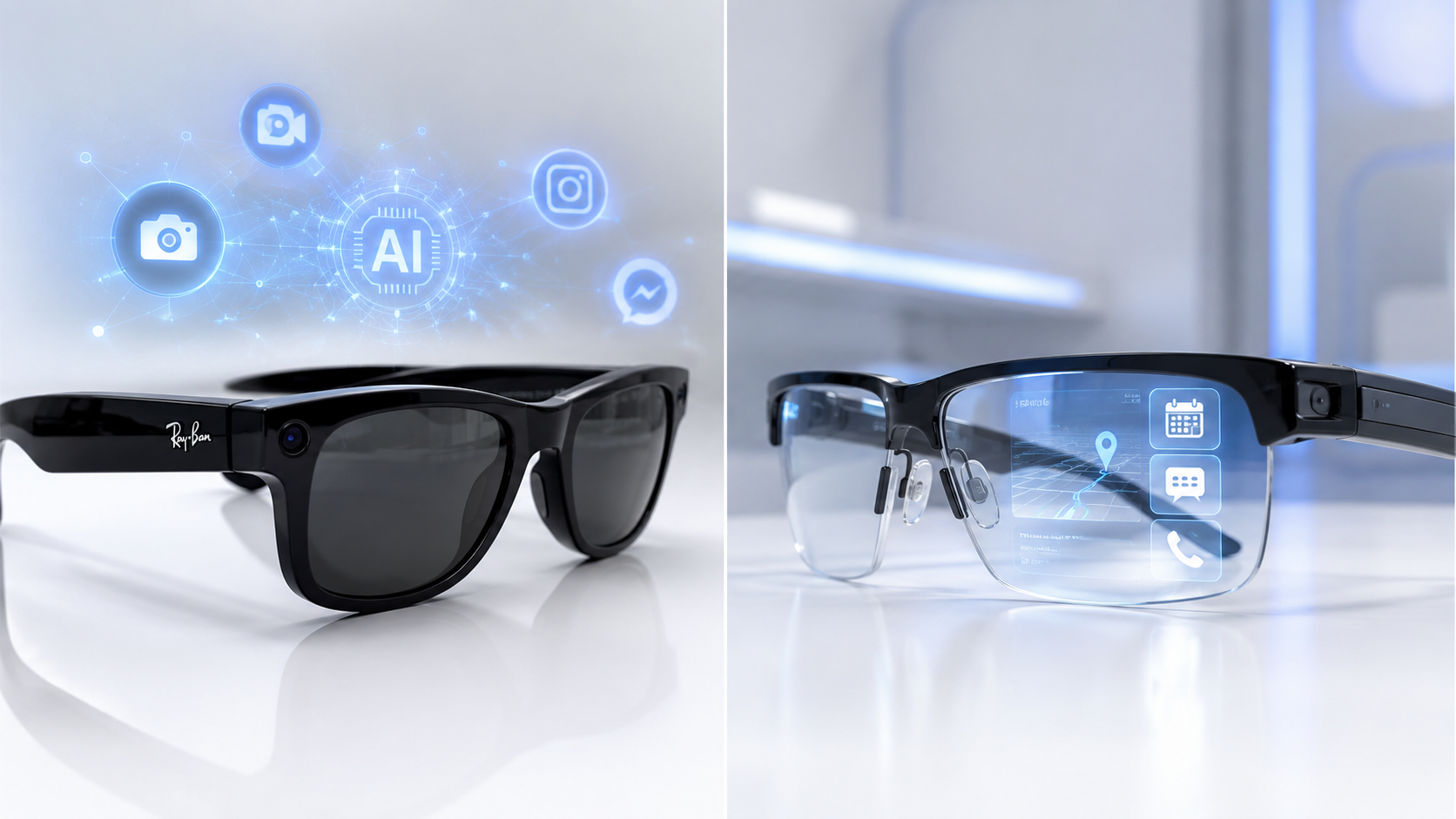
Among the most talked-about options are the Ray-Ban Meta Smart Glasses and the Even Realities G2. While both belong to the same product category, they target completely different users. Ray-Ban Meta focuses on AI-powered social experiences and multimedia, whereas the Even Realities G2 is designed for productivity with an invisible heads-up display.
If you’re searching for the best ray-ban meta vs even realities g2 comparison, this guide explains the differences in design, features, battery life, comfort, and value to help you choose the right pair.
Ray-Ban Meta vs Even Realities G2 at a Glance
| Feature | Ray-Ban Meta | Even Realities G2 |
|---|---|---|
| AI Assistant | Meta AI | Even AI |
| Camera | 12MP Built-in | No Camera |
| Display | No Display | Micro LED Heads-Up Display |
| Speakers | Open-ear Speakers | Open-ear Speakers |
| Microphones | 5 Microphones | Multiple Microphones |
| Notifications | Audio | Visual + Audio |
| Battery | Up to 4 hours | Around 1.5–2 days (mixed use) |
| Best For | Content Creators | Productivity Users |
Design and Comfort
Ray-Ban Meta
Ray-Ban Meta keeps the classic Ray-Ban look, making it difficult for others to notice you’re wearing smart glasses. Available in Wayfarer and Headliner styles, they feel like premium sunglasses rather than a tech gadget.
The built-in camera is subtly integrated into the frame, while touch controls are placed along the temples.
Pros
- Stylish and fashionable
- Premium frame quality
- Lightweight enough for daily wear
- Multiple lens options available
Even Realities G2
The Even Realities G2 takes a different approach. Instead of focusing on cameras or social features, it integrates an almost invisible display inside the lenses.
The glasses look surprisingly normal despite containing display technology. They’re designed to be worn throughout the workday without drawing attention.
Users who spend long hours reading messages, checking calendars, or following navigation directions may appreciate this minimalist design.
AI Features
One of the biggest differences in the ray-ban meta vs even realities g2 debate is how each product uses artificial intelligence.
Ray-Ban Meta
Meta AI can:
- Answer questions
- Identify landmarks
- Translate languages
- Describe surroundings
- Capture photos using voice commands
- Record videos hands-free
For example, while walking through a city, you can simply say:
“Hey Meta, what building is this?”
The assistant analyzes what the camera sees and responds almost instantly.
This makes Ray-Ban Meta ideal for travelers and creators.
Even Realities G2
Even AI focuses less on photography and more on productivity.
Features include:
- Live notifications
- Calendar reminders
- Navigation prompts
- Meeting notes
- Quick information display
- Translation support
Instead of speaking every response aloud, information appears directly inside your field of view.
This creates a less distracting experience, especially in meetings or offices.
Camera Performance
This is perhaps the easiest category to judge.
Ray-Ban Meta Wins
The 12MP ultra-wide camera captures:
- High-quality photos
- Vertical social media videos
- First-person perspective footage
Creators frequently use it for:
- Walking tours
- Food reviews
- Travel videos
- Daily vlogs
The camera quality is significantly better than early smart glasses.
Even Realities G2
There is no camera.
This is intentional.
Many professionals prefer not wearing cameras in workplaces due to privacy concerns.
If photography isn’t important, the lack of a camera becomes an advantage rather than a disadvantage.
Display Experience
This category completely changes the comparison.
Ray-Ban Meta
There is no display.
Everything happens through:
- Voice responses
- Speakers
- Smartphone integration
You never see visual information inside the lenses.
Even Realities G2
The built-in micro-display projects information into your field of vision.
Examples include:
- Walking directions
- Incoming messages
- Time
- Calendar events
- Notes
- Language translations
The display remains subtle and doesn’t block your surroundings.
If you want true augmented information without bulky AR headsets, the G2 offers a unique experience.
Audio Quality
Both glasses feature open-ear speakers.
Ray-Ban Meta
Excellent for:
- Music
- Phone calls
- Podcasts
- AI conversations
The sound quality is surprisingly rich considering the speaker size.
Even Realities G2
Audio is designed mainly for:
- Notifications
- Voice assistant
- Calls
Music performance is good but isn’t the primary focus.
Battery Life
Battery life often depends on usage.
Ray-Ban Meta
Typical usage includes:
- About 4 hours of mixed use
- Charging case provides multiple additional charges
Heavy video recording drains the battery faster.
Even Realities G2
Since there’s no power-hungry camera, battery efficiency improves considerably.
Many users can comfortably get through an entire workday, with light use extending beyond a single day before recharging.
Software and Ecosystem
Ray-Ban Meta
Works closely with:
- Meta AI
- Messenger
If you’re already using Meta’s ecosystem, setup feels seamless.
Even Realities G2
Focuses on productivity rather than social media.
Useful integrations include:
- Calendar
- Navigation
- Notifications
- Notes
- Translation
Professionals may find this workflow more practical.
Price and Value
Ray-Ban Meta generally starts at a lower price than many display-equipped smart glasses, making it attractive for users who want AI features and a built-in camera without entering the premium AR category.
Even Realities G2 typically commands a higher price because of its advanced micro-display technology and productivity-focused design. While the investment is greater, it may be worthwhile for users who value hands-free information throughout the workday.
The better value depends on how you plan to use the glasses rather than on price alone.
Who Should Buy Ray-Ban Meta?
Choose Ray-Ban Meta if you:
- Create content regularly
- Want an AI assistant
- Need a wearable camera
- Enjoy voice commands
- Prefer stylish everyday glasses
- Use Meta apps frequently
Who Should Buy Even Realities G2?
Choose Even Realities G2 if you:
- Want an in-lens display
- Prefer privacy without cameras
- Need navigation while walking
- Attend many meetings
- Want notifications without checking your phone
- Prioritize productivity over photography
There isn’t a universal winner in the ray-ban meta vs even realities g2 comparison because the products solve different problems.
Ray-Ban Meta is the better choice for creators, travelers, and anyone wanting an AI-powered wearable with an excellent camera. It combines stylish eyewear with hands-free photography and voice assistance in a familiar design.
Even Realities G2 is aimed at professionals who prefer discreet access to notifications, navigation, and productivity tools through an integrated display—without the privacy concerns of an always-available camera.
If your day revolves around creating and sharing content, Ray-Ban Meta is likely the better fit. If your priority is staying informed while keeping your hands and phone free, the Even Realities G2 stands out.
Expert Tips
- Think about your primary use case before comparing specifications.
- If you frequently create videos or photos, prioritize camera quality over display technology.
- If you work in offices or attend meetings regularly, a camera-free design may be more appropriate.
- Consider software ecosystem compatibility if you already rely on Meta services.
- Comfort matters for wearable devices—choose a frame style you’ll be happy wearing for hours.
Frequently Asked Questions
1. Which is better, Ray-Ban Meta or Even Realities G2?
Ray-Ban Meta is better for creators and AI photography, while Even Realities G2 is better for productivity and hands-free information.
2. Does Even Realities G2 have a camera?
No. It intentionally omits a camera to improve privacy.
3. Can Ray-Ban Meta display notifications?
No. Notifications are delivered through audio rather than a visual display.
4. Which smart glasses have a display?
Even Realities G2 includes a built-in micro-display, while Ray-Ban Meta does not.
5. Which has better battery life?
Even Realities G2 generally lasts longer because it doesn’t power a camera.
6. Can Ray-Ban Meta record videos?
Yes. It supports hands-free photo and video recording using its integrated camera.
7. Are either of these true AR glasses?
Neither is a full mixed-reality headset. Even Realities G2 provides a lightweight heads-up display, while Ray-Ban Meta focuses on AI and media capture.
8. Which smart glasses are better for work?
Even Realities G2 is usually the stronger option for office productivity and discreet notifications.
9. Are these glasses compatible with prescription lenses?
Both brands offer or support prescription lens options, depending on the selected frame model and region.
The smart glasses market is maturing, and today’s devices cater to different lifestyles rather than trying to be one-size-fits-all. Ray-Ban Meta excels as an AI-powered wearable for capturing life’s moments and staying connected through voice, while Even Realities G2 emphasizes subtle, screen-like convenience for professionals who want information without constantly reaching for their phone.
Ultimately, the best choice comes down to whether your priority is creativity and multimedia or productivity and everyday efficiency. Choosing the pair that aligns with your routine will provide far more value than simply opting for the device with the longest feature list.
Related Internal Article Suggestions
- Best Smart Glasses in 2026: Complete Buying Guide
- Smart Ring vs Smartwatch: Which Should You Actually Buy
- AI Webcams in 2026: Do You Actually Need One for Video Calls?
- Xiaomi Watch S5 vs Apple Watch: Is This the Smartwatch Upgrade Worth Watching?
- Best Budget Smartwatches 2026: Under $100 Picks That Don’t Feel Cheap