McKesson Confirms Data Breach After Customer Data Is Stolen: What We Know So Far
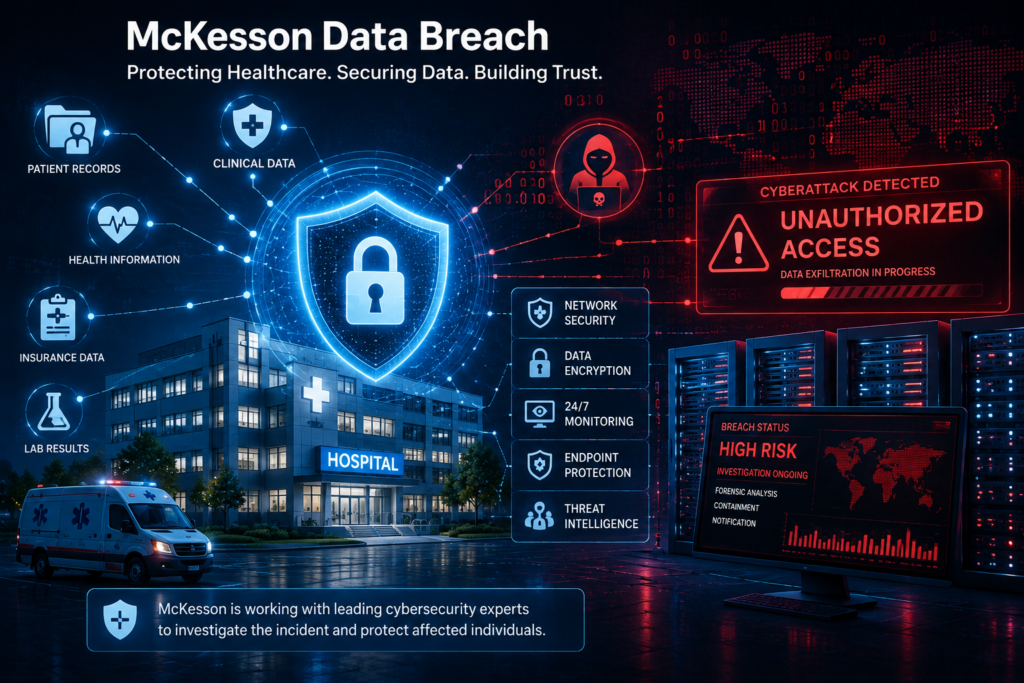
The McKesson Data Breach has become one of the biggest healthcare cybersecurity stories of 2026, raising concerns about customer information and third-party security.
Healthcare and pharmaceutical giant McKesson Corporation has confirmed that hackers stole customer data during a recent cybersecurity incident, making it one of the most significant healthcare security events reported in 2026.
The company stated that unauthorized actors gained access to certain systems and exfiltrated data associated with a subset of customers. While McKesson has assured customers that its core operations remain functional and patient care services have not been disrupted, many important questions remain unanswered, including the total number of affected individuals and the exact scope of the stolen information.
The confirmation comes as the cyber extortion group ShinyHunters claims responsibility for the attack and threatens to publish the allegedly stolen data if ransom negotiations do not begin before its stated deadline. However, these claims have not been independently verified by McKesson, and readers should distinguish between officially confirmed information and allegations made by the attackers.
This article explains everything currently known about the McKesson data breach, what the company has confirmed, what remains unverified, and why this incident matters for customers, healthcare providers, and the cybersecurity industry.
What Is McKesson?
McKesson Corporation is one of the world’s largest healthcare services and pharmaceutical distribution companies.
Headquartered in the United States, the company plays a critical role in the healthcare supply chain by delivering approximately one-third of all prescription medicines used across North America. Its operations support hospitals, pharmacies, clinics, physician practices, specialty healthcare providers, and cancer treatment centers.
McKesson also provides:
- Pharmaceutical distribution
- Medical and surgical supplies
- Oncology and specialty healthcare solutions
- Healthcare technology services
- Pharmacy management solutions
- Supply chain and logistics support
Because of its enormous role in healthcare infrastructure, any cybersecurity incident affecting McKesson attracts significant attention from hospitals, regulators, healthcare providers, and cybersecurity professionals.
McKesson Data Breach: What Happened?
According to McKesson, the company detected suspicious activity involving its information systems in late August 2026. After launching an investigation with the assistance of external cybersecurity experts, the company determined that unauthorized individuals had gained access to certain third-party applications connected to its environment and had stolen customer-related data.
McKesson disclosed the incident through an official filing with the U.S. Securities and Exchange Commission (SEC) and later published additional information through its customer cybersecurity information center.
The company emphasized that:
- The unauthorized activity has been contained.
- The investigation remains ongoing.
- Core business operations continue normally.
- Healthcare services have not been interrupted.
- Impacted individuals will receive complimentary credit monitoring and identity protection services where appropriate.
Although these statements provide reassurance regarding operational continuity, McKesson has not yet disclosed the total number of affected customers or the precise categories of data that were compromised.
As is common in large-scale cybersecurity investigations, additional information may become available as forensic analysis progresses.
The McKesson Data Breach investigation continues as the company works with cybersecurity experts to determine the full impact of the incident.
Timeline of the McKesson Data Breach
| Date | Event |
|---|---|
| August 25, 2026 | McKesson discovers a cybersecurity incident affecting its information systems. |
| August 25, 2026 | Company files an SEC disclosure confirming an active cybersecurity investigation. |
| August 29, 2026 | McKesson publicly confirms that customer data was exfiltrated from certain business units. |
| Late August 2026 | Cyber extortion group ShinyHunters lists McKesson on its leak site. |
| September 1, 2026 (claimed deadline) | Attackers claim they will publish allegedly stolen data if negotiations do not begin. This deadline is part of the attackers’ statements and has not been confirmed by McKesson. |
What McKesson Has Officially Confirmed
As of publication, McKesson has confirmed several important facts regarding the incident.
1. A Cybersecurity Incident Occurred
McKesson has publicly acknowledged that it experienced a cybersecurity incident involving unauthorized access to parts of its information systems.
The company has not attempted to deny the incident and instead initiated an investigation immediately after discovering suspicious activity.
2. Customer Data Was Stolen
McKesson confirmed that attackers successfully exfiltrated data associated with a subset of customers.
At this stage, the company has not disclosed:
- The total volume of stolen data
- The number of affected individuals
- The specific information contained within the stolen files
Those details remain under investigation.
3. Certain Business Units Were Affected
According to the company’s official update, the compromised information is associated with customers from:
- Oncology & Multispecialty
- Medical-Surgical
McKesson has not indicated that all of its business divisions were impacted.
4. Operations Continue Normally
One of the most important announcements from McKesson is that the company has not disconnected its operational systems.
Unlike some ransomware attacks that force organizations to shut down networks, pharmacies, logistics platforms, and ordering systems, McKesson says its services continue operating.
This suggests that the company chose a containment strategy designed to minimize disruption while continuing its investigation.
5. The Attack Has Been Contained
McKesson says it has disrupted the unauthorized access and continues working with cybersecurity specialists to strengthen its environment.
Although containment is a positive development, cybersecurity investigations often continue for weeks or even months while analysts determine exactly:
- How attackers entered the network
- Which systems were accessed
- What information was viewed
- What information was copied
- Whether additional persistence mechanisms remain
6. Affected Individuals Will Receive Support
McKesson has stated that impacted individuals will receive complimentary:
- Credit monitoring
- Identity protection services
These measures are commonly offered following data breaches involving potentially sensitive customer information and are intended to help detect signs of identity theft or financial fraud.
The company has not yet announced when all affected customers will begin receiving formal notification letters.
The McKesson Data Breach investigation has confirmed several important facts while other details remain under investigation.
Confirmed Facts vs. Unverified Claims
One of the most important aspects of responsible cybersecurity reporting is separating verified information from attacker claims.
The following table summarizes what has been confirmed by McKesson and what remains unverified.
| Confirmed by McKesson | Not Confirmed by McKesson |
| Cybersecurity incident occurred | 284 million records stolen |
| Unauthorized access took place | $55 million ransom demand |
| Customer data was exfiltrated | Exact volume of stolen data |
| Oncology & Multispecialty affected | Full categories of compromised information |
| Medical-Surgical business affected | Total number of affected individuals |
| Investigation ongoing | Identity of the attackers officially confirmed |
Readers should treat claims made by cybercriminals with caution until they are independently verified through official investigations.
Why This Incident Matters
McKesson is not just another enterprise affected by a cyberattack. It is one of the largest organizations supporting healthcare delivery across North America.
Its infrastructure helps hospitals, pharmacies, clinics, and healthcare providers obtain medications, medical products, and essential services every day.
When a company operating at this scale experiences a data breach, the consequences extend beyond a single organization. Customers, healthcare providers, business partners, regulators, and cybersecurity professionals all closely monitor developments because of the potential impact on sensitive healthcare information and critical healthcare operations.
Although McKesson has stated that patient care and business services remain operational, the investigation is still ongoing, and additional details may emerge as forensic experts complete their analysis.
In the next part of this article, we’ll examine the claims made by the ShinyHunters extortion group, discuss the potential risks to affected customers, and explain what individuals and healthcare organizations should do while the investigation continues.
ShinyHunters’ Claims, Potential Impact, and What Customers Should Do
Editor’s Note: The following section discusses claims made by the cyber extortion group ShinyHunters. Unless otherwise stated, these claims have not been independently verified by McKesson. They are included to provide readers with context and should not be treated as confirmed facts.
Who Is Behind the Attack?
Shortly after McKesson publicly acknowledged the cybersecurity incident, the cyber extortion group ShinyHunters added the company to its dark web leak site, claiming responsibility for the attack.
The group alleged that it had stolen a massive amount of customer information and warned that the data would be released publicly if McKesson did not enter ransom negotiations before the deadline it announced.
As of this writing, McKesson has not officially attributed the attack to ShinyHunters, and law enforcement agencies have not publicly confirmed the identity of the attackers.
This distinction is important because cybercriminal groups sometimes exaggerate or misrepresent the amount of data they possess in an effort to pressure victims into paying a ransom.
What Is ShinyHunters?
ShinyHunters is one of the most well-known cyber extortion groups active in recent years.
The group has been linked by security researchers to multiple high-profile data breaches involving technology companies, retailers, cloud service providers, and large enterprises worldwide.
Unlike traditional ransomware operators that encrypt systems and demand payment for a decryption key, ShinyHunters is primarily associated with data theft and extortion.
Their typical attack pattern includes:
- Compromising an organization’s network
- Stealing sensitive internal data
- Threatening to publish the stolen information
- Demanding a ransom payment in exchange for deleting the data
This approach places significant pressure on organizations because even if business operations continue normally, the exposure of confidential information can lead to financial losses, legal challenges, regulatory investigations, and reputational damage.
What Are the Attackers Claiming?
According to posts attributed to ShinyHunters, the group claims to have stolen approximately 284 million customer records from McKesson.
The attackers also reportedly claim that the stolen information includes:
- Personally Identifiable Information (PII)
- Protected Health Information (PHI)
- Prescription records
- Medical treatment information
- Billing records
- Employee information
- Information related to physicians and healthcare clinics
Some reports have also suggested that the group demanded a ransom of approximately $55 million.
However, none of these figures have been confirmed by McKesson.
Until the company’s forensic investigation is complete, the actual scale of the breach remains unknown.
Readers should avoid assuming that every reported figure is accurate simply because it appears on a criminal leak site.
Why Healthcare Data Is So Valuable to Cybercriminals
Healthcare organizations remain one of the most attractive targets for cybercriminals because the information they store is significantly more valuable than ordinary personal data.
Unlike a stolen credit card, which can be canceled quickly, medical records often contain information that cannot easily be changed.
A healthcare record may include:
- Full name
- Date of birth
- Address
- Phone number
- Email address
- Government identification numbers
- Insurance information
- Medical history
- Prescription information
- Diagnostic reports
- Billing details
This combination of personal and medical information can be exploited for identity theft, financial fraud, insurance fraud, phishing campaigns, social engineering attacks, and even blackmail in certain cases.
For this reason, healthcare organizations have become one of the most frequently targeted sectors by cybercriminal groups worldwide.
Potential Risks for Customers
Although McKesson has not disclosed exactly what information was compromised, customers should remain alert until additional details become available.
If sensitive personal information was accessed, affected individuals could face several risks.
Identity Theft
Criminals may attempt to use stolen personal information to open financial accounts, apply for loans, or impersonate victims.
Monitoring credit reports and financial statements can help detect suspicious activity early.
Phishing Emails
Following major data breaches, attackers often launch phishing campaigns pretending to represent:
- Healthcare providers
- Insurance companies
- Banks
- Government agencies
- The affected organization itself
These messages frequently attempt to trick recipients into revealing passwords, financial information, or one-time verification codes.
Customers should be cautious of unexpected emails requesting personal information or urging immediate action.
Healthcare Fraud
Medical information can sometimes be misused to obtain prescription medications, submit fraudulent insurance claims, or impersonate patients.
Any unexpected insurance claims or unfamiliar medical bills should be investigated immediately.
Credential Attacks
If attackers obtained email addresses or usernames, they may attempt credential stuffing attacks using passwords exposed in previous breaches.
This highlights the importance of using unique passwords for every online account.
If you may be affected by the McKesson Data Breach, taking proactive security measures can help reduce the risk of fraud or identity theft.
What Should Customers Do?
Even if you have not yet received a notification from McKesson, taking proactive security measures is a good practice after any major data breach.
1. Watch for Official Communications
Only trust notifications sent through McKesson’s official communication channels.
Cybercriminals often exploit publicized breaches by sending fake emails that appear legitimate.
Never click links or download attachments from suspicious messages.
2. Change Important Passwords
If you reuse passwords across multiple websites, change them immediately.
Create strong, unique passwords for:
- Email accounts
- Banking services
- Healthcare portals
- Insurance accounts
- Pharmacy accounts
A password manager can help generate and securely store complex passwords.
3. Enable Multi-Factor Authentication (MFA)
Whenever possible, enable Multi-Factor Authentication.
Even if an attacker obtains your password, MFA adds an additional layer of security that significantly reduces the risk of unauthorized access.
4. Monitor Financial Accounts
Regularly review:
- Bank statements
- Credit card transactions
- Insurance activity
- Credit reports
Report any suspicious activity to the relevant financial institution immediately.
5. Take Advantage of Credit Monitoring
McKesson has stated that affected individuals will receive complimentary credit monitoring and identity protection services.
If you are notified that your information was involved, enrolling in these services can help identify signs of fraud earlier.
What Does This Mean for Healthcare Providers?
McKesson supports thousands of hospitals, clinics, pharmacies, and healthcare organizations.
Although the company has stated that its operational services remain available, healthcare providers should continue following cybersecurity best practices while monitoring official updates.
Organizations that work with McKesson should consider:
- Reviewing recent account activity
- Monitoring administrative accounts for unusual behavior
- Verifying unexpected communications before responding
- Reinforcing phishing awareness among employees
- Ensuring critical systems remain fully patched
- Reviewing third-party access controls
While there is currently no indication that customers need to disconnect systems or halt operations, maintaining vigilance is essential during an active investigation.
Cybersecurity Experts Stress Patience
Large-scale incident investigations rarely conclude within a few days.
Digital forensics teams must determine:
- How the attackers entered the network
- How long they remained inside
- Which systems were accessed
- Which files were copied
- Whether customer information was exposed
- Whether any additional security gaps remain
As a result, organizations often release information gradually as facts become verified.
This means future updates from McKesson could include revised impact estimates, additional affected business units, or expanded customer notifications.
Investigation Continues
At the time of publication, McKesson continues working with external cybersecurity specialists to investigate the incident.
The company has not released the total number of affected individuals, confirmed the identity of the attackers, or verified the scale of the alleged data theft.
Until the investigation is complete, readers should rely on official company statements and updates from trusted cybersecurity sources rather than unverified claims circulating on social media or criminal leak sites.
The coming weeks will likely provide a clearer picture of the incident’s full scope and its potential impact on customers, healthcare organizations, and the broader healthcare industry.
Lessons From the McKesson Data Breach, FAQs, and Final Takeaways
What Businesses Can Learn From the McKesson Data Breach
While the full details of the McKesson incident are still under investigation, the breach serves as another reminder that no organization—regardless of its size or industry—is immune to cyber threats.
Large enterprises often invest heavily in cybersecurity, yet attackers continue to find new ways to exploit vulnerabilities. Organizations can reduce their risk by adopting a proactive security strategy rather than relying solely on reactive measures.
Below are some of the key lessons businesses can take away from this incident.
1. Third-Party Applications Can Introduce Significant Risk
McKesson has indicated that the incident involved third-party applications, highlighting a growing challenge in modern cybersecurity.
Most organizations depend on external vendors for cloud services, software platforms, analytics tools, payment systems, and business operations. If one of these services is compromised or improperly secured, attackers may gain access to sensitive corporate environments.
To reduce third-party risk, organizations should:
- Conduct regular security assessments of vendors.
- Review supplier cybersecurity policies before onboarding.
- Limit vendor access to only the systems they require.
- Continuously monitor third-party connections.
- Require vendors to follow recognized security standards.
Managing third-party risk is now a critical part of any cybersecurity strategy.
2. Early Detection Can Reduce the Impact of an Attack
The faster a cybersecurity incident is detected, the greater the chance of limiting damage.
Organizations should invest in technologies and processes that help identify suspicious activity before attackers can move across the network or exfiltrate data.
Examples include:
- Security Information and Event Management (SIEM)
- Endpoint Detection and Response (EDR)
- Managed Detection and Response (MDR)
- Network monitoring
- Threat intelligence platforms
- Continuous log analysis
Rapid detection and response can significantly reduce both operational disruption and data loss.
3. Employee Awareness Remains Essential
Technology alone cannot prevent every cyberattack.
Many breaches begin with phishing emails, stolen credentials, or social engineering attacks targeting employees.
Regular cybersecurity awareness training should teach staff how to:
- Recognize phishing attempts.
- Verify unexpected requests.
- Protect passwords.
- Report suspicious activity quickly.
- Handle sensitive information securely.
Well-trained employees often serve as the first line of defense against cyber threats.
4. Incident Response Planning Is Critical
Every organization should have a documented and regularly tested incident response plan.
A strong response plan should clearly define:
- Roles and responsibilities
- Communication procedures
- Technical containment steps
- Legal and regulatory requirements
- Customer notification processes
- Business continuity strategies
Organizations that prepare for incidents before they occur generally recover more quickly than those forced to create procedures during an active crisis.
5. Transparency Builds Customer Trust
McKesson publicly acknowledged the cybersecurity incident, filed the required regulatory disclosures, and informed customers that an investigation was underway.
Although many questions remain unanswered, timely communication helps reduce speculation and demonstrates accountability.
Organizations responding to cyber incidents should strive to provide:
- Accurate updates
- Transparent communication
- Clear guidance for affected individuals
- Regular progress reports as new information becomes available
Maintaining public trust is an important part of incident response.
Frequently Asked Questions (FAQ)
1. What happened in the McKesson data breach?
McKesson confirmed that unauthorized actors gained access to certain information systems and exfiltrated customer-related data. The company has stated that the incident has been contained and that its operations continue without disruption.
2. Was patient care affected?
According to McKesson, there has been no indication that healthcare services or operational systems were disrupted as a result of the incident.
3. How many people were affected?
As of publication, McKesson has not disclosed the total number of affected individuals.
Claims circulating online regarding the scale of the breach have not been officially confirmed by the company.
4. What information was stolen?
McKesson has confirmed that customer data was exfiltrated but has not publicly disclosed the exact categories of compromised information.
The company’s investigation is ongoing.
5. Has McKesson identified the attackers?
No.
Although the cyber extortion group ShinyHunters has claimed responsibility, McKesson has not officially attributed the attack to any specific threat actor.
6. Should customers change their passwords?
While McKesson has not instructed all customers to change passwords, cybersecurity experts generally recommend updating passwords, enabling multi-factor authentication (MFA), and remaining alert for phishing attempts after any major data breach.
7. Is the investigation still ongoing?
Yes.
McKesson continues to work with external cybersecurity experts to determine the full scope of the incident.
Additional information may become available as the investigation progresses.
Final Thoughts
The McKesson data breach is another reminder that cybersecurity has become a critical business priority across every industry, especially healthcare.
Healthcare organizations manage vast amounts of sensitive personal and medical information, making them attractive targets for cybercriminals seeking financial gain through data theft and extortion.
Although McKesson has confirmed that customer data was stolen, many important details—including the total number of affected individuals, the specific data involved, and the identity of the attackers—remain under investigation.
Until the company releases additional findings, it is important to distinguish between verified facts and claims made by threat actors. Responsible reporting requires relying on official disclosures and trusted sources rather than treating criminal allegations as established truth.
For customers, the incident serves as a reminder to stay vigilant, monitor financial and healthcare accounts, use strong and unique passwords, enable multi-factor authentication, and pay close attention to official notifications regarding the breach.
For businesses, the attack reinforces the importance of robust cybersecurity practices, vendor risk management, employee awareness, and comprehensive incident response planning. As cyber threats continue to evolve, organizations that invest in resilience and transparency will be better positioned to protect both their operations and the trust of their customers.
McKesson’s investigation is ongoing, and further updates are expected as forensic experts continue their analysis. Voltixaz will continue to monitor this developing story and provide updates as new verified information becomes available.
Official Sources
- McKesson Cybersecurity Information Center
https://www.mckesson.com/utility/cybersecurity/customer-cybersecurity-information-center/ - McKesson SEC Cybersecurity Incident Filing (Form 8-K)
https://www.sec.gov/Archives/edgar/data/927653/000092765326000247/mck-20260825.htm - Cybersecurity and Infrastructure Security Agency (CISA) – Cybersecurity Resources
https://www.cisa.gov/topics/cybersecurity
Additional Trusted References (Recommended)
- CISA – Shields Up
https://www.cisa.gov/shields-up - FBI Internet Crime Complaint Center (IC3)
https://www.ic3.gov/ - National Institute of Standards and Technology (NIST) Cybersecurity Framework
https://www.nist.gov/cyberframework - U.S. Department of Health & Human Services (HHS) – Health Sector Cybersecurity
https://www.hhs.gov/about/agencies/asa/ocio/cybersecurity/index.html
Suggested Internal Links for Voltixaz
- How to Protect Yourself After a Data Breach
- What Is Personally Identifiable Information (PII)?
- What Is Protected Health Information (PHI)?
- How Multi-Factor Authentication (MFA) Improves Online Security
- Common Phishing Scams and How to Avoid Them
- Latest Cybersecurity News
- Enterprise Security Guides
Explore More on Voltixaz
Continue exploring the latest technology content with our other categories:
- Artificial Intelligence – Discover AI news, tutorials, tools, and practical guides.
- Windows – Learn Windows tips, troubleshooting, updates, and optimization techniques.
- Linux – Explore Linux tutorials, terminal commands, distributions, and open-source news.
- Smartphones – Read smartphone reviews, buying guides, software updates, and mobile tips.
- Cybersecurity – Stay protected with online security guides, privacy tips, and the latest cyber threat updates.
- Tech News – Keep up with breaking technology news, product launches, and industry trends.
- Reviews & Buying Guides – Make informed decisions with expert product reviews and detailed buying advice.