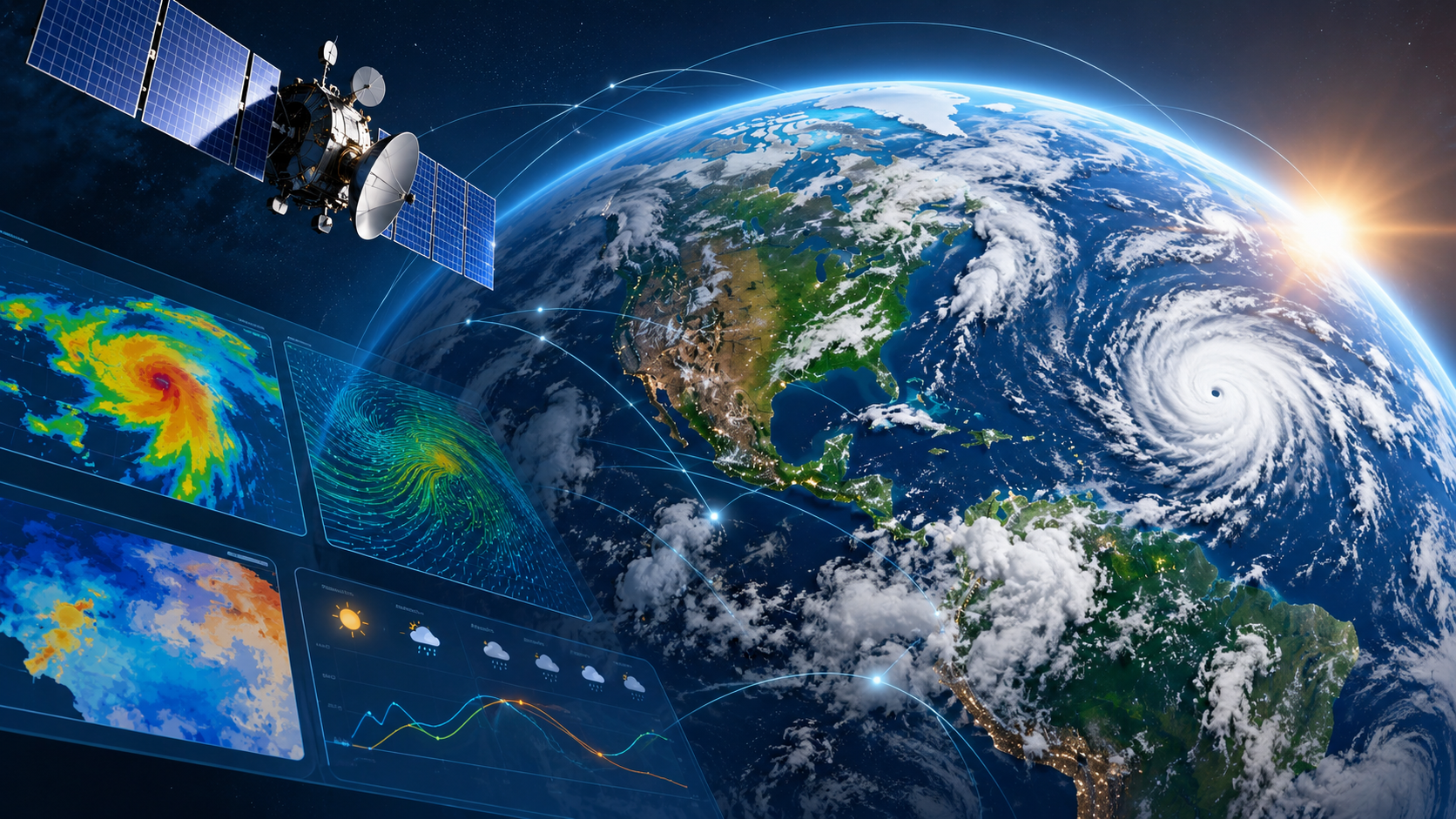
WeatherNext 3 is Google’s newest artificial intelligence weather forecasting model developed jointly by Google DeepMind and Google Research. The company says this is its most advanced global forecasting system yet, capable of delivering faster, more detailed, and more accurate weather predictions than previous AI models.
Weather forecasting has traditionally relied on enormous supercomputers solving complex physics equations. While those systems remain highly reliable, they require substantial computing power and often update only every few hours. WeatherNext 3 takes a different approach. Using artificial intelligence trained on decades of atmospheric observations and live satellite data, it can generate forecasts much faster while improving the level of detail.
As climate change increases the frequency of extreme weather events, faster forecasting tools are becoming more important than ever. Google believes WeatherNext 3 can help governments, businesses, researchers, and everyday users make better weather-related decisions.
What is WeatherNext 3?
WeatherNext 3 is an AI-powered forecasting system that predicts weather conditions across the globe using machine learning instead of relying entirely on traditional numerical weather prediction methods.
The model analyzes enormous amounts of historical weather data alongside real-time satellite imagery and meteorological observations. It learns weather patterns and produces highly detailed forecasts within minutes.
Google states that WeatherNext 3 significantly improves the prediction of rainfall, temperature, humidity, wind, cloud cover, and other atmospheric variables. It also delivers forecasts with much finer geographical detail than earlier versions.
Why Google Developed WeatherNext 3
Modern weather forecasting is incredibly complex. Traditional forecasting centers use massive supercomputers that continuously solve mathematical equations describing Earth’s atmosphere.
Although these methods are extremely accurate, they are computationally expensive and require significant processing time.
Google created WeatherNext 3 to address several challenges:
- Produce forecasts much faster.
- Improve prediction accuracy.
- Increase forecast resolution.
- Update weather information every hour.
- Support Google products with better weather data.
By combining AI with observational data, WeatherNext 3 can complement existing forecasting methods rather than replace them.
How WeatherNext 3 Works
Unlike traditional systems that simulate atmospheric physics from scratch, WeatherNext 3 uses deep learning.
Its AI model has been trained using:
- Historical weather observations
- Global satellite imagery
- Surface weather stations
- Ocean measurements
- Rainfall datasets
- Atmospheric reanalysis data
Once trained, the model recognizes complex weather patterns and predicts how conditions are likely to evolve over time.
Google also introduced a new Functional Generative Network architecture that enables WeatherNext 3 to generate multiple possible forecast scenarios, helping meteorologists better estimate uncertainty.
Top Features of WeatherNext 3
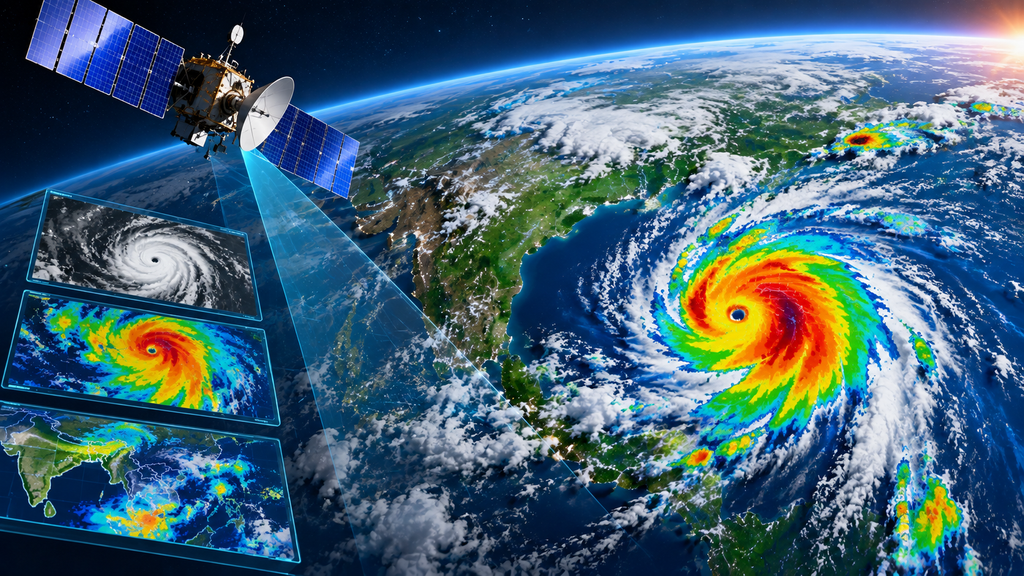
1. Hourly Forecast Updates
Previous AI forecasting systems often updated every six hours.
WeatherNext 3 now refreshes forecasts every hour, allowing it to track rapidly changing weather systems more effectively.
2. High Resolution Forecasting
Google says the model produces forecasts at resolutions as fine as 5 kilometers for several important weather variables.
This allows users to receive more localized weather predictions than before.
3. Live Satellite Integration
WeatherNext 3 continuously incorporates live satellite observations.
Instead of waiting for scheduled model updates, the AI can quickly respond to changing atmospheric conditions.
4. Better Rainfall Prediction
Rain forecasting remains one of meteorology’s biggest challenges.
Google reports that WeatherNext 3 substantially improves precipitation forecasting, helping users prepare for heavy rain and flooding more accurately.
5. Faster Processing
Traditional weather simulations may require hours on powerful supercomputers.
WeatherNext 3 generates forecasts within minutes while using significantly fewer computing resources.
6. Global Coverage
The model provides forecasts across nearly the entire planet, making it useful for countries with limited forecasting infrastructure.
7. AI Ensemble Forecasting
Instead of generating only one prediction, WeatherNext 3 creates multiple possible forecast scenarios.
This gives meteorologists a better understanding of uncertainty.
8. Improved Wind Forecasts
Accurate wind prediction benefits aviation, shipping, renewable energy, and outdoor event planning.
WeatherNext 3 improves wind speed forecasting using enhanced AI modeling.
9. Better Extreme Weather Monitoring
Rapidly evolving storms, thunderstorms, and heavy rainfall events can be monitored more effectively thanks to hourly forecast updates.
10. Integration Across Google Services
Google plans to integrate WeatherNext 3 into:
- Google Search
- Google Maps
- Gemini
- Google Cloud
- Maps Platform Weather API
- Earth Engine
- BigQuery
This means millions of users could benefit from more accurate weather forecasts without needing a dedicated weather application.
WeatherNext 3 vs Traditional Weather Forecasting
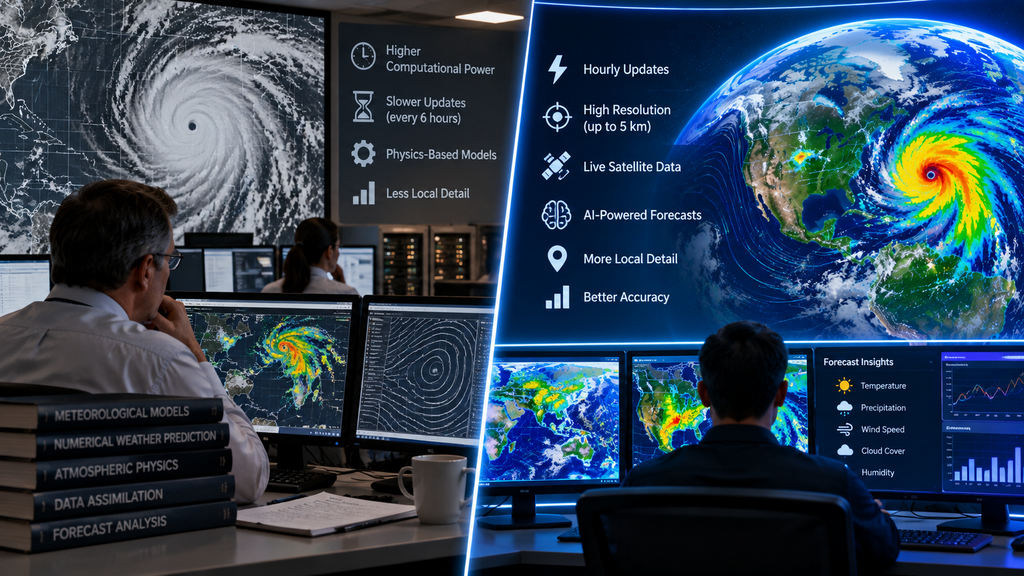
Traditional forecasting remains the backbone of global meteorology, but AI introduces several advantages.
Traditional systems depend on solving complex atmospheric equations using powerful supercomputers. While highly accurate, they require considerable computational resources and time.
WeatherNext 3 uses artificial intelligence to recognize weather patterns learned from historical data. As a result, forecasts can be produced much faster while maintaining impressive accuracy.
Rather than replacing physics-based forecasting, experts expect AI systems like WeatherNext 3 to work alongside traditional models to improve forecasting performance.
Where WeatherNext 3 Will Be Used
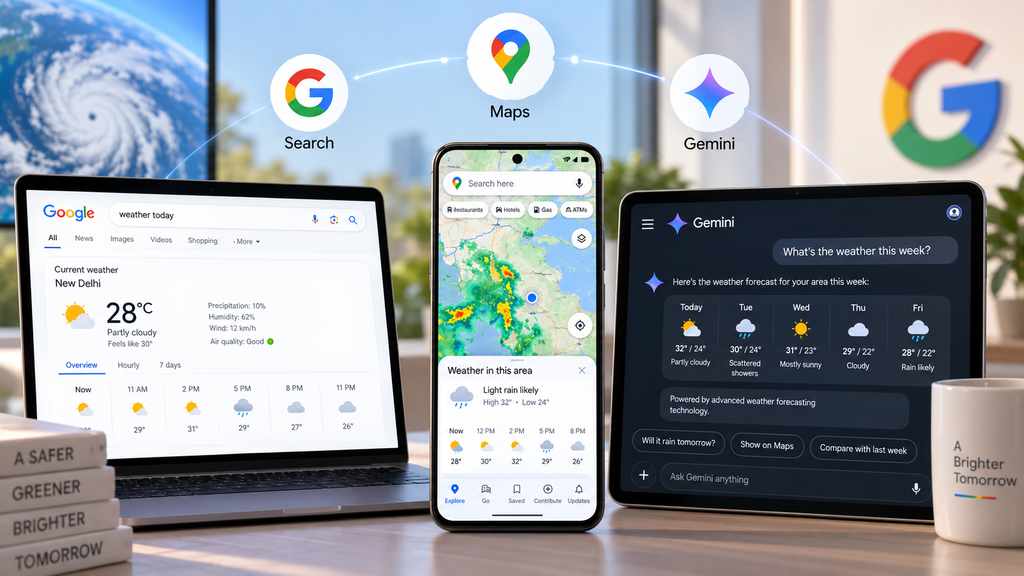
Google is making WeatherNext 3 available across multiple products and cloud services.
Consumers will benefit through improved weather information in Google Search and Google Maps.
Businesses can access forecasting capabilities through Google Cloud APIs.
Researchers can analyze weather datasets using BigQuery and Earth Engine.
This broad integration makes WeatherNext 3 one of Google’s most ambitious AI infrastructure projects.
Industries That Will Benefit
The applications of WeatherNext 3 extend well beyond everyday weather forecasts.
Agriculture can use improved rainfall predictions for irrigation planning.
Airlines may optimize flight routes based on better wind forecasts.
Renewable energy companies can forecast wind and solar generation more accurately.
Shipping companies can avoid dangerous weather conditions.
Insurance providers can better assess weather-related risks.
Emergency management agencies can improve disaster preparedness and response planning.
Construction companies can also reduce delays caused by unexpected weather changes.
Limitations of WeatherNext 3
Although WeatherNext 3 represents a major advancement, Google emphasizes that it is not intended to replace national weather agencies.
Official meteorological organizations remain responsible for issuing severe weather alerts, hurricane warnings, and public safety advisories.
AI forecasting also depends heavily on the quality of observational data available.
As with every forecasting system, WeatherNext 3 cannot eliminate uncertainty entirely.
The Future of AI Weather Forecasting
Artificial intelligence is becoming an increasingly important tool in meteorology.
Future versions of WeatherNext may offer:
- Even higher spatial resolution
- Faster forecast updates
- Improved hurricane prediction
- Better climate modeling
- More accurate flood forecasting
- Enhanced wildfire weather prediction
As AI continues to evolve, weather forecasting is expected to become faster, more accessible, and increasingly personalized.
Final Thoughts
WeatherNext 3 represents one of Google’s most significant AI innovations in environmental science. By combining advanced machine learning, live satellite observations, and high-resolution forecasting, the model has the potential to reshape how weather information is generated and delivered.
While traditional forecasting systems remain essential, AI models like WeatherNext 3 demonstrate how artificial intelligence can complement existing meteorological techniques and provide faster insights for governments, businesses, researchers, and consumers.
As Google integrates WeatherNext 3 into Search, Maps, Gemini, and Cloud services, millions of users around the world are likely to experience more timely and accurate weather forecasts. If its real-world performance matches Google’s early claims, WeatherNext 3 could mark a major milestone in the future of AI-powered weather prediction.
Internal Links
- AI News →
/artificial-intelligence/ - Tech News →
/tech-news/ - Reviews →
/reviews-buying-guides/
DoFollow External Links
- Google DeepMind: https://deepmind.google/
- Google Research: https://research.google/
- Google Cloud Weather: https://cloud.google.com/
- Google WeatherNext Announcement: https://blog.google/