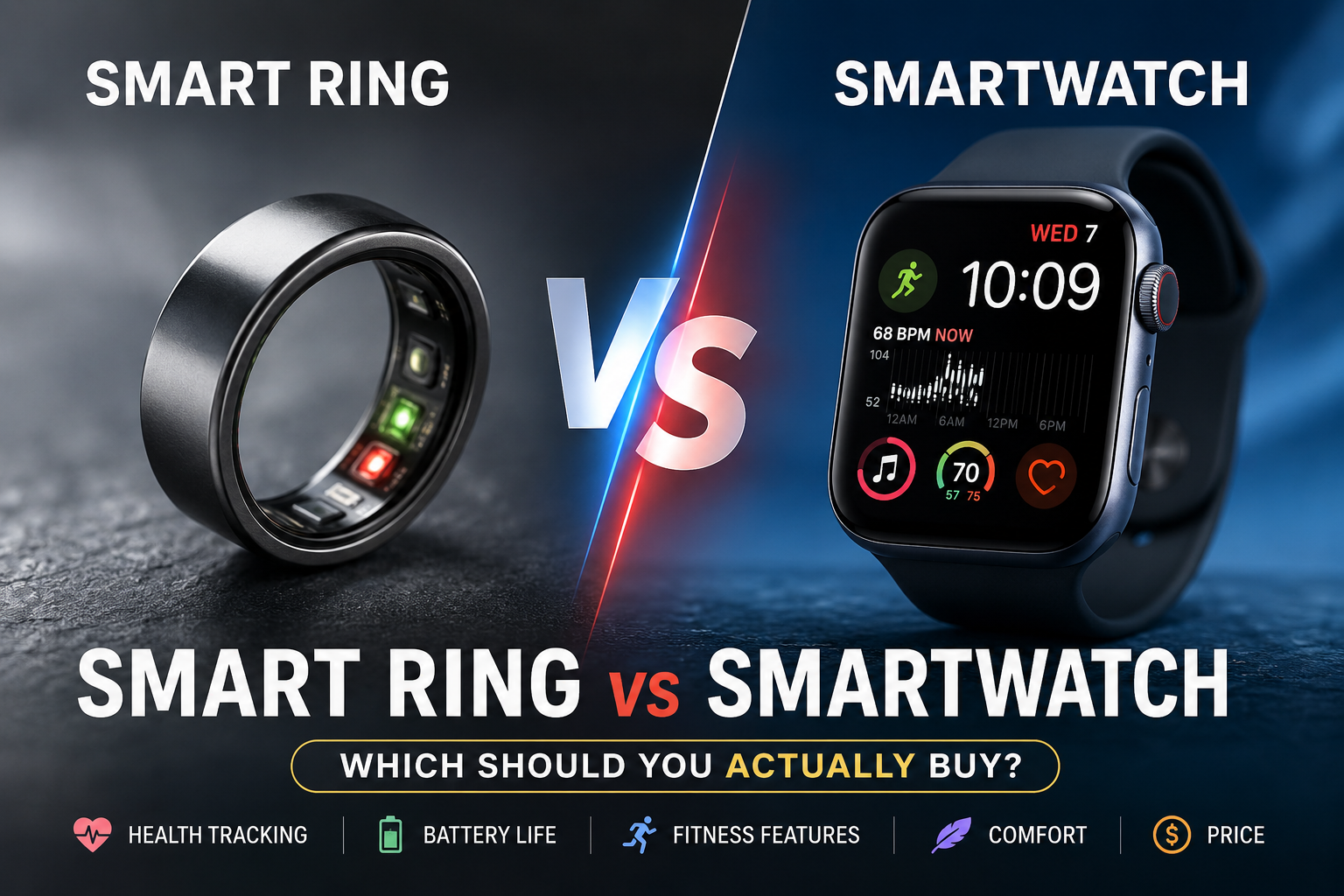
Smart Ring vs Smartwatch: Which Should You Actually Buy?
Wearable technology has evolved far beyond simple step counters. In 2026, consumers have more choices than ever before, with smart rings joining smartwatches as one of the fastest-growing categories in personal technology. Both devices promise to help users live healthier lives by tracking fitness, monitoring vital signs, and providing valuable health insights. However, they are designed for different types of users and offer unique advantages that make choosing between them more complicated than it may seem.
If you’re planning to invest in a wearable device this year, you may be wondering whether a smart ring is enough for your daily needs or if a smartwatch remains the better all-round option. While both devices share several health and fitness features, the overall experience is completely different. Smart rings focus on discreet health tracking with minimal distractions, whereas smartwatches combine fitness features with productivity tools, communication, navigation, and entertainment.
This guide compares smart rings and smartwatches across every important category to help you decide which wearable is worth buying in 2026.
Understanding Smart Rings
Smart rings are compact wearable devices that look almost identical to traditional rings but contain advanced sensors capable of monitoring your health throughout the day and night. Despite their small size, today’s smart rings can measure heart rate, blood oxygen levels, skin temperature, stress levels, heart rate variability (HRV), sleep stages, daily activity, and overall recovery.
Unlike smartwatches, smart rings are designed to stay in the background. There are no large displays constantly lighting up with notifications or vibrating every few minutes. Instead, the collected health data is synchronized with a companion smartphone app, where users can view detailed reports and personalized recommendations. This minimalist approach has made smart rings increasingly popular among people who want to monitor their health without feeling constantly connected to their phones.
Several manufacturers have entered this market, making smart rings more accessible than ever. Devices such as the Oura Ring, Samsung Galaxy Ring, Ultrahuman Ring Air, and RingConn have helped establish the category as a serious alternative to traditional wearable technology.
Understanding Smartwatches
Smartwatches remain the most feature-rich wearable devices available today. Originally introduced as companions to smartphones, they have gradually evolved into powerful standalone gadgets capable of handling everything from phone calls and navigation to health monitoring and mobile payments.
Modern smartwatches include advanced fitness tracking features, built-in GPS, workout detection, sleep analysis, ECG monitoring, blood oxygen tracking, voice assistants, music streaming, app support, and even LTE connectivity in premium models. They are essentially miniature smartphones designed to sit comfortably on your wrist.
Because they offer so many capabilities, smartwatches appeal to a wide range of users. Fitness enthusiasts rely on them for detailed workout analysis, professionals use them to manage notifications and calendars, while casual users appreciate the convenience of accessing essential information without taking out their phones.
Design and Everyday Comfort
Comfort plays a significant role in determining which wearable you’ll actually enjoy using every day. Smart rings have a clear advantage in this area due to their incredibly compact design. Most weigh only a few grams and quickly become almost unnoticeable after a few days of use. Since they resemble regular jewelry, they blend naturally with both casual and formal clothing and don’t attract unnecessary attention.
Smartwatches, while comfortable for most users, are still much larger and heavier. Wearing one throughout the day usually isn’t a problem, but sleeping with a smartwatch isn’t always pleasant, especially for people who prefer lightweight accessories. Larger watch cases may also interfere with certain activities like typing for extended periods or wearing fitted dress shirts.
For users who prioritize subtle design and maximum comfort, smart rings provide a more seamless experience.
Health Monitoring: The Biggest Strength of Smart Rings
Health tracking has become one of the primary reasons people purchase wearable devices, and this is where smart rings have earned considerable attention. Because a ring sits directly on the finger, an area with rich blood circulation, many of its sensors are able to capture consistent physiological data. This positioning allows smart rings to excel at monitoring resting heart rate, sleep quality, heart rate variability, skin temperature, and overnight recovery.
Most premium smart rings analyze your nightly sleep in remarkable detail, identifying deep sleep, REM sleep, light sleep, sleep interruptions, breathing patterns, and recovery scores. Many also provide readiness scores that help users understand whether their bodies are prepared for intense exercise or should focus on recovery instead.
These insights have made smart rings particularly popular among people interested in improving long-term wellness rather than simply counting daily steps.
Smartwatches Still Dominate Fitness Tracking
Although smart rings provide excellent health data, smartwatches remain unmatched when it comes to active fitness tracking. Modern smartwatches are equipped with built-in GPS, multiple exercise modes, automatic workout detection, pace monitoring, elevation tracking, swimming metrics, cycling performance, and detailed post-workout analysis.
Whether you’re training for a marathon, cycling long distances, hiking in remote areas, or swimming regularly, a smartwatch offers significantly more detailed information during workouts. Many premium models even include coaching programs, interval training, recovery suggestions, VO₂ Max estimation, and advanced running dynamics that simply aren’t available on most smart rings.
If structured exercise is an important part of your routine, a smartwatch provides much greater value.
Smart Features Beyond Health Tracking
One of the biggest differences between these two devices becomes obvious once you move beyond health monitoring. A smartwatch acts as an extension of your smartphone, allowing you to receive calls, reply to messages, view notifications, control music, access navigation, use voice assistants, make contactless payments, and install third-party applications.
These features reduce the need to constantly check your smartphone and make daily life considerably more convenient.
Smart rings intentionally avoid this approach. Most do not display notifications, support apps, or allow interaction beyond basic gesture controls available on select models. Their purpose is to collect health information quietly in the background rather than becoming another digital screen demanding your attention.
For people looking to reduce digital distractions while still monitoring their health, this simplicity is actually one of the biggest advantages of a smart ring.
Battery Life Comparison
Battery life is another area where smart rings perform exceptionally well. Without a power-hungry display or continuous app usage, many smart rings easily last between five and ten days on a single charge, depending on usage patterns. Some users may only need to recharge once a week, making them extremely convenient for continuous health monitoring.
Smartwatches, especially models with bright OLED displays, LTE connectivity, and GPS, generally require charging every one to three days. While premium sports watches from brands like Garmin can last much longer, popular devices such as the Apple Watch or Pixel Watch often need daily charging if used heavily.
Users who dislike frequent charging often find smart rings far more practical for everyday wear.
Which Device Provides Better Sleep Tracking?
Sleep monitoring has become one of the most valuable features offered by wearable technology, and smart rings have established themselves as leaders in this area. Their lightweight design makes them comfortable enough to wear throughout the night, while their finger-based sensors collect detailed physiological data with impressive consistency.
Many smart rings provide daily sleep scores, recovery insights, stress analysis, body temperature trends, and readiness recommendations based on your overnight recovery. This information can help users improve sleep habits and better understand how lifestyle choices affect overall health.
Although smartwatches also offer sleep tracking, many users remove them before bed due to their size or because they need overnight charging. This naturally reduces the consistency of long-term sleep data collection.
Price and Overall Value
The price difference between smart rings and smartwatches is smaller than many people expect. Premium smart rings often cost between $300 and $500, placing them in the same price range as high-end smartwatches. However, entry-level smartwatches are generally much more affordable and often include a wider variety of features.
The true value depends on what you expect from your wearable. If your primary objective is comprehensive health monitoring with excellent comfort and long battery life, a smart ring offers outstanding value despite its premium pricing. On the other hand, if you want a wearable that can replace many smartphone interactions while also serving as an advanced fitness companion, a smartwatch remains the better investment.
Can You Use Both Together?
Interestingly, many users no longer see smart rings and smartwatches as competing devices. Instead, they use them together. A smartwatch is worn during workouts, office hours, or travel to take advantage of GPS, notifications, and productivity features, while the smart ring remains on throughout the day and night to continuously monitor sleep, recovery, and long-term health trends.
This combination offers the most complete picture of personal wellness but also comes at a significantly higher cost. For users who are deeply invested in health tracking, however, wearing both devices has become an increasingly popular choice.
Which One Should You Buy?
The answer ultimately depends on your lifestyle rather than the technology itself.
If your primary goal is improving your health, understanding your sleep patterns, tracking recovery, and wearing a device so comfortable that you almost forget it’s there, a smart ring is the better choice. Its minimalist design, long battery life, and highly detailed health insights make it one of the most impressive wearable technologies available in 2026.
However, if you want a device that keeps you connected throughout the day while also offering advanced fitness tracking, GPS navigation, mobile payments, messaging, and a rich app ecosystem, a smartwatch remains the more versatile option. It delivers significantly more functionality beyond health monitoring and is ideal for active users who rely on wearable technology for both fitness and productivity.
Neither device is universally better. They simply serve different purposes. A smart ring excels as a dedicated health companion, while a smartwatch functions as an all-in-one digital assistant for everyday life.
Final Verdict
The wearable technology market has matured considerably, and smart rings are no longer niche gadgets. They have become powerful health-monitoring devices capable of delivering meaningful insights while remaining almost invisible in daily life. At the same time, smartwatches continue to dominate the broader wearable market by combining communication, fitness tracking, productivity, and entertainment into a single device.
For users focused on wellness, recovery, sleep quality, and comfort, a smart ring is likely the better investment. For those who want a versatile wearable capable of replacing many smartphone tasks while delivering advanced fitness features, a smartwatch remains the smarter purchase.
Before making your decision, consider how you plan to use your wearable every day. Choosing the device that matches your lifestyle—not simply the one with the longest feature list—will ensure you get the most value from your investment.
Frequently Asked Questions
1. Are smart rings more accurate than smartwatches?
For sleep tracking, recovery analysis, and heart rate variability, smart rings are often highly accurate because they measure data directly from your finger. Smartwatches, however, are generally better for tracking workouts and outdoor activities.
2. Can a smart ring replace a smartwatch?
Not entirely. A smart ring focuses on health monitoring, while a smartwatch offers notifications, GPS, calls, messaging, mobile payments, and access to apps.
3. Which wearable has better battery life?
Most smart rings last between five and ten days on a single charge, whereas many smartwatches require charging every one to three days.
4. Are smart rings worth buying in 2026?
Yes. If your priority is health tracking, sleep monitoring, recovery insights, and comfort, smart rings are among the best wearable devices available today.
5. Should I buy both?
If your budget allows, using both provides the most complete wearable experience. A smartwatch handles fitness and productivity, while a smart ring continuously monitors health and sleep with greater comfort.
Related Articles
- Xiaomi Watch S5 vs Apple Watch: Is This the Smartwatch Upgrade Worth Watching?
- Best Budget Smartwatches 2026: Under $100 Picks That Don’t Feel Cheap
- AI Webcams 2026: Do You Actually Need One for Video Calls?
- Foldable Phones in 2026: Are the Creases Finally Gone?
- Best Home Security Cameras 2026: Budget and Premium Picks Compared