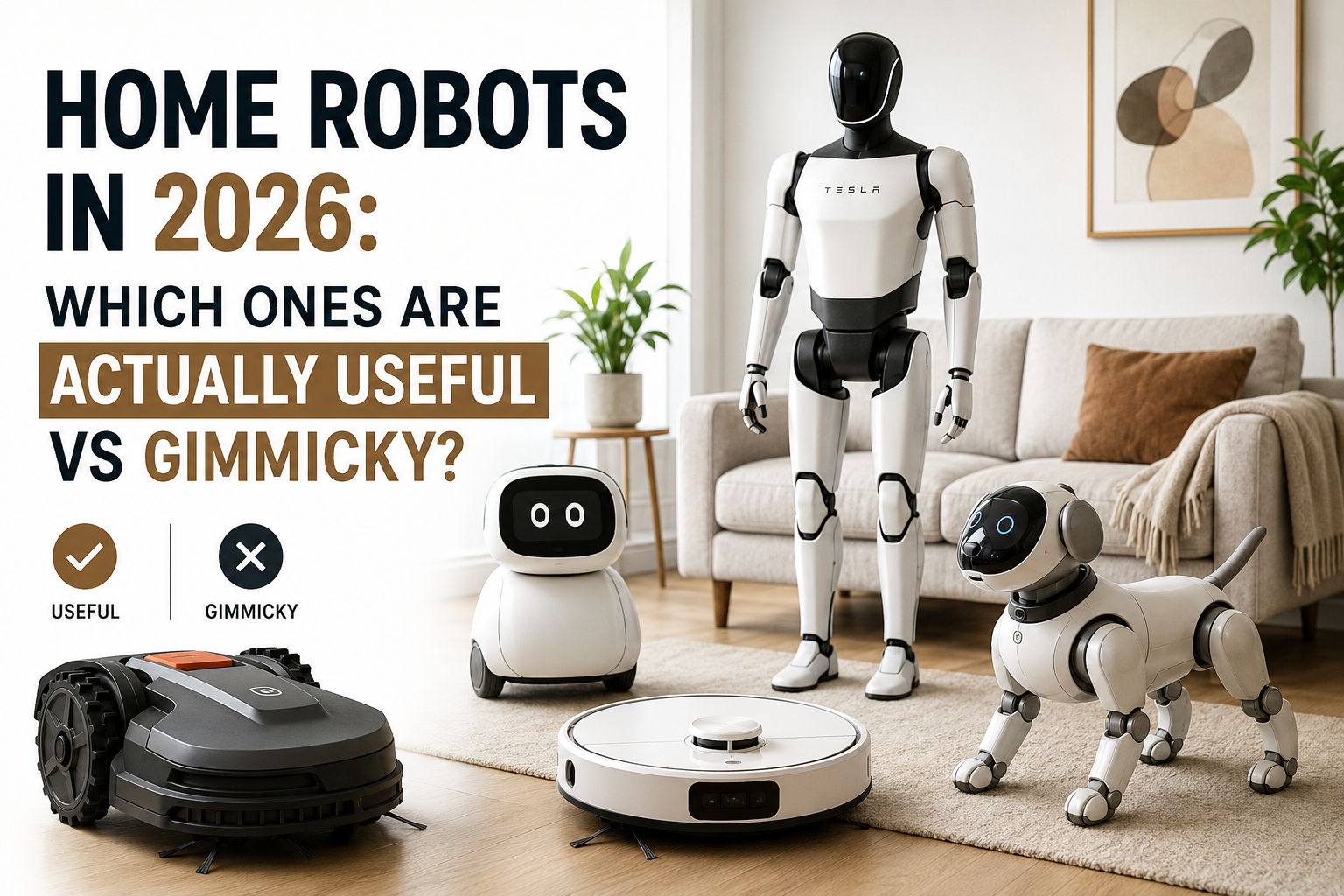
Home Robots in 2026: Which Ones Are Actually Useful vs Gimmicky?
The idea of having robots around the house has fascinated people for decades. What once belonged in science fiction is now becoming part of everyday life. In 2026, home robots are smarter, more connected, and more capable than ever before. Artificial intelligence has transformed many consumer robots from simple automated machines into devices that can learn routines, recognize people, avoid obstacles, and even hold conversations.
Major technology companies are investing heavily in consumer robotics. Robot vacuum cleaners continue to dominate the market, robotic lawn mowers are becoming increasingly autonomous, AI-powered companion robots are gaining attention, and companies like Tesla are pushing the idea that humanoid robots could eventually assist with household chores.
But amid all the excitement, an important question remains:
Are home robots truly useful in 2026, or are many of them still expensive gimmicks?
The answer depends on the type of robot you’re considering. While some categories have matured into genuinely valuable household tools, others are still searching for practical everyday use.
Why 2026 Is a Turning Point for Home Robotics
Several technological advances have accelerated the home robotics industry over the past few years.
Artificial intelligence models now process voice commands more naturally, computer vision systems identify objects with remarkable accuracy, and modern sensors allow robots to navigate homes without constantly getting stuck.
At the same time, processors have become more efficient, batteries last longer, and cloud AI services allow robots to improve over time through software updates.
Instead of simply following programmed paths, today’s home robots can learn room layouts, remember user preferences, recognize family members, and adapt their behavior based on daily routines.
These improvements make robotics far more practical than they were just a few years ago.
Robot Vacuums: The Most Useful Home Robot Today
If there is one category that has fully proven its value, it is robot vacuum cleaners.
Modern robot vacuums in 2026 do much more than randomly clean floors. Premium models can:
- Map multiple floors accurately
- Detect different floor types
- Empty their own dust bins
- Wash and dry mop pads automatically
- Avoid cables, shoes, pet waste, and toys
- Learn cleaning schedules
- Clean only specific rooms when requested
Instead of replacing traditional cleaning completely, they dramatically reduce the amount of routine vacuuming homeowners need to perform.
For busy families, pet owners, and professionals, robot vacuums save several hours every month.
Verdict: Actually useful.
Robot Lawn Mowers Continue to Improve
Outdoor robotics has quietly become one of the fastest-growing segments.
Modern robotic lawn mowers no longer rely entirely on perimeter wires. Many use GPS, cameras, LiDAR, and AI navigation to mow lawns more efficiently.
Benefits include:
- Automatic mowing schedules
- Weather-aware operation
- Quiet electric motors
- Reduced maintenance
- Healthier grass through continuous trimming
Although installation still requires some planning, homeowners with medium or large lawns can save considerable time throughout the year.
Verdict: Useful for homeowners with gardens.
AI Home Assistant Robots
Voice assistants have existed for years, but 2026 introduces a new generation of physical AI assistant robots.
Instead of being just smart speakers, these robots include:
- Cameras
- Wheels
- Display screens
- Microphones
- AI conversation models
- Home monitoring features
Some can patrol your house, check doors, remind family members about appointments, monitor pets, and answer questions while following users from room to room.
However, many still perform tasks that smartphones and smart displays already handle well.
For most households, the physical mobility adds novelty but not necessarily enough value to justify the price.
Verdict: Interesting, but still limited.
Companion Robots Are Becoming More Emotional
One of the fastest-changing categories is AI companion robots.
Unlike productivity-focused robots, companion robots aim to provide conversation, emotional support, reminders, entertainment, and social interaction.
Newer systems remember previous conversations, recognize facial expressions, respond to emotions, and personalize interactions over time.
Potential users include:
- Elderly individuals living alone
- Children learning communication skills
- People with limited mobility
- Individuals seeking daily companionship
These robots are not replacements for human relationships, but they can reduce loneliness and encourage healthier routines.
The technology has improved significantly, although pricing remains relatively high.
Verdict: Useful for specific users rather than everyone.
Humanoid Home Robots: Still Early Days
Humanoid robots generate the most headlines because they resemble humans.
Several companies are developing robots capable of performing household tasks such as:
- Carrying groceries
- Folding laundry
- Organizing rooms
- Picking up objects
- Delivering items across the home
While demonstrations look impressive, most humanoid robots are still in limited testing or early commercial deployment.
Current challenges include:
- Very high prices
- Slow movement
- Limited battery life
- Safety requirements
- Complex environments
- Reliability
Although the long-term potential is enormous, most consumers will not own a fully capable humanoid home robot in 2026.
Verdict: Exciting future technology but not yet practical for most homes.
Kitchen Robots Still Have a Long Way to Go
Cooking robots continue to evolve, but most remain specialized appliances rather than true robotic chefs.
Current capabilities include:
- Automatic stirring
- Measuring ingredients
- Guided cooking
- Smart recipe recommendations
- Temperature control
While they simplify cooking, they rarely eliminate the need for human preparation.
Fully autonomous cooking remains difficult because kitchens contain unpredictable objects, ingredients, and layouts.
Verdict: Helpful but not revolutionary.
Security Patrol Robots
Home security robots are becoming more capable through AI-powered cameras and autonomous navigation.
These robots can:
- Patrol your property
- Detect unusual activity
- Stream live video
- Send alerts
- Recognize familiar faces
- Monitor pets
For homeowners who travel frequently, these robots provide an additional layer of monitoring beyond traditional security cameras.
However, they complement rather than replace conventional home security systems.
Verdict: Useful for larger homes and security-focused users.
Pet Robots: More Than Just Toys?
Robotic pets have advanced dramatically thanks to generative AI.
Modern robotic pets can:
- Respond to voice
- Learn owner preferences
- Show expressive behavior
- Remember interactions
- React differently to different family members
For people unable to own real pets because of allergies, housing restrictions, or medical reasons, robotic companions can provide meaningful interaction.
They are also increasingly used in healthcare and elderly care settings.
Verdict: Valuable for niche audiences.
Where Home Robots Still Fall Short
Despite rapid innovation, home robotics still faces significant limitations.
High Purchase Prices
Many advanced robots remain expensive, making them difficult for average households to justify.
Limited Battery Life
Most mobile robots still require regular charging.
Complex Homes
Homes contain clutter, stairs, furniture changes, pets, and unexpected obstacles that remain difficult for robots to handle perfectly.
Privacy Concerns
Many home robots rely on:
- Cameras
- Microphones
- Cloud AI
- Internet connectivity
Consumers should carefully review privacy policies before bringing AI-powered robots into their homes.
Maintenance
Robots require:
- Software updates
- Cleaning
- Battery maintenance
- Replacement parts
- Occasional repairs
Owning a robot is not entirely maintenance-free.
Who Should Consider Buying a Home Robot in 2026?
Home robots are becoming worthwhile investments for people who value convenience and automation.
They make the most sense for:
- Busy professionals
- Families with children
- Pet owners
- Elderly individuals
- People with mobility challenges
- Smart home enthusiasts
- Homeowners with large properties
For these users, the time savings and convenience can outweigh the initial cost.
Who Should Wait?
Some consumers may be better off waiting another few years.
You may want to delay purchasing if:
- You expect humanoid robots to handle household chores.
- Your budget is limited.
- You have privacy concerns.
- Your home layout is particularly challenging.
- You prefer proven technology over early adoption.
As AI continues to improve, future generations will likely offer better capabilities at lower prices.
Home Robots That Are Worth Buying in 2026
| Robot Category | Practical Value | Recommendation |
|---|---|---|
| Robot Vacuum | ⭐⭐⭐⭐⭐ | Highly Recommended |
| Robot Mop | ⭐⭐⭐⭐⭐ | Highly Recommended |
| Robot Lawn Mower | ⭐⭐⭐⭐☆ | Recommended |
| Security Robot | ⭐⭐⭐⭐☆ | Good for Larger Homes |
| Companion Robot | ⭐⭐⭐☆☆ | Depends on User Needs |
| Pet Robot | ⭐⭐⭐☆☆ | Niche Recommendation |
| Kitchen Robot | ⭐⭐⭐☆☆ | Useful but Limited |
| Humanoid Robot | ⭐⭐☆☆☆ | Wait for Future Versions |
The Future of Home Robotics
The next few years are expected to bring significant advances in household robotics. Improvements in AI reasoning, robotic dexterity, battery technology, and edge computing will enable robots to handle more complex tasks with greater reliability.
Future home robots are likely to:
- Learn entire household routines automatically.
- Work together with other smart home devices.
- Understand natural conversations more accurately.
- Perform multiple household chores instead of single-purpose tasks.
- Operate with less dependence on cloud services.
- Become more affordable as production scales up.
While fully autonomous humanoid helpers may still be several years away for most consumers, specialized home robots are already becoming a practical part of everyday life.
Final Verdict
Home robots in 2026 are no longer just futuristic gadgets—they are steadily becoming practical household tools. The biggest winners are robot vacuums, robot mops, and robotic lawn mowers, all of which deliver measurable time savings and consistent performance. Companion robots and AI home assistants have improved significantly, especially for older adults and users seeking personalized interaction, but they remain more situational than essential.
On the other hand, humanoid robots continue to attract attention with impressive demonstrations, yet they are still too expensive and limited for widespread household adoption. Many products marketed as revolutionary are, in reality, early-generation technologies that need further refinement.
If you’re considering a home robot today, focus on solutions that solve a real problem in your daily routine rather than buying into marketing hype. The best home robots are those that quietly save you time, reduce repetitive chores, and integrate seamlessly into your lifestyle. As artificial intelligence and robotics continue to evolve, the line between useful household assistant and futuristic novelty will become increasingly clear.
Frequently Asked Questions (FAQs)
1. Are home robots worth buying in 2026?
Yes, certain categories such as robot vacuums and robotic lawn mowers offer genuine everyday value. Others, like humanoid robots, are still better viewed as early-stage technology.
2. What is the most useful home robot today?
Robot vacuum and mop combinations remain the most practical and widely recommended home robots due to their reliability and time-saving benefits.
3. Can humanoid robots do household chores?
Some prototypes can perform simple tasks, but they are not yet affordable or reliable enough for most homes.
4. Are AI companion robots replacing smart speakers?
Not entirely. They offer mobility, richer conversations, and personalization, but smart speakers remain a more cost-effective choice for basic voice assistance.
5. Are home robots safe to use?
Most consumer robots include safety features such as obstacle detection and emergency stopping. However, users should also consider privacy settings, software updates, and data-sharing policies.
Related Articles
- Foldable Phones in 2026: Are the Creases Finally Gone?
- Best Home Security Cameras 2026: Budget and Premium Picks Compared
- Best Cheap Smart Home Devices 2026: Upgrade Your Home for Under $50
- AI Webcams 2026: Do You Actually Need One for Video Calls?
- GaN Chargers 2026: Why Your Old Charger Is Officially Obsolete?