
Apple First Foldable iPhone Could Be Apple’s Biggest Smartphone
For nearly two decades, Apple has largely refined the iPhone rather than reinventing it. Larger displays, improved cameras, faster processors, and better battery life have shaped each generation, but the overall design philosophy has remained familiar. That may soon change.
According to multiple industry reports, Apple is preparing to introduce its first foldable iPhone—a device expected to compete directly with premium foldable smartphones from Samsung, Google, Honor, and other manufacturers. Although Apple has not officially announced the product, a growing number of supply-chain reports, analyst predictions, and software discoveries suggest that the company is entering a new chapter in smartphone design.
Unlike many early foldable devices that focused on novelty, Apple appears to be emphasizing durability, usability, and long-term reliability. Reports indicate that the company has spent several years refining the hardware to address common concerns such as display creases, hinge wear, software optimization, and battery efficiency before bringing the product to market.
If these reports prove accurate, Apple’s first foldable iPhone could represent the most significant redesign of the iPhone since the introduction of the iPhone X.
Why Apple Waited to Enter the Foldable Smartphone Market
When Samsung introduced its first Galaxy Fold in 2019, it opened a new category of smartphones capable of transforming from a standard phone into a small tablet. Since then, several manufacturers—including Google, Huawei, Honor, OnePlus, and Motorola—have launched foldable devices with increasingly refined hardware.
Apple, however, chose a different path.
Instead of rushing to compete, the company appears to have spent years observing how the technology evolved. Early foldable phones faced a variety of challenges, including fragile displays, visible creases, bulky designs, limited software optimization, and durability concerns. Rather than releasing a product before those issues were resolved, Apple reportedly continued investing in research and testing.
This approach aligns with Apple’s long-standing product strategy. The company often enters established product categories later than its competitors, focusing on delivering a polished user experience rather than being first to market. Previous examples include smartwatches, wireless earbuds, and tablets, where Apple prioritized refinement over speed.
Industry analysts believe Apple has applied the same philosophy to foldable smartphones. Instead of introducing a device solely to match competitors, the company appears to be aiming for a product that integrates seamlessly with its hardware, software, and broader ecosystem.
A Book-Style Foldable Design Appears Most Likely
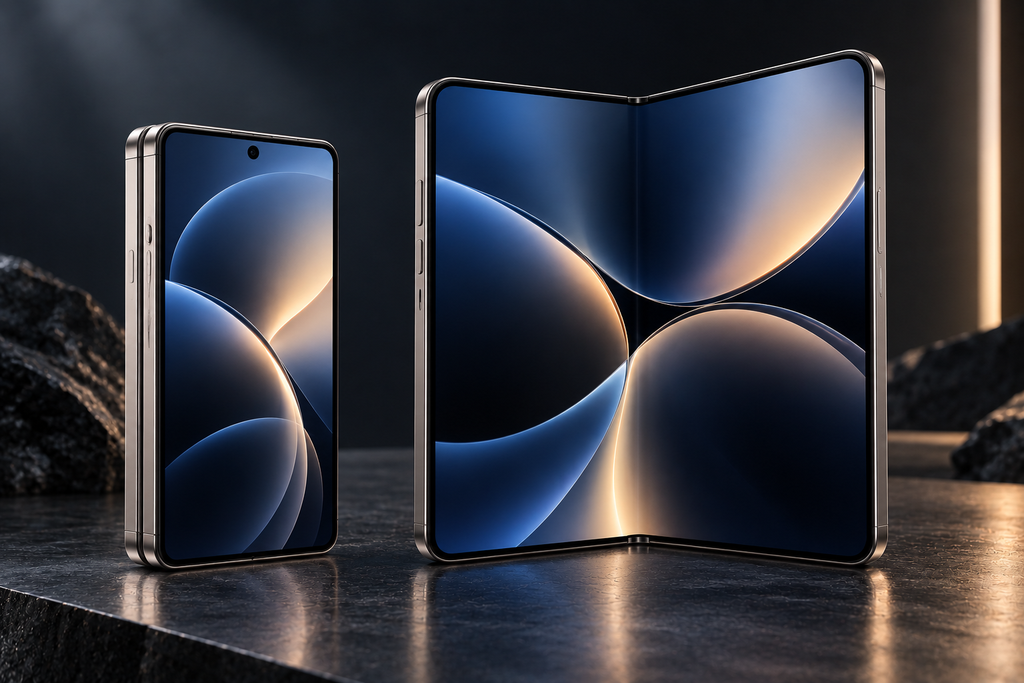
Among the many rumors surrounding Apple’s upcoming device, one detail has remained remarkably consistent: its form factor.
Most reputable reports suggest Apple is developing a book-style foldable smartphone, similar in concept to devices like Samsung’s Galaxy Z Fold series. Rather than flipping open vertically like a classic flip phone, the device is expected to unfold horizontally into a significantly larger display.
Current reports suggest the device may feature:
- Approximately 5.5-inch outer OLED display
- Around 7.8-inch inner OLED display
- Slim bezels surrounding both screens
- Nearly invisible crease compared with existing foldables
- Premium titanium frame
- Thin overall profile despite its folding mechanism
The outer display would allow users to perform everyday tasks—such as messaging, browsing, or taking calls—without opening the device. Once unfolded, the larger display could provide a tablet-like experience for multitasking, productivity, gaming, video streaming, and creative work.
If Apple succeeds in minimizing the display crease while maintaining structural durability, it could address one of the biggest criticisms facing current foldable smartphones.
Apple May Be Focusing on the Most Advanced Hinge Yet

Perhaps the most important component of any foldable smartphone is its hinge.
Unlike conventional smartphones, foldables rely on a complex mechanical system that must withstand thousands of opening and closing cycles without damaging the display or compromising structural integrity.
According to multiple reports, Apple has devoted significant engineering resources to redesigning this critical component.
Rumors suggest the hinge could incorporate advanced materials such as liquid metal alloys, known for their exceptional strength and resistance to wear. Combined with precision-machined titanium components, the hinge may provide smoother operation while reducing stress on the flexible OLED display.
Several analysts also believe Apple has focused heavily on reducing the gap between the two halves of the phone when folded. Many current foldable devices leave a noticeable wedge-shaped opening, allowing dust to accumulate over time. A tighter folding mechanism could improve durability while creating a more premium appearance.
Although Apple has not confirmed these technologies, the consistent focus on hinge improvements across multiple reports indicates that reliability remains one of the company’s highest priorities.
A Larger Display Could Transform How People Use an iPhone
One of the biggest advantages of a foldable smartphone is its ability to function as both a phone and a compact tablet.
When folded, the device behaves like a traditional smartphone, making it comfortable for one-handed use. When opened, the larger display provides considerably more screen space for productivity and entertainment.
A nearly 8-inch internal display could unlock several new possibilities:
- Running two or more apps simultaneously
- Editing documents while referencing web pages
- Enhanced gaming experiences
- Improved video conferencing
- Reading books and magazines more comfortably
- Watching movies on a significantly larger screen
- Better support for creative applications
For professionals who frequently travel, a foldable iPhone could reduce the need to carry a separate tablet for many everyday tasks.
Apple’s ecosystem—including iCloud, Continuity, AirDrop, Handoff, and Apple Intelligence—could further enhance this experience by allowing users to transition seamlessly between devices.
Apple Appears to Be Prioritizing Software as Much as Hardware
Foldable hardware alone does not guarantee a great user experience. The software must intelligently adapt as the device transitions between folded and unfolded states.
Recent reports indicate that Apple has been preparing iOS to support multiple display configurations, improved multitasking, and dynamic interface adjustments.
Developers have reportedly discovered references within newer versions of iOS that suggest Apple is expanding support for foldable form factors. While these discoveries do not confirm a specific product, they indicate that the operating system is evolving to accommodate more flexible display layouts.
If Apple introduces its first foldable iPhone, software optimization could become one of its strongest competitive advantages. Rather than simply enlarging existing apps, Apple is expected to encourage developers to create experiences that fully utilize the expanded screen, making multitasking more intuitive and productive.
Apple’s Next-Generation Performance Could Be Built Around the A20 Pro Chip
While Apple has yet to reveal the processor that will power its first foldable iPhone, industry reports suggest the device could debut with the company’s next-generation A20 Pro chipset.
If accurate, this would place the foldable alongside Apple’s highest-end flagship devices rather than positioning it as a niche experiment. Apple has historically reserved its latest silicon for premium models, and analysts believe the foldable will follow the same strategy.
The expected improvements include:
- Faster CPU performance for demanding applications
- More powerful GPU for console-quality gaming
- Improved Neural Engine for on-device AI processing
- Better thermal efficiency
- Enhanced battery optimization
Running a larger display requires additional graphics performance and efficient power management. Whether users are editing 4K videos, switching between multiple applications, or gaming on the larger internal screen, Apple’s newest processor would need to deliver sustained performance without excessive heat generation.
Apple Intelligence Could Be One of the Foldable’s Biggest Advantages
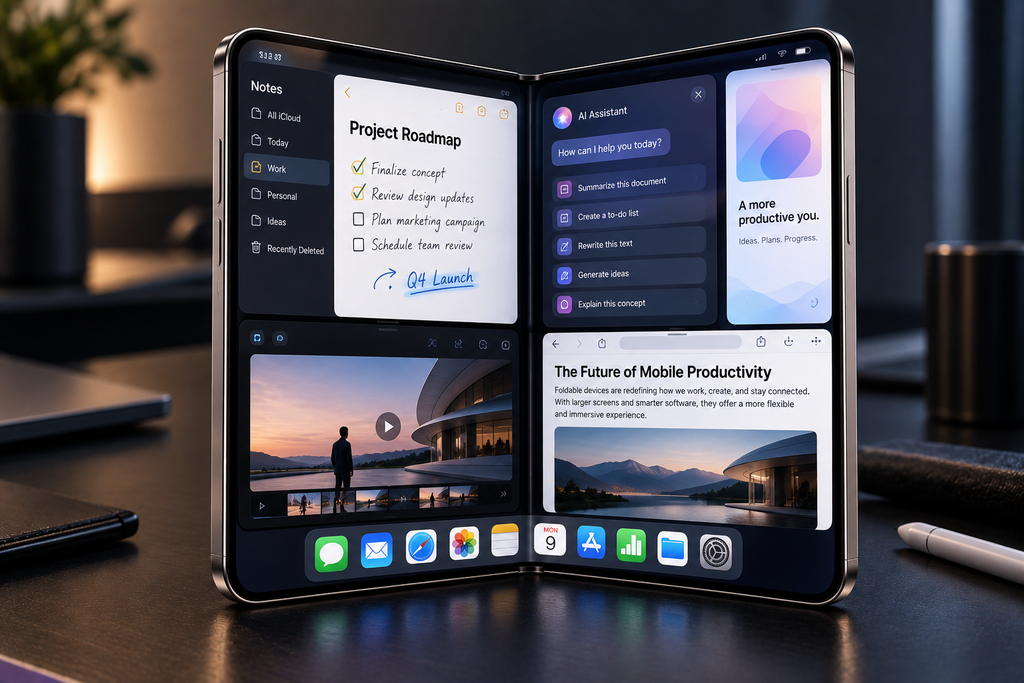
Hardware is only one part of the experience. Apple is increasingly investing in software powered by Apple Intelligence, and the foldable iPhone could become one of the best showcases for these AI features.
The larger internal display offers significantly more room for intelligent multitasking than a conventional smartphone.
Possible AI-powered experiences include:
Smarter Writing Tools
Users could draft emails while referencing documents, summarize long articles, rewrite text, or generate content without constantly switching between apps.
Visual Intelligence
The larger display may make it easier to analyze images, identify objects, translate text, or organize screenshots using on-device AI.
Productivity Assistance
Apple Intelligence could help users:
- Organize notes
- Summarize meetings
- Generate reminders
- Prioritize notifications
- Create schedules
- Assist with research
Rather than treating AI as a standalone feature, Apple is expected to integrate it deeply throughout iOS, making everyday interactions faster and more intuitive.
iOS 27 Could Introduce New Multitasking Capabilities
One of the biggest limitations of traditional smartphones is screen space. Foldable devices largely solve that problem, but only if the software takes full advantage of the additional display.
Reports suggest Apple has been expanding iOS to support features such as:
- Split-screen multitasking
- Resizable app windows
- Drag-and-drop between applications
- Improved Stage Manager-style workflows
- Better external display support
- Adaptive layouts when opening or closing the device
Imagine replying to emails while reviewing spreadsheets, watching a video during note-taking, or editing photos while browsing the web—all without repeatedly switching apps.
Apple has consistently emphasized smooth user experiences, so any multitasking features are likely to prioritize simplicity over complexity.
Could Apple Finally Bring Desktop-Class Productivity to the iPhone?
For years, users have asked whether the iPhone could replace a tablet or even a lightweight laptop for certain tasks.
A foldable model moves that idea much closer to reality.
The larger display could significantly improve workflows such as:
- Document editing
- PDF annotation
- Spreadsheet management
- Graphic design
- Video editing
- Coding
- Remote desktop access
- Presentation reviews
Professionals who travel frequently may find the foldable iPhone capable of handling many everyday tasks without requiring a second device.
Combined with cloud storage, external keyboards, and Apple’s ecosystem, the foldable could become one of the company’s most versatile mobile devices.
Camera System: Apple May Prioritize Quality Over Quantity
Foldable smartphones face a unique engineering challenge: internal space is extremely limited.
Instead of adding numerous camera sensors, Apple may choose a more balanced approach focused on image quality.
Current reports suggest the device could feature:
Rear Cameras
- 48 MP Wide Camera
- 48 MP Ultra-Wide Camera
Some reports indicate Apple may omit a dedicated telephoto camera in order to reduce thickness and simplify the internal design.
Rather than relying on additional hardware, Apple could use computational photography to deliver high-quality zoom performance.
Front Cameras
Several reports also suggest Apple may include:
- One selfie camera on the external display
- One selfie camera on the internal display
This setup would allow users to participate in video calls regardless of whether the phone is folded or unfolded.
Face ID or Touch ID? Apple May Choose a Different Direction
One of the more interesting rumors involves Apple’s biometric authentication system.
Because foldable smartphones require thinner internal components, some analysts believe Apple may replace Face ID with a side-mounted Touch ID sensor integrated into the power button.
Potential advantages include:
- Reduced internal space requirements
- Faster unlocking
- Lower power consumption
- Greater design flexibility
However, Apple has not confirmed this change, and some analysts believe Face ID could still be included if engineering challenges are resolved before production.
Until Apple officially unveils the device, this remains one of the most uncertain aspects of the rumored specifications.
Battery Life Could Improve Despite the Thin Design
Battery capacity has long been one of the biggest concerns surrounding foldable smartphones.
Larger displays naturally consume more power, yet manufacturers must fit batteries into extremely thin chassis.
Reports indicate Apple may use a dual-cell battery design, placing separate battery cells in each half of the device.
Potential benefits include:
- Better weight distribution
- Improved thermal management
- Faster charging
- Longer battery lifespan
- More efficient use of internal space
Combined with Apple’s custom silicon and software optimization, battery performance could become one of the foldable’s strongest selling points.
While exact capacity figures continue to vary across reports, Apple is expected to prioritize real-world endurance over headline specifications.
Will MagSafe Continue to Be Supported?
Earlier rumors suggested Apple’s foldable design might require removing MagSafe due to internal engineering constraints.
More recent reports, however, indicate that Apple is likely to retain MagSafe compatibility.
If true, users would continue to enjoy:
- Magnetic wireless charging
- Wallet accessories
- Battery packs
- Car mounts
- Charging stands
Maintaining compatibility with the existing MagSafe ecosystem would make upgrading considerably easier for current iPhone users.
Connectivity and Future-Proof Features
Although Apple has not announced official specifications, industry expectations include support for:
- Wi-Fi 7
- Bluetooth 6
- Ultra Wideband (UWB)
- USB-C
- Satellite Emergency SOS
- 5G Advanced connectivity
These technologies would position the foldable alongside Apple’s premium flagship lineup rather than as a separate experimental product.
How Apple’s Foldable Could Compare With Its Biggest Rivals

Apple will enter a market already occupied by several mature foldable smartphones.
Samsung Galaxy Z Fold
Samsung currently leads the foldable segment with years of experience.
Its strengths include:
- Mature multitasking software
- S Pen support (on supported models)
- Established ecosystem
- Multiple generations of refinement
Apple’s potential advantages could include:
- Tighter hardware-software integration
- Longer software support
- More powerful custom silicon
- Apple Intelligence features
- Better ecosystem continuity
Google Pixel Fold
Google focuses heavily on AI-powered software and photography.
Apple is expected to compete by emphasizing:
- Privacy
- On-device AI
- Performance efficiency
- Cross-device integration
Honor, OnePlus, and Huawei
Several Chinese manufacturers currently lead in hardware innovation, producing exceptionally thin foldables with impressive battery life.
Apple’s challenge will not necessarily be building the thinnest device—it will be delivering the most consistent overall user experience.
Why Apple’s Entry Could Change the Entire Foldable Market
Industry analysts believe Apple’s arrival could significantly accelerate adoption of foldable smartphones.
Historically, Apple’s entry into a product category has influenced consumer expectations and encouraged developers to optimize apps for new hardware.
A successful foldable iPhone could encourage:
- More optimized applications
- Increased competition
- Lower prices over time
- Faster innovation
- Greater consumer confidence in foldable technology
Even consumers who do not purchase Apple’s first foldable device may benefit as the broader market evolves in response.
How Much Could Apple’s Foldable iPhone Cost?
If there’s one aspect of Apple’s first foldable that most analysts agree on, it’s that the device will be positioned as an ultra-premium product.
Industry estimates currently place the starting price between $1,999 and $2,499, depending on storage configuration and regional pricing. That would make it the most expensive iPhone Apple has ever sold.
Why so expensive?
Unlike a traditional smartphone, a foldable device requires several costly components:
- Flexible OLED display
- Precision-engineered hinge
- Premium materials such as titanium
- Advanced internal cooling
- Larger batteries
- More complex manufacturing process
Apple is also expected to produce the device in relatively small quantities during its first generation, which increases production costs compared to mainstream iPhone models.
For many consumers, this won’t be an upgrade from a standard iPhone—it will be a luxury flagship designed for users who want cutting-edge technology and are willing to pay for it.
Expected Release Timeline
Apple has remained silent about its foldable plans, but recent reports suggest development has reached an advanced stage.
Current expectations indicate the company could unveil its first foldable iPhone during a future product event, with availability following once production reaches sufficient scale. However, exact dates remain uncertain.
Several factors could influence the launch schedule:
- Manufacturing yield rates
- Display production capacity
- Hinge quality testing
- Software readiness
- Supply chain stability
Apple has a history of delaying products if they do not meet its quality standards. Rather than rushing to market, the company typically prioritizes reliability over speed.
Because of this, launch timing should be viewed as an expectation based on industry reporting—not a confirmed schedule.
Availability May Be Limited at Launch
Even if Apple introduces its foldable iPhone soon, purchasing one immediately may prove challenging.
Analysts expect the first production run to be relatively limited due to:
- Complex manufacturing processes
- Strict quality control requirements
- Limited availability of foldable OLED panels
- Specialized hinge production
- High demand from early adopters
This would be consistent with previous Apple product launches, where initial inventory sold out quickly before production increased over the following months.
Consumers interested in the first-generation device may need to pre-order early or be prepared for longer delivery times.
Rumors vs. What We Actually Know
One of the biggest challenges with high-profile Apple products is separating credible reporting from speculation. Here’s a quick overview.
| Claim | Current Status |
|---|---|
| Apple is developing a foldable iPhone | Supported by multiple credible reports |
| Book-style foldable design | Strongly supported |
| Approximately 7.8-inch internal display | Likely, based on several analyst reports |
| Approximately 5.5-inch cover display | Likely |
| Premium hinge with advanced materials | Likely |
| A20 Pro processor | Expected but unconfirmed |
| Apple Intelligence integration | Very likely |
| Side-mounted Touch ID | Possible, but unconfirmed |
| Dual 48 MP rear cameras | Rumored |
| MagSafe support | Expected, but unconfirmed |
| Starting price around $2,000 | Industry estimate |
| Product name “iPhone Ultra” | Speculation |
| Exact launch date | Not confirmed by Apple |
This distinction is important. While many reports point in the same direction, none of these details should be considered official until Apple makes an announcement.
What Could This Mean for the Smartphone Industry?
Apple’s entry into the foldable market could have effects beyond a single product launch.
Historically, when Apple enters a new hardware category, developers, accessory makers, and competitors often adapt quickly. If a foldable iPhone becomes successful, it may encourage:
- More apps optimized for larger, flexible displays
- Increased competition among smartphone manufacturers
- Faster innovation in foldable display technology
- Improved durability standards across the industry
- Broader consumer adoption of foldable devices
Whether Apple’s device becomes an instant bestseller or a niche premium product, its arrival is likely to influence the direction of future smartphones.
Is It Worth Waiting for Apple’s Foldable iPhone?
The answer depends on your priorities.
You may want to wait if you:
- Want a larger display without carrying both a phone and tablet
- Are invested in the Apple ecosystem
- Value multitasking and productivity
- Prefer first-party hardware and long software support
- Are comfortable paying a premium for new technology
You may prefer a current flagship if you:
- Need a new phone immediately
- Want a more affordable option
- Prefer proven foldable devices with multiple generations of refinement
- Do not expect to use the larger display regularly
Apple’s first foldable is expected to target enthusiasts and professionals more than the average smartphone buyer.
Final Verdict
Apple’s rumored foldable iPhone represents one of the company’s most anticipated hardware projects in years. Rather than simply following competitors, Apple appears to be focusing on solving the challenges that have limited wider adoption of foldable smartphones—durability, software optimization, and overall user experience.
If the current reports are accurate, the device could feature a book-style design, a large internal OLED display, a refined hinge, flagship-level performance, and deep integration with Apple Intelligence. Combined with Apple’s ecosystem and long-term software support, it has the potential to become a compelling option in the premium smartphone market.
That said, it’s important to remember that many details—including the product name, final specifications, pricing, and launch timing—remain unconfirmed. Until Apple makes an official announcement, the information available today should be viewed as informed expectations rather than established facts.
For now, one thing is clear: Apple’s first foldable iPhone is shaping up to be one of the most closely watched technology launches in recent memory.
Frequently Asked Questions
1. Is Apple making a foldable iPhone?
Apple has not officially announced a foldable iPhone. However, multiple reputable analysts and supply-chain reports indicate that the company has been developing one for several years.
2. What will Apple’s foldable iPhone be called?
The official name has not been confirmed. While “iPhone Ultra” has appeared in some rumors, other reports suggest different branding. Apple has not announced a name.
3. How much will Apple’s foldable iPhone cost?
Current industry estimates suggest a starting price between $1,999 and $2,499, though Apple has not confirmed pricing.
4. Will the foldable iPhone support Apple Intelligence?
Although unconfirmed, analysts expect Apple’s latest AI features to play a major role in the foldable experience because of the larger display and multitasking capabilities.
5. When will Apple’s foldable iPhone launch?
Apple has not announced a launch date. Industry reports suggest a release could happen in the near future, but timing remains subject to production and development progress.
Conclusion
Apple’s first foldable iPhone has generated significant interest because it represents more than just another smartphone—it signals a possible shift in how future iPhones are designed and used. While many questions remain unanswered, the steady stream of credible reports suggests Apple is taking a deliberate approach to entering the foldable market.
If the company delivers on expectations, its first foldable could become a benchmark for premium smartphones, blending innovative hardware with polished software and a mature ecosystem. Until then, prospective buyers and Apple enthusiasts should follow official announcements and treat ongoing leaks as evolving reports rather than confirmed specifications.
External links:
- Apple Newsroom (Official)
- https://www.apple.com/newsroom/
- Use for: Official Apple announcements and product updates.
- MacRumors – iPhone Fold Rumor Guide
- https://www.macrumors.com/roundup/foldable-iphone/
- Use for: Ongoing coverage of credible analyst reports and supply-chain leaks.
- Display Supply Chain Consultants (DSCC)
- https://www.displaysupplychain.com/
- Use for: Display industry analysis and foldable OLED market insights.
- Counterpoint Research
- https://www.counterpointresearch.com/
- Use for: Smartphone market trends, premium device analysis, and foldable market forecasts.
- IDC – Worldwide Mobile Phone Tracker
- https://www.idc.com/promo/smartphone-market-share
- Use for: Global smartphone shipment data and foldable market growth trends.
Internal Links
- AI News →
/artificial-intelligence/ - Tech News →
/tech-news/ - Reviews →
/reviews-buying-guides/