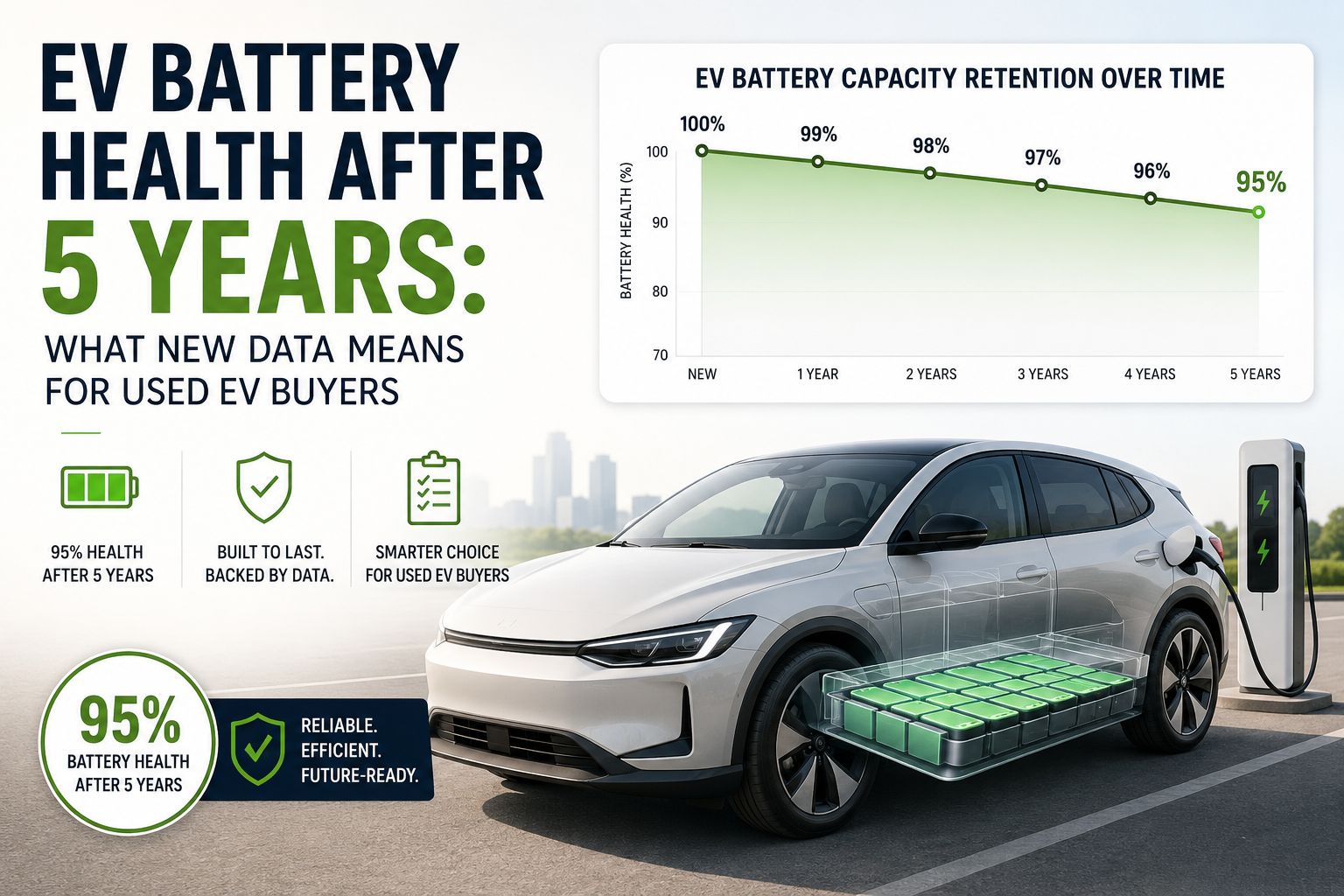
Electric vehicles (EVs) have rapidly evolved over the past decade, but one concern has consistently influenced buying decisions: battery longevity. Many prospective buyers worry that a five-year-old EV may have lost a significant portion of its battery capacity, resulting in reduced driving range and expensive replacement costs. However, newly released real-world battery data is changing that perception.
Studies conducted on thousands of electric vehicles reveal that modern EV batteries retain approximately 95% of their original capacity after five years of regular use. This means today’s EVs are proving to be far more durable than many early critics predicted, making the used EV market increasingly attractive for budget-conscious buyers.
Battery Health Has Improved Significantly
Advancements in battery chemistry, thermal management systems, and intelligent charging software have dramatically reduced battery degradation. Earlier generations of EVs experienced faster capacity loss due to heat and limited battery management technology. Modern vehicles, however, continuously monitor battery temperature and charging cycles, helping preserve long-term performance.
For most drivers, a battery retaining 95% capacity means almost no noticeable difference in everyday driving.
What Does 95% Battery Health Mean?
Imagine purchasing a new electric vehicle with an official driving range of 400 km. After five years, if the battery retains 95% of its capacity, the expected range would still be around 380 km. For most daily commuters, this difference is hardly noticeable.
The battery also continues to support fast charging, regenerative braking, and overall vehicle performance with minimal impact during the early years of ownership.
Why Used EV Buyers Should Be Optimistic
The latest battery health data is excellent news for buyers looking to save money by purchasing a pre-owned electric vehicle. Unlike traditional gasoline vehicles, EVs have fewer moving mechanical parts, meaning maintenance costs are generally lower. If the battery remains in good condition, a five-year-old EV can still provide years of reliable service.
Many automakers now offer battery warranties of 8 years or 160,000 km, giving additional confidence to second-hand buyers.
What to Check Before Buying a Used EV
Although the latest data is encouraging, buyers should still inspect the battery before making a purchase. Request a Battery State of Health (SoH) report if available, review the service history, and confirm whether the battery warranty is still active.
It is also helpful to ask about charging habits. Vehicles that were mostly charged using slower AC chargers often experience less battery stress than those that relied heavily on frequent DC fast charging.
What Affects Battery Degradation?
Several factors influence how quickly an EV battery ages. High ambient temperatures, repeated fast charging, and consistently charging to 100% can accelerate wear. On the other hand, moderate charging habits, avoiding deep discharges, and keeping the battery between 20% and 80% for everyday driving can significantly extend battery life.
Modern battery management systems automatically protect the battery from many harmful conditions, making today’s EVs much more resilient than earlier models.
Is a Five-Year-Old EV Worth Buying?
For many consumers, the answer is yes. The latest battery retention data suggests that fears surrounding battery degradation are often overstated. A well-maintained EV with 95% battery health can still deliver excellent range, lower running costs, and dependable performance while costing considerably less than a brand-new model.
As electric vehicle technology continues to improve, the used EV market is becoming one of the smartest places for buyers to find value.
Final Thoughts
The newest battery health reports provide reassuring evidence that modern EV batteries are built to last. With around 95% battery capacity remaining after five years, today’s electric vehicles offer far better long-term reliability than many people expected.
For anyone considering a used electric vehicle, battery degradation should no longer be viewed as an automatic deal-breaker. Instead, focus on battery health reports, maintenance records, and warranty coverage. A carefully selected used EV can provide excellent performance, significant savings, and a smooth transition into electric mobility.
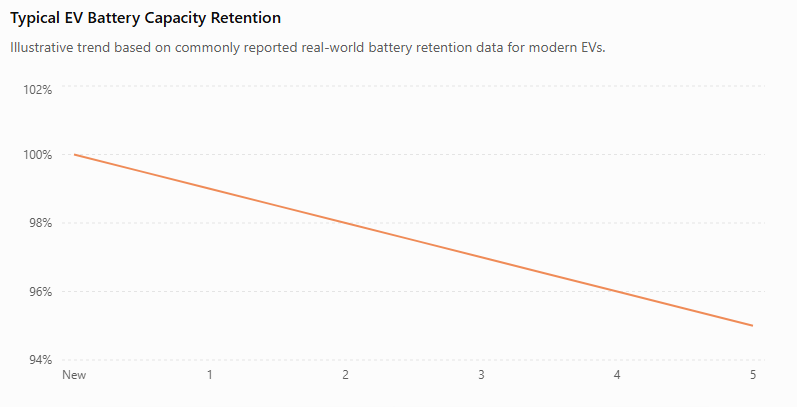
Typical EV Battery Capacity Retention
Illustrative trend based on commonly reported real-world battery retention data for modern EVs.
| year | capacity |
|---|---|
| New | 100 |
| 1 | 99 |
| 2 | 98 |
| 3 | 97 |
| 4 | 96 |
| 5 | 95 |
Related Articles
- Best Budget Smartwatches 2026: Under $100 Picks That Don’t Feel Cheap
- Garmin vs Apple Watch vs Fitbit: Which Smartwatch Deal Is Actually Worth Buying
- Best Power Banks 2026: Fast Charging, Multi-Port, and Travel-Friendly Picks
- Anker Nano Power Bank Review: Is the 10,000mAh Pick Still Worth It?
- Samsung Galaxy Z Fold 8 Ultra: Everything We Know Ahead of Unpacked London