Have you ever been in the middle of an important phone call, navigating an unfamiliar city, or capturing memorable travel moments when your smartphone suddenly ran out of battery? In today’s connected world, our smartphones, tablets, wireless earbuds, smartwatches, and even laptops have become essential tools for work and daily life. Unfortunately, battery life often doesn’t last as long as we need it to. This is where a reliable power bank becomes one of the most valuable accessories you can own.
However, choosing the right power bank is not as straightforward as buying the one with the highest battery capacity or the lowest price. The market is filled with hundreds of options, each claiming to offer the fastest charging speeds and the biggest battery backup. Without understanding the key features, it’s easy to end up with a product that charges slowly, has poor battery efficiency, or lacks the safety features necessary to protect your expensive devices.
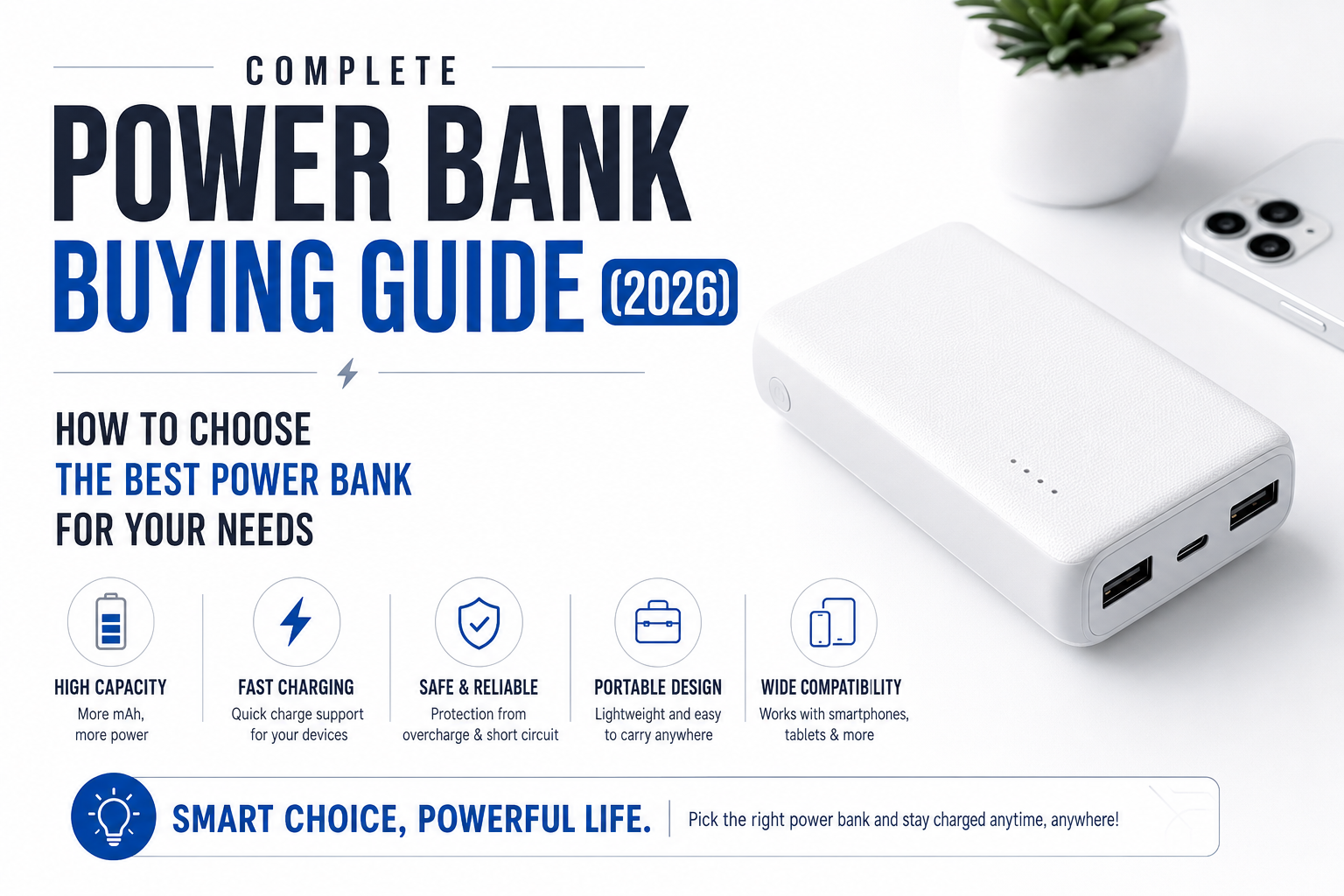
This complete buying guide will explain everything you need to know before purchasing a power bank. From battery capacity and charging speed to safety certifications and airline travel regulations, this guide will help you make an informed decision and choose a power bank that perfectly matches your needs.

Why You Need a Power Bank
Modern smartphones have become incredibly powerful. High-resolution AMOLED displays, 5G connectivity, GPS navigation, mobile gaming, video streaming, and social media apps all consume a significant amount of battery power throughout the day. Even flagship smartphones with large batteries often struggle to last through heavy usage. A power bank serves as a portable energy source that allows you to recharge your devices wherever you are, eliminating the anxiety of searching for a power outlet.
Power banks are particularly useful for travelers, students, office professionals, photographers, content creators, campers, and anyone who spends long hours away from home. Whether you’re on a business trip, attending college, hiking in the mountains, or waiting during a long airport layover, a dependable power bank ensures your devices remain powered when you need them most.
Understanding Battery Capacity
The first specification most buyers notice is battery capacity, which is measured in milliamp-hours (mAh). While this number gives a general idea of how much energy a power bank can store, it should not be the only factor influencing your purchase decision.
A compact 5,000mAh power bank is suitable for emergency charging and usually provides approximately one full smartphone charge. It is lightweight and easy to carry, making it ideal for users who only need occasional backup power.
The most popular option is a 10,000mAh power bank, which strikes an excellent balance between portability and battery life. Most modern smartphones can be charged approximately two to three times with a quality 10,000mAh model, making it perfect for students, office workers, and daily commuters.
For frequent travelers or users carrying multiple devices, a 20,000mAh power bank offers significantly more backup. It can recharge most smartphones four to five times and even provide enough power for tablets during long trips.
If you frequently travel, camp outdoors, or need to charge laptops, cameras, or several devices simultaneously, power banks with capacities of 30,000mAh or higher are worth considering. Although these models are larger and heavier, they provide exceptional battery life and extended usability.
Why the Advertised Capacity Isn’t the Actual Capacity
One of the biggest misconceptions among buyers is believing that a 10,000mAh power bank delivers exactly 10,000mAh to a smartphone. In reality, every power bank experiences energy loss during voltage conversion, heat generation, internal circuitry operation, and cable resistance. As a result, most high-quality power banks deliver between 60% and 75% of their advertised capacity.
For example, a 10,000mAh power bank typically provides around 6,500 to 7,500mAh of usable energy. This is completely normal and should not be mistaken for a manufacturing defect. Understanding this difference helps buyers set realistic expectations before making a purchase.
Charging Speed Is More Important Than Ever
Battery capacity determines how long a power bank lasts, but charging speed determines how quickly your devices are ready to use again. Modern smartphones support advanced fast-charging technologies that dramatically reduce charging times. Choosing a power bank with these technologies ensures you spend less time waiting and more time using your devices.
Technologies such as USB Power Delivery (PD), Qualcomm Quick Charge (QC), PPS, Samsung Super Fast Charging, and Apple Fast Charging allow compatible smartphones to reach approximately 50 percent battery in around thirty minutes under ideal conditions. If your phone supports fast charging, your power bank should support it as well; otherwise, you’ll miss out on one of its biggest advantages.
Understanding Output Power
Many buyers confuse battery capacity with charging power. While capacity determines how much energy is stored, output power determines how quickly that energy can be delivered to your device.
Basic power banks offering 10W output are suitable for simple charging but are relatively slow by today’s standards. Models with 18W or 20W output provide excellent performance for most smartphones. If you own tablets, gaming devices, or lightweight laptops, consider power banks offering 30W, 45W, or even 65W USB-C Power Delivery. High-output power banks are capable of charging compatible laptops, gaming handhelds, and premium tablets efficiently, making them a versatile investment for professionals and travelers alike.
USB-C Has Become the New Standard


The charging industry has rapidly shifted toward USB-C, and for good reason. Compared to traditional USB-A ports, USB-C supports much faster charging speeds, higher power delivery, reversible connectors, and improved compatibility with modern devices. Many premium smartphones, tablets, laptops, and accessories now rely entirely on USB-C for charging.
When purchasing a new power bank, choosing one that includes USB-C input and output ports is highly recommended. Not only will it charge your devices faster, but it will also future-proof your purchase as more manufacturers continue adopting USB-C technology.
Should You Buy a Wireless Charging Power Bank?
Wireless charging power banks have become increasingly popular, especially among users who appreciate convenience. These models allow compatible smartphones to recharge simply by placing the device on top of the power bank without connecting any cables.
Although wireless charging is extremely convenient, it is generally slower and less energy-efficient than wired charging. Some energy is lost through heat during wireless charging, meaning charging sessions take longer. For this reason, wired charging remains the preferred option when speed is your priority, while wireless charging serves as an excellent feature for casual everyday use.
Don’t Ignore How Fast the Power Bank Recharges
Another important factor many buyers overlook is the charging speed of the power bank itself. A large-capacity power bank that takes twelve hours to recharge can become frustrating during frequent travel.
Older models using slow charging may require an entire night to recharge fully, whereas modern USB-C Power Delivery power banks can often recharge in just three to five hours. If you plan to use your power bank regularly, investing in a model that supports fast input charging will save significant time and improve your overall experience.
Safety Features Matter More Than Price
A power bank stores a considerable amount of electrical energy, making safety one of the most important purchasing considerations. While low-cost, unbranded products may seem attractive, they often lack proper protection systems that safeguard both the power bank and your connected devices.
A quality power bank should include protection against overcharging, overcurrent, overheating, short circuits, overvoltage, and excessive discharge. These safety systems help prevent battery damage, extend product lifespan, and significantly reduce the risk of electrical failures. Spending slightly more on a trusted manufacturer is a worthwhile investment when it comes to protecting expensive smartphones, tablets, and laptops.
Build Quality and Portability
Build quality directly influences how long a power bank will last. Premium models typically feature durable ABS plastic or aluminum alloy housings that resist scratches, dissipate heat efficiently, and withstand everyday wear and tear. Well-built ports also maintain a secure connection after thousands of charging cycles.
Portability is equally important. While higher-capacity power banks provide more charging cycles, they are also heavier. A 10,000mAh power bank is usually compact enough to fit comfortably into a pocket or small bag, making it ideal for daily commuting. Larger 20,000mAh or 30,000mAh models are better suited for travel, road trips, or situations where extended battery backup is more important than portability.
Traveling with a Power Bank
Power banks are generally permitted on commercial flights, but there are important regulations to keep in mind. Most airlines require passengers to carry power banks in their cabin baggage rather than checked luggage because lithium-ion batteries pose potential fire risks if stored in cargo compartments. Additionally, many airlines allow power banks up to 100Wh without requiring special approval. If you travel internationally, it is always advisable to review your airline’s current battery policies before your journey.
Choosing the Right Power Bank for Your Needs
There is no single “best” power bank for everyone. The ideal choice depends entirely on your usage habits. Casual users who only need occasional backup will be well served by a 10,000mAh model. Students and office professionals benefit from either 10,000mAh or 20,000mAh capacities depending on daily usage. Travelers and photographers often prefer 20,000mAh or larger models because they can recharge multiple devices over several days without needing a wall charger. Laptop users should prioritize USB-C Power Delivery models capable of delivering at least 65W of output for reliable charging.
Common Mistakes Buyers Make
Many people purchase a power bank solely based on battery capacity or price, overlooking important factors such as charging speed, USB-C compatibility, build quality, and safety certifications. Others assume every power bank supports laptop charging or fast charging without checking the technical specifications. These mistakes often result in disappointing performance and unnecessary replacement costs. Taking a few extra minutes to compare specifications before buying can save money and ensure a much better user experience.
Final Verdict
A power bank has evolved from a simple travel accessory into an everyday essential for millions of people. Whether you’re commuting to work, attending college, exploring new destinations, or working remotely, having reliable backup power provides peace of mind and keeps your devices running when you need them most.
Rather than focusing only on the advertised battery capacity, consider the complete package. Look for a model with USB-C Power Delivery, fast charging support, high-quality battery cells, strong safety protections, durable construction, and enough capacity to match your daily routine. For most users, a 10,000mAh or 20,000mAh power bank offers the best combination of portability, performance, and value. Those who frequently charge laptops or multiple devices should invest in a higher-capacity model with at least 65W USB-C output.
Choosing the right power bank is an investment in convenience, reliability, and productivity. By understanding the features discussed in this guide, you can confidently select a power bank that will keep your devices powered wherever your day takes you.