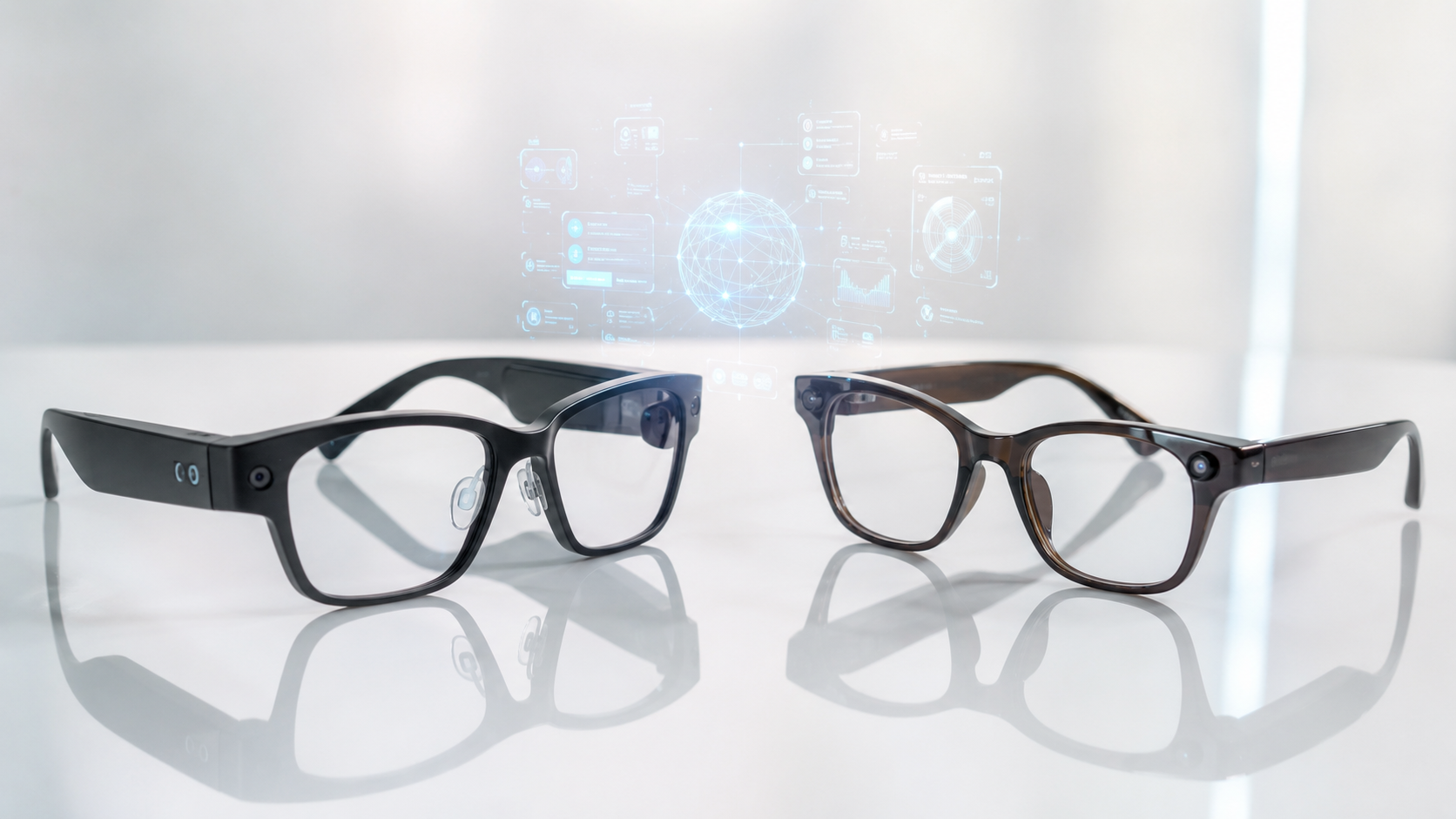
Samsung has officially entered the AI smart glasses market.
After months of previews, the company showcased its first Galaxy intelligent eyewear during Galaxy Unpacked 2026, confirming partnerships with Google, Warby Parker, and Gentle Monster. Rather than chasing full augmented reality, Samsung is focusing on lightweight AI-powered glasses designed for everyday use.
That strategy immediately places Samsung against the current category leader: Meta Ray-Ban Smart Glasses.
In this guide, we’ll explain what Samsung officially announced, how the hardware compares with Meta’s offering, where Gemini AI fits into the experience, and whether Samsung has a realistic chance of becoming the next major player in wearable AI.
Samsung Galaxy Glasses at a Glance
Samsung’s new wearable is not an AR headset like Vision Pro.
Instead, it’s an AI-powered pair of smart glasses designed to look like normal eyewear while providing voice assistance, camera functions, translations, navigation, messaging, and contextual AI.
The company developed the glasses alongside Google while fashion brands Warby Parker and Gentle Monster created premium frame designs. Samsung says the goal is to make AI feel natural instead of forcing users to constantly reach for their phones. (news.samsung.com)
Officially Confirmed
| Feature | Status |
|---|---|
| Gemini AI integration | ✅ Confirmed |
| Snapdragon AR1 platform | ✅ Confirmed |
| Android XR platform | ✅ Confirmed |
| Camera | ✅ Confirmed |
| Speakers & microphones | ✅ Confirmed |
| Warby Parker frames | ✅ Confirmed |
| Gentle Monster frames | ✅ Confirmed |
| Fall 2026 launch | ✅ Confirmed |
| Price | ❌ Not announced |
| Display inside lenses | ❌ Not confirmed |
Source Reliability
| Information | Reliability |
|---|---|
| Samsung announcement | High |
| Google partnership | High |
| Snapdragon AR1 | High |
| Pricing rumors | Low |
Voltixaz Analysis
Samsung’s biggest decision wasn’t adding more technology—it was adding less. By avoiding bulky AR displays, the company has prioritized comfort, battery life, and everyday wearability. That approach mirrors what’s currently working for Meta rather than repeating the mistakes of early smart glasses.
Hardware and AI Features
Samsung confirmed several core capabilities that position Galaxy Glasses as an AI companion rather than a replacement for your smartphone.
Expected features include:
- Voice conversations with Gemini
- Live translation
- Navigation assistance
- Camera for photos and AI vision
- Hands-free messaging
- Notification summaries
- Context-aware assistance
- Point-of-view video sharing during calls (news.samsung.com)
The glasses run on Qualcomm’s Snapdragon AR1 Gen 1, a processor specifically built for lightweight smart glasses where battery efficiency is more important than raw computing power. (theverge.com)
Voltixaz Analysis
This isn’t about replacing your phone. Samsung is trying to reduce the number of times you need to look at your phone throughout the day. If Gemini can answer questions, summarize notifications, translate signs, and help with navigation using voice alone, the glasses become a convenience device rather than another screen competing for attention.
Snapdragon AR1 Explained
Most smartphones use chips designed for powerful graphics and multitasking.
Smart glasses have different priorities:
- Minimal heat
- Lightweight hardware
- Long battery life
- Always-listening microphones
- Fast AI processing
- Efficient camera handling
That’s exactly what Snapdragon AR1 was designed for.
Instead of rendering complex 3D graphics, it focuses on AI workloads, image processing, and voice interactions while consuming much less power than a traditional smartphone processor. This is also the chip powering Meta’s latest smart glasses. (theverge.com)
Voltixaz Analysis
Choosing Snapdragon AR1 suggests Samsung isn’t chasing futuristic demos. It’s building around today’s most practical AI experiences—voice, vision, and context—which are already proving useful on competing devices.
Samsung Galaxy Glasses vs Meta Ray-Ban
| Feature | Samsung Galaxy Glasses | Meta Ray-Ban |
|---|---|---|
| AI Assistant | Gemini + Bixby | Meta AI |
| Chip | Snapdragon AR1 | Snapdragon AR1 |
| Operating Platform | Android XR | Meta Platform |
| Camera | Yes | Yes |
| Speakers | Yes | Yes |
| Live Translation | Yes | Limited |
| Navigation | Gemini | Meta AI |
| Fashion Partners | Warby Parker, Gentle Monster | Ray-Ban |
| Launch | Fall 2026 | Available now |
Meta currently benefits from years of software refinement and a mature ecosystem.
Samsung’s advantage comes from its partnership with Google, giving users direct access to Gemini and deeper Android integration.
Voltixaz Analysis
The real competition isn’t camera quality.
It’s AI quality.
If Gemini consistently provides more useful answers, understands context better, and integrates deeply with Android apps, Samsung could quickly become the preferred option for Android users.
What Is Still Unknown?
Samsung deliberately avoided discussing several important details during Galaxy Unpacked.
These include:
- Retail pricing
- Battery specifications beyond early estimates
- Storage capacity
- Camera resolution
- Regional availability
- Prescription lens support
- Developer SDK timeline
Those details are expected closer to launch later this year. (theverge.com)
Voltixaz Analysis
This is normal for first-generation hardware previews. Samsung wants developers and consumers to understand the vision first while leaving pricing discussions until manufacturing and regional plans are finalized.
Pros & Cons
Pros
- Premium fashion-focused designs
- Gemini AI integration
- Android XR platform
- Lightweight form factor
- Snapdragon AR1 efficiency
- Strong Android ecosystem potential
Cons
- No pricing yet
- Limited real-world testing
- First-generation product
- Availability limited initially
- Camera privacy concerns remain
Who Should Buy?
Samsung Galaxy Glasses could be a good choice for:
- Android users invested in Galaxy devices
- Frequent travelers needing translation
- Professionals who use voice assistants daily
- Early adopters of AI wearables
- Users wanting hands-free photography and navigation
Who Should Skip?
You may want to wait if:
- You primarily use an iPhone
- You expect full augmented reality displays
- You need prescription compatibility immediately
- You prefer waiting for second-generation hardware
- Budget is your biggest concern until pricing is announced
Expert Tips
- Wait for independent battery tests before purchasing.
- Compare Gemini’s AI performance against Meta AI rather than hardware specifications alone.
- Check privacy settings carefully before enabling camera features.
- If you already own Ray-Ban Meta glasses, compare software ecosystems before upgrading.
- Look for prescription lens availability if you wear glasses daily.
Common Misconceptions
“These are AR glasses.”
Not exactly.
Samsung has not confirmed transparent AR displays. These are AI smart glasses focused on voice, cameras, and contextual assistance.
“They replace your smartphone.”
No.
Samsung describes them as companion devices that extend the Galaxy ecosystem rather than replace a phone. (samsungmobilepress.com)
Samsung’s first Galaxy Glasses represent one of the company’s most significant AI hardware launches since Galaxy AI debuted on smartphones.
Instead of pursuing futuristic augmented reality that remains expensive and niche, Samsung is betting on practical intelligence—voice assistance, contextual awareness, live translation, and hands-free interaction—all inside frames that resemble ordinary eyewear.
Whether that strategy succeeds will depend less on the hardware and more on Gemini’s ability to provide genuinely useful everyday assistance. Meta currently leads the category through experience and ecosystem maturity, but Samsung’s partnership with Google gives it a credible opportunity to challenge that position, particularly for Android users.
If Samsung delivers competitive pricing, reliable battery life, and polished AI experiences at launch, Galaxy Glasses could become one of the most important wearable devices of 2026.
Frequently Asked Questions
1. What are Samsung Galaxy Glasses?
Samsung Galaxy Glasses are AI-powered smart glasses developed with Google that offer voice assistance, navigation, translation, messaging, and camera features.
2. Do they have augmented reality displays?
Samsung has not officially confirmed built-in AR displays.
3. Which AI assistant do they use?
The glasses support Google Gemini, with Samsung also highlighting Bixby compatibility.
4. What processor powers them?
Qualcomm’s Snapdragon AR1 Gen 1 platform.
5. When will they launch?
Samsung says the first collections are scheduled for Fall 2026 in select markets. (news.samsung.com)
6. How do they compare with Meta Ray-Ban?
Samsung emphasizes Gemini AI and Android integration, while Meta benefits from a more mature smart-glasses ecosystem.
7. Has Samsung announced pricing?
No. Pricing has not yet been revealed.
8. Can they translate languages?
Yes. Samsung confirmed real-time translation features powered by AI. (news.samsung.com)
9. Will they work without a phone?
Samsung positions them as companion devices designed to work with a smartphone.
10. Should I wait before buying?
If you value independent reviews, battery testing, and pricing details, waiting until launch is the safer decision.