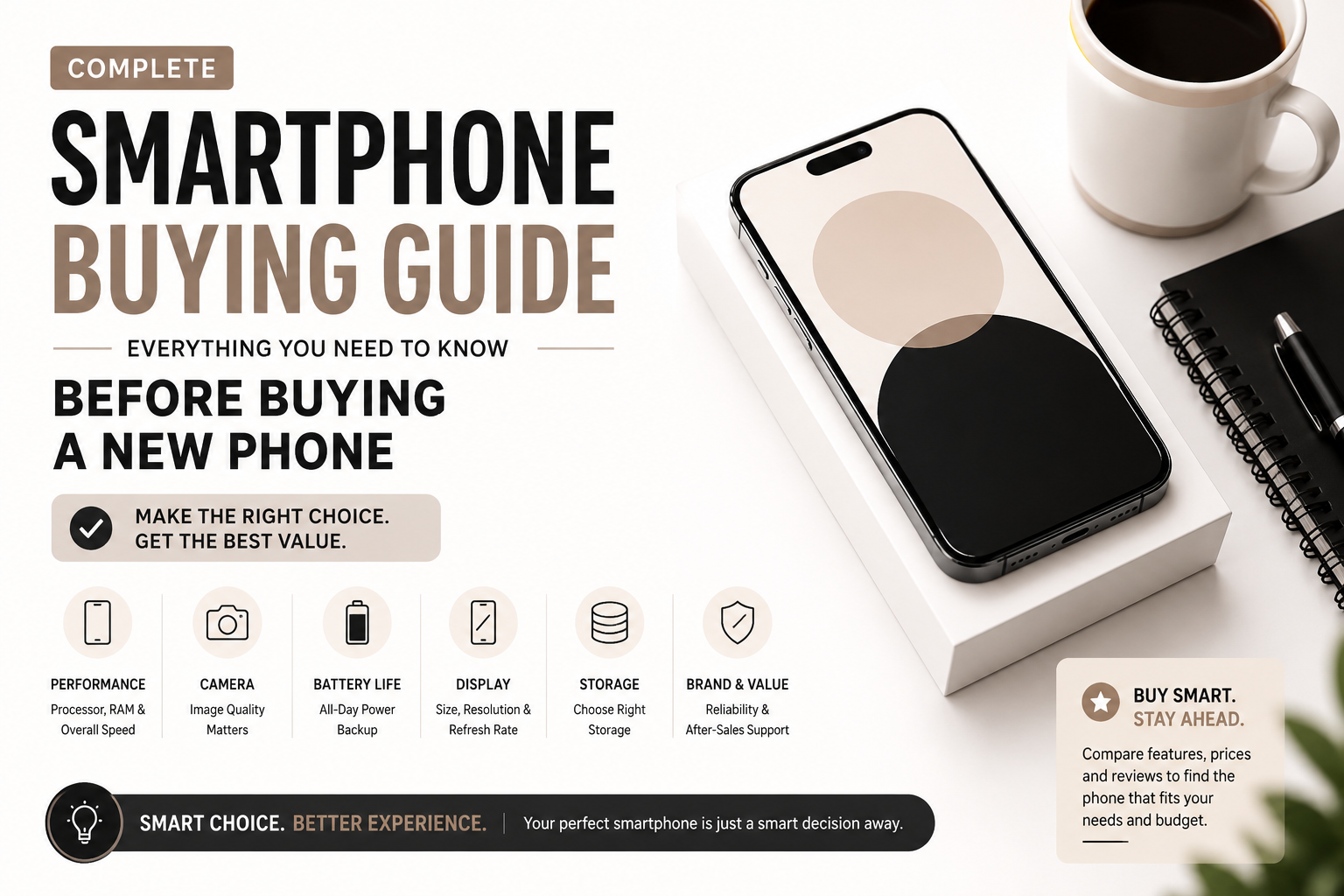
Buying a new smartphone has become more confusing than ever. With hundreds of models available from brands like Apple, Samsung, Google, OnePlus, Xiaomi, Motorola, Vivo, Oppo, and Nothing, choosing the right device can feel overwhelming. Every manufacturer claims to offer the best camera, the fastest processor, and the longest battery life, but not every smartphone is suitable for every user. The best phone for a mobile gamer may not be the best choice for a photographer, business professional, or casual user.
A smartphone is no longer just a communication device. It has become your camera, entertainment system, digital wallet, navigation device, office, gaming console, and personal assistant. Since most people keep their phones for three to five years, choosing the right one is an important investment. This complete smartphone buying guide will help you understand every important feature so you can confidently choose the perfect smartphone for your needs and budget.
Why Choosing the Right Smartphone Matters
Most people replace their smartphones every few years. During that time, the device becomes an essential part of daily life. Whether you’re working remotely, attending online classes, managing finances, capturing memories, or staying connected with family and friends, your smartphone plays a central role. Buying the wrong phone can lead to poor performance, short battery life, slow software updates, or disappointing camera quality. Taking the time to understand the important specifications will help you avoid expensive mistakes.
Determine Your Budget First
Before comparing specifications, establish a realistic budget. Smartphones are available in every price category, and understanding what you can expect at each price range makes shopping much easier.
Budget smartphones usually provide excellent value for basic tasks such as web browsing, video streaming, social media, and messaging. Mid-range smartphones often include premium features like AMOLED displays, fast charging, excellent cameras, and powerful processors. Flagship smartphones deliver the best performance, premium materials, professional cameras, and years of software support, making them ideal for users who want the latest technology.
Instead of stretching your budget for features you may never use, focus on finding the phone that offers the best balance between price and performance.
Choose the Right Operating System
The first major decision is choosing between Android and iPhone.
Android smartphones offer tremendous flexibility, a wide variety of manufacturers, customizable software, and options across every budget. Users can personalize their home screens, install third-party applications, and choose from countless hardware designs.
Apple’s iPhone provides a highly polished experience with smooth performance, excellent security, regular software updates, and seamless integration with products like the Apple Watch, iPad, and MacBook. Although iPhones generally cost more, they also retain their value longer and receive software updates for many years.
The best operating system depends on your personal preferences and the devices you already own.
Display Quality Makes a Huge Difference
The display is the feature you’ll interact with every day, making it one of the most important considerations.
Modern smartphones generally use LCD or AMOLED displays. AMOLED screens produce deeper blacks, richer colors, higher contrast, and improved battery efficiency because individual pixels can turn off completely. They also provide a more premium viewing experience when watching videos or gaming.
Screen resolution also matters. Full HD+ displays are ideal for most users, while Quad HD displays provide sharper images on premium devices. Higher refresh rates such as 90Hz or 120Hz create smoother scrolling, animations, and gaming compared to traditional 60Hz displays.
If you spend hours using your phone every day, investing in a quality display significantly improves the overall experience.
Performance Depends on the Processor
The processor acts as the brain of your smartphone. It determines how quickly applications open, how smoothly games run, and how efficiently multitasking is handled.
Premium processors like the latest Snapdragon, Apple A-series, Google Tensor, and MediaTek Dimensity flagship chips deliver outstanding performance for gaming, photography, artificial intelligence, and demanding applications. Mid-range processors are more than capable of handling everyday tasks such as web browsing, streaming, social media, and office work without noticeable slowdowns.
Unless you’re a heavy gamer or professional content creator, a modern mid-range processor is usually sufficient for several years of reliable performance.
RAM and Storage Should Match Your Usage
RAM allows your smartphone to keep multiple applications running simultaneously. More RAM improves multitasking and prevents apps from constantly reloading.
For most users, 8GB of RAM provides an excellent balance between performance and value. Power users, gamers, and professionals may benefit from 12GB or even 16GB of RAM.
Storage capacity is equally important because many smartphones no longer support expandable microSD cards. If you primarily use cloud storage and stream media, 128GB is generally enough. However, if you frequently record 4K videos, download games, or store thousands of photos, choosing 256GB or 512GB can help avoid running out of space in the future.
Camera Quality Is About More Than Megapixels
Many advertisements emphasize megapixel counts, but megapixels alone do not determine camera quality. Factors such as sensor size, image processing, optical image stabilization, aperture, autofocus, and software optimization have a much greater impact on photo quality.
A smartphone with a well-optimized 50MP camera can often outperform another device advertising a 200MP sensor. When comparing smartphones, look beyond marketing numbers and consider real-world image quality, low-light performance, video stabilization, portrait photography, and color accuracy.
If photography is important to you, reading camera reviews and viewing sample images before purchasing is highly recommended.
Battery Life Is Essential
Battery capacity is measured in milliamp-hours (mAh), but larger numbers do not always guarantee longer battery life. Processor efficiency, display technology, software optimization, and refresh rate all influence battery performance.
Most modern smartphones include batteries between 4,500mAh and 6,000mAh, which comfortably last an entire day under typical usage. Heavy users should prioritize phones with efficient processors and larger batteries to avoid frequent charging.
Fast Charging Saves Valuable Time
Fast charging has become one of the most useful smartphone features. Instead of waiting several hours for a full charge, many modern smartphones can recharge from nearly empty to around 50% in less than thirty minutes.
Charging speeds vary significantly between manufacturers. Some devices support 25W charging, while others exceed 100W. If you travel frequently or use your phone extensively throughout the day, fast charging can greatly improve convenience.
Wireless charging is another useful premium feature that offers cable-free convenience, although it is generally slower than wired charging.
Build Quality and Durability
Premium smartphones often feature aluminum frames, Gorilla Glass protection, and water-resistant designs. These materials improve durability while giving the phone a more premium appearance.
Many flagship devices carry IP67 or IP68 ratings, meaning they can survive accidental exposure to water and dust. If you frequently travel or work outdoors, choosing a phone with certified water resistance provides additional peace of mind.
Software Updates and Security
A smartphone is only as good as its software support. Regular operating system updates introduce new features, improve security, and extend the useful life of your device.
Manufacturers like Apple, Samsung, and Google currently offer some of the industry’s longest software support periods, making them excellent long-term investments. Choosing a smartphone with several years of guaranteed updates ensures your device remains secure and compatible with future applications.
Connectivity Features
Modern smartphones support technologies such as 5G, Wi-Fi 6 or Wi-Fi 7, Bluetooth 5.3 or later, NFC for contactless payments, and USB-C connectivity. While not every user requires every feature, investing in a future-ready device helps extend its lifespan and compatibility with upcoming technologies.
Should You Buy a Foldable Smartphone?
Foldable smartphones have introduced an exciting new category, combining the portability of a phone with the larger display of a tablet. They are excellent for multitasking, productivity, and entertainment. However, they remain more expensive than traditional smartphones and may not be necessary for every user. Unless you specifically need the larger folding display, conventional smartphones continue to provide better overall value.
Common Mistakes to Avoid
Many buyers focus only on camera megapixels, battery capacity, or processor names while ignoring equally important factors such as software support, display quality, charging speed, and storage. Others purchase the cheapest available option only to replace it much sooner than expected. Comparing the complete package rather than a single specification leads to much greater long-term satisfaction.
Which Smartphone Is Right for You?
The ideal smartphone depends entirely on your lifestyle. Students usually benefit from mid-range devices offering excellent battery life and reliable performance. Business professionals should prioritize software reliability, security, and long-term updates. Mobile gamers need powerful processors, high-refresh-rate displays, and advanced cooling systems. Photography enthusiasts should focus on camera quality, image processing, and video capabilities. Travelers often appreciate long battery life, water resistance, and excellent GPS performance.
Understanding your own priorities makes it much easier to select the right device without overspending.
Final Verdict
Choosing the perfect smartphone requires looking beyond flashy advertisements and impressive specification sheets. Instead of focusing on a single feature, evaluate the complete experience, including display quality, processor performance, battery life, charging speed, software support, camera performance, storage, and build quality.
For most users, a well-balanced mid-range smartphone offers outstanding value and easily handles everyday tasks for several years. Those seeking professional photography, advanced gaming performance, or premium design may find a flagship smartphone worth the additional investment.
By carefully considering your needs, budget, and long-term usage, you can confidently purchase a smartphone that delivers excellent performance, lasting reliability, and exceptional value for years to come.