Running out of battery at the worst possible moment is something almost everyone has experienced. Whether you’re attending online meetings, traveling, working remotely, gaming on your phone, or simply navigating with GPS, a reliable power bank has become an essential everyday accessory.
Modern smartphones are more powerful than ever, but battery technology hasn’t advanced at the same pace. Features like high-refresh-rate displays, AI-powered cameras, 5G connectivity, and demanding applications consume battery much faster than older devices. That’s why investing in a quality power bank can save you from constantly searching for a wall outlet.
However, choosing the right portable charger isn’t as simple as buying the one with the highest capacity. Charging speed, safety certifications, battery efficiency, build quality, portability, supported charging protocols, number of ports, and overall reliability all play an important role.
Some power banks are designed for casual smartphone users, while others can charge tablets, laptops, gaming handhelds, cameras, drones, and even portable monitors. Selecting the wrong model may leave you with slower charging speeds, compatibility issues, or unnecessary weight.
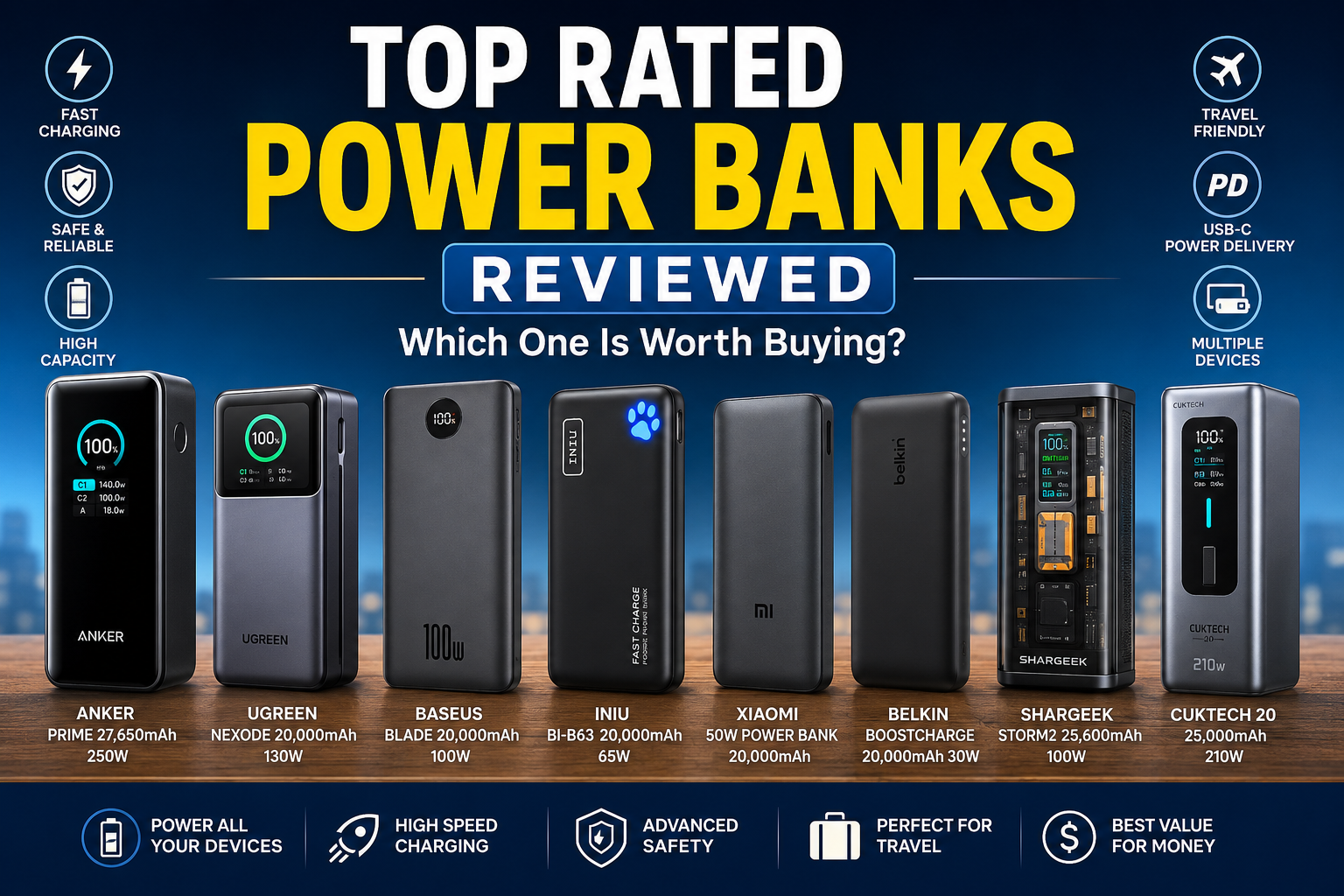
This comprehensive Voltixa buying guide reviews today’s top-rated power banks based on performance, charging technology, safety, portability, value for money, and real-world usability. Whether you’re a student, professional, traveler, content creator, or mobile gamer, you’ll find a model that suits your needs and budget.
Why You Can Trust This Guide
At Voltixa, we focus on practical buying advice rather than marketing claims. Instead of choosing products based solely on advertised battery capacity, this guide evaluates each power bank using factors that genuinely affect everyday use.
Our evaluation considers:
- Battery efficiency
- Real charging performance
- Charging protocols
- USB-C Power Delivery support
- Quick Charge compatibility
- Build quality
- Heat management
- Port selection
- Airline travel suitability
- Safety certifications
- Brand reputation
- Long-term reliability
- Overall value
Rather than recommending dozens of nearly identical products, we’ve selected models that excel in specific categories, making it easier to choose the right one for your lifestyle.
Quick Comparison Table
| Power Bank | Capacity | Max Output | Best For | Overall Rating |
|---|---|---|---|---|
| Anker Prime 27,650mAh | 27,650mAh | 250W | Professionals & laptops | ⭐⭐⭐⭐⭐ |
| UGREEN Nexode 20000 | 20,000mAh | 130W | Fast charging multiple devices | ⭐⭐⭐⭐⭐ |
| Baseus Blade 20000 | 20,000mAh | 100W | Travel & slim design | ⭐⭐⭐⭐☆ |
| INIU BI-B63 | 20,000mAh | 65W | Excellent value | ⭐⭐⭐⭐☆ |
| Xiaomi 50W Power Bank | 20,000mAh | 50W | Everyday users | ⭐⭐⭐⭐☆ |
| Belkin BoostCharge | 20,000mAh | 30W | Apple ecosystem | ⭐⭐⭐⭐☆ |
| Shargeek Storm2 | 25,600mAh | 100W | Tech enthusiasts | ⭐⭐⭐⭐⭐ |
| CUKTECH 20 | 25,000mAh | 210W | Heavy multitasking | ⭐⭐⭐⭐⭐ |
How We Selected the Best Power Banks
Not every power bank performs as advertised. Some lose a significant amount of capacity due to conversion losses, while others struggle to maintain fast charging under heavy loads.
To create this guide, we focused on characteristics that directly affect the user experience.
Battery Capacity
Many buyers assume that higher mAh automatically means better battery life. While capacity is important, usable output is even more critical.
For example, a 20,000mAh power bank typically delivers around 12,000–14,000mAh of usable energy after accounting for voltage conversion and efficiency losses. High-quality brands generally offer better energy efficiency than low-cost alternatives.
Charging Speed
Today’s premium smartphones support charging speeds ranging from 25W to over 100W. Purchasing a slow 18W power bank for a phone capable of 65W charging significantly increases charging time.
We prioritized models supporting technologies such as:
- USB Power Delivery (PD)
- Quick Charge (QC)
- PPS Fast Charging
- Samsung Super Fast Charging
- Apple Fast Charging
- Laptop USB-C Charging
Port Selection
Modern users often carry multiple devices.
The best power banks include combinations such as:
- USB-C input/output
- Multiple USB-C ports
- USB-A compatibility
- Simultaneous charging support
This allows users to charge smartphones, earbuds, tablets, smartwatches, cameras, and laptops at the same time.
Build Quality
A power bank spends much of its life inside backpacks, laptop bags, or travel luggage. Durable construction helps protect the internal battery from accidental drops and daily wear.
We preferred models with:
- Premium materials
- Fire-resistant casing
- Scratch-resistant finish
- High-quality internal battery cells
- Strong USB connectors
Safety Features
Battery safety should never be overlooked.
Reliable manufacturers include multiple protection systems such as:
- Over-voltage protection
- Over-current protection
- Short-circuit protection
- Overheating protection
- Overcharging protection
- Temperature monitoring
- Intelligent power management
These features help protect both your devices and the power bank itself.
Our Top Picks
1. Anker Prime 27,650mAh 250W — Best Overall Power Bank
Specifications
| Feature | Details |
|---|---|
| Capacity | 27,650mAh |
| Maximum Output | 250W |
| USB-C Ports | 2 |
| USB-A Ports | 1 |
| Laptop Charging | Yes |
| Fast Charging | Yes |
| Airline Safe | Yes |
Overview
If you’re looking for the most capable power bank available today, the Anker Prime 27,650mAh stands at the top of the list. Designed for professionals and power users, it delivers enough power to charge not only smartphones and tablets but also high-performance laptops, gaming handhelds, cameras, and multiple accessories simultaneously.
Its impressive 250W combined output makes it one of the fastest charging portable batteries currently available.
Unlike traditional power banks that prioritize only capacity, the Anker Prime focuses equally on charging speed, intelligent power distribution, and premium build quality.
Performance
During everyday use, this power bank consistently delivers excellent charging speeds without noticeable overheating.
Typical performance includes:
- 4–6 smartphone charges
- 2 tablet charges
- 1–2 laptop charges
- Simultaneous charging for three devices
Professionals carrying a MacBook Air, iPad, smartphone, wireless earbuds, and smartwatch can comfortably rely on it throughout an entire workday.
Pros
✔ Outstanding charging speed
✔ Excellent build quality
✔ Premium battery efficiency
✔ Intelligent display
✔ Supports laptops
✔ Multiple USB-C ports
✔ Extremely reliable
Cons
✘ Expensive
✘ Slightly heavier than standard power banks
Who Should Buy It?
This model is ideal for:
- Business professionals
- Frequent travelers
- Remote workers
- Digital creators
- Engineers
- Photographers
- Laptop users
- Anyone carrying multiple USB-C devices
2. UGREEN Nexode 20000mAh 130W — Best Value Premium Power Bank
Specifications
| Feature | Details |
|---|---|
| Capacity | 20,000mAh |
| Output | 130W |
| USB-C | 2 |
| USB-A | 1 |
| Laptop Charging | Yes |
| Fast Charging | Excellent |
Overview
UGREEN has earned a strong reputation for producing reliable charging accessories, and the Nexode 20,000mAh 130W power bank continues that trend. It strikes an impressive balance between portability, charging performance, and affordability, making it one of the best value options in the premium category.
Despite being more compact than many competing models, it delivers enough power to fast-charge smartphones, tablets, ultrabooks, handheld gaming consoles, and other USB-C devices with ease.
One of its standout features is intelligent power distribution. When charging multiple devices simultaneously, the Nexode automatically allocates power efficiently, ensuring each connected device receives optimal charging speeds without compromising safety.
Real-World Performance
In everyday use, the Nexode performs consistently across a wide range of scenarios. Whether you’re topping up a smartphone during your commute or powering a lightweight laptop while working from a café, it maintains stable output with minimal heat buildup.
You can typically expect:
- Up to 4 full smartphone charges
- Around 1.5 charges for most tablets
- A meaningful recharge for USB-C laptops
- Simultaneous charging for three devices without major speed loss
Its compact design also makes it easy to slip into a backpack or laptop sleeve, making it an excellent companion for business trips, college, or remote work.
Pros
✔ Excellent balance of price and performance
✔ High-speed 130W output
✔ Dual USB-C ports
✔ Reliable thermal management
✔ Compact and travel-friendly
✔ Supports laptops, tablets, and smartphones
Cons
✘ No built-in display
✘ Premium price compared to entry-level power banks
Who Should Buy It?
The UGREEN Nexode 20,000mAh 130W is an excellent choice for:
- Students with multiple gadgets
- Remote professionals
- Frequent flyers
- Hybrid workers
- Creators using tablets and lightweight laptops
- Users who want premium features without paying flagship prices
3. Baseus Blade 20,000mAh 100W – Best Slim Power Bank for Travel
Specifications
| Feature | Details |
|---|---|
| Capacity | 20,000mAh |
| Maximum Output | 100W |
| USB-C Ports | 2 |
| USB-A Ports | 2 |
| Laptop Charging | Yes |
| Weight | Approximately 490g |
Overview
If portability is your top priority, the Baseus Blade stands out from traditional power banks thanks to its incredibly slim profile. Instead of the usual thick brick-like design, it resembles a compact tablet, making it easy to slide into a laptop sleeve, backpack, or briefcase.
Despite its slim construction, it still delivers enough power to charge smartphones, tablets, ultrabooks, handheld gaming devices, cameras, and accessories. For professionals who travel frequently, it strikes an excellent balance between portability and performance.
Its digital display provides clear information about the remaining battery percentage and charging status, helping users better manage power throughout the day.
Real-World Performance
The Baseus Blade performs exceptionally well during travel and office use. It comfortably charges a modern smartphone several times while also providing enough power for lightweight laptops.
In everyday testing, users can generally expect:
- Around 4 smartphone charges
- One full charge for many USB-C laptops
- Multiple tablet charges
- Stable charging for several devices simultaneously
The intelligent power management system helps maintain charging efficiency without excessive heat generation.
Pros
✔ Ultra-slim premium design
✔ Supports 100W USB-C charging
✔ Easy to carry while traveling
✔ Digital battery display
✔ Four charging ports
✔ High-quality construction
Cons
✘ Slightly more expensive than standard 20,000mAh models
✘ Wide shape may not fit smaller pockets
Who Should Buy It?
The Baseus Blade is ideal for:
- Business travelers
- Students carrying laptops
- Digital nomads
- Remote workers
- Users who prioritize portability
4. INIU BI-B63 20,000mAh 65W – Best Budget Premium Choice
Specifications
| Feature | Details |
|---|---|
| Capacity | 20,000mAh |
| Maximum Output | 65W |
| USB-C | Yes |
| USB-A | Yes |
| Laptop Support | Yes |
Overview
INIU has built a strong reputation by offering reliable charging accessories at competitive prices. The BI-B63 proves that buyers don’t always need to spend flagship prices to enjoy modern fast-charging technology.
This model delivers excellent value by combining a large battery, USB-C Power Delivery, multiple charging ports, and dependable safety features in an affordable package.
For most smartphone users, it offers nearly everything needed for everyday charging without unnecessary premium extras.
Performance
During daily use, the BI-B63 performs consistently across different device types.
Typical charging results include:
- Four to five smartphone charges
- One tablet recharge
- Emergency laptop charging
- Simultaneous charging for multiple accessories
Heat management remains impressive, even during extended charging sessions.
Pros
✔ Outstanding value
✔ Compact design
✔ Reliable fast charging
✔ Good battery efficiency
✔ Multiple device support
✔ Excellent safety protection
Cons
✘ Lower output than flagship models
✘ Plastic construction instead of aluminum
Who Should Buy It?
Choose this model if you:
- Want the best value for money
- Need reliable travel charging
- Mainly charge smartphones and tablets
- Occasionally charge a laptop
5. Xiaomi 50W Power Bank 20,000mAh – Best Everyday Power Bank
Specifications
| Feature | Details |
|---|---|
| Capacity | 20,000mAh |
| Maximum Output | 50W |
| USB-C | Yes |
| USB-A | Yes |
| Fast Charging | Supported |
Overview
Xiaomi has become one of the most trusted brands for affordable consumer electronics, and its 50W Power Bank continues that reputation.
Instead of targeting power users with extremely high wattage, Xiaomi focuses on delivering dependable everyday charging for smartphones, tablets, earbuds, smartwatches, and other portable electronics.
Its straightforward design makes it easy for beginners while still offering enough performance for experienced users.
Real-World Performance
Most users will find the Xiaomi Power Bank more than capable for daily use.
Typical performance includes:
- Four smartphone charges
- Two wireless earbud recharges
- One tablet charge
- Fast charging for compatible Xiaomi devices
Charging remains stable throughout the battery cycle with consistent output.
Pros
✔ Excellent reliability
✔ Trusted brand
✔ Competitive pricing
✔ Good charging efficiency
✔ Supports fast charging
✔ Easy to use
Cons
✘ Lower output for larger laptops
✘ Limited advanced features
Who Should Buy It?
Perfect for:
- Students
- Office workers
- Casual travelers
- Android users
- Everyday smartphone owners
6. Belkin BoostCharge 20,000mAh – Best for Apple Users
Specifications
| Feature | Details |
|---|---|
| Capacity | 20,000mAh |
| Output | 30W |
| USB-C | Yes |
| USB-A | Yes |
| Safety Protection | Comprehensive |
Overview
Belkin has long been a preferred accessory brand for Apple users, known for dependable quality and broad compatibility. The BoostCharge 20,000mAh is designed for users who value reliability over maximum charging speeds.
While it doesn’t offer the highest wattage in this roundup, it excels in consistent performance and works seamlessly with iPhones, iPads, AirPods, Apple Watches, and many USB-C Android devices.
Real-World Performance
For everyday Apple users, the BoostCharge provides dependable charging throughout the day.
Expected usage includes:
- Four to five iPhone charges
- Multiple AirPods recharges
- One to two iPad charges
- Stable charging with minimal heat
Pros
✔ Excellent compatibility with Apple devices
✔ Trusted brand
✔ Compact design
✔ Reliable safety features
✔ Durable construction
Cons
✘ Slower than newer 65W–140W competitors
✘ Premium pricing
Who Should Buy It?
Ideal for:
- iPhone users
- Apple ecosystem owners
- Business professionals
- Travelers wanting dependable performance
7. Shargeek Storm2 25,600mAh – Best Premium Smart Power Bank
Specifications
| Feature | Details |
|---|---|
| Capacity | 25,600mAh |
| Maximum Output | 100W |
| Display | Transparent Smart Display |
| Laptop Charging | Yes |
Overview
The Shargeek Storm2 is unlike almost any other power bank on the market. Its transparent casing immediately stands out, revealing the internal components while giving it a futuristic appearance.
Beyond its unique design, it features one of the most informative displays available, providing real-time information about voltage, current, temperature, battery health, charging speed, and remaining capacity.
This makes it especially appealing to technology enthusiasts and professionals who like detailed performance data.
Performance
The Storm2 easily powers demanding devices including:
- MacBooks
- Windows ultrabooks
- Steam Deck
- Nintendo Switch
- DSLR cameras
- Drones
- Smartphones
Its battery management system efficiently distributes power between connected devices while maintaining safe operating temperatures.
Pros
✔ Outstanding display
✔ Premium construction
✔ Excellent charging speed
✔ High-quality battery cells
✔ Ideal for power users
Cons
✘ Expensive
✘ Transparent design may not appeal to everyone
Who Should Buy It?
This model is best suited for:
- Tech enthusiasts
- Engineers
- Developers
- Photographers
- Videographers
- Frequent travelers carrying multiple gadgets
8. CUKTECH 20 25,000mAh – Best High-Power Charging Solution
Specifications
| Feature | Details |
|---|---|
| Capacity | 25,000mAh |
| Maximum Output | 210W |
| USB-C Ports | Multiple |
| Laptop Charging | Excellent |
Overview
The CUKTECH 20 is built for users with demanding charging requirements. With a combined output of up to 210W, it can simultaneously charge high-performance laptops, tablets, smartphones, cameras, and other USB-C devices without compromising speed.
Its large battery capacity makes it an excellent option for professionals working remotely, long-haul travelers, or creators who spend extended periods away from power outlets.
Performance
In real-world scenarios, the CUKTECH 20 delivers:
- Up to 5 smartphone charges
- Multiple tablet recharges
- One to two laptop charges
- Simultaneous charging for several high-power devices
Its intelligent power allocation ensures efficient charging even when all ports are in use.
Pros
✔ Extremely high power output
✔ Excellent for laptops
✔ Premium build quality
✔ Large battery capacity
✔ Future-ready USB-C support
Cons
✘ Heavier than standard models
✘ Premium pricing
Who Should Buy It?
This is the ideal choice for:
- Creative professionals
- Video editors
- Software developers
- Remote workers
- Frequent business travelers
- Users carrying several USB-C devices
Performance Comparison
| Model | Capacity | Max Output | Laptop Support | Portability | Value for Money |
|---|---|---|---|---|---|
| Anker Prime | 27,650mAh | 250W | ⭐⭐⭐⭐⭐ | ⭐⭐⭐⭐☆ | ⭐⭐⭐⭐☆ |
| UGREEN Nexode | 20,000mAh | 130W | ⭐⭐⭐⭐⭐ | ⭐⭐⭐⭐⭐ | ⭐⭐⭐⭐⭐ |
| Baseus Blade | 20,000mAh | 100W | ⭐⭐⭐⭐☆ | ⭐⭐⭐⭐⭐ | ⭐⭐⭐⭐☆ |
| INIU BI-B63 | 20,000mAh | 65W | ⭐⭐⭐⭐☆ | ⭐⭐⭐⭐☆ | ⭐⭐⭐⭐⭐ |
| Xiaomi 50W | 20,000mAh | 50W | ⭐⭐⭐☆☆ | ⭐⭐⭐⭐⭐ | ⭐⭐⭐⭐☆ |
| Belkin BoostCharge | 20,000mAh | 30W | ⭐⭐⭐☆☆ | ⭐⭐⭐⭐⭐ | ⭐⭐⭐⭐☆ |
| Shargeek Storm2 | 25,600mAh | 100W | ⭐⭐⭐⭐⭐ | ⭐⭐⭐⭐☆ | ⭐⭐⭐⭐☆ |
| CUKTECH 20 | 25,000mAh | 210W | ⭐⭐⭐⭐⭐ | ⭐⭐⭐⭐☆ | ⭐⭐⭐⭐⭐ |
Understanding Power Bank Capacity
Many buyers believe a 20,000mAh power bank can deliver exactly 20,000mAh to their devices. In reality, some energy is lost during voltage conversion and heat generation, so the usable capacity is typically around 60–75% of the advertised rating.
As a general guide:
| Capacity | Typical Real-World Usage |
|---|---|
| 5,000mAh | Emergency backup for one smartphone charge |
| 10,000mAh | 1–2 smartphone charges |
| 20,000mAh | 3–5 smartphone charges or one tablet recharge |
| 25,000–27,000mAh | Multiple smartphones, tablets, and many laptops |
Capacity is only one part of the equation. Charging speed, efficiency, safety, and build quality are equally important when choosing a power bank that will serve you well over the long term.
Complete Power Bank Buying Guide
Choosing the right power bank isn’t simply about purchasing the one with the biggest battery. Your ideal choice depends on the devices you own, how often you travel, your charging habits, and whether you need to charge only a smartphone or multiple devices like tablets, laptops, cameras, and gaming consoles.
A power bank that works perfectly for a student may not be suitable for a photographer carrying multiple batteries, and a business traveler will have different requirements from someone who simply wants emergency backup power.
This buying guide explains the most important factors to consider before making your purchase.
Capacity: How Much Battery Do You Really Need?
Battery capacity is measured in milliampere-hours (mAh) and indicates how much energy a power bank can store. However, larger capacity also means more weight and a longer recharge time.
5,000mAh
Best for:
- Emergency backup
- Occasional travelers
- Compact everyday carry
Typical charging capability:
- Around one full smartphone charge
10,000mAh
Best for:
- Daily commuters
- College students
- Office workers
Typical charging capability:
- One to two smartphone charges
- Earbuds and smartwatch charging
20,000mAh
The sweet spot for most users.
Ideal for:
- Weekend trips
- Remote work
- Multiple devices
- Frequent travelers
Typical charging capability:
- Three to five smartphone charges
- One to two tablet charges
25,000mAh and Above
Recommended for:
- Laptop users
- Content creators
- Digital nomads
- Business professionals
These high-capacity models can often recharge a lightweight laptop while still having enough power left for a smartphone and wireless accessories.
Understanding Fast Charging Technologies
Fast charging has evolved significantly over the past few years. Not every power bank supports the same standards, so compatibility matters.
1. USB Power Delivery (USB PD)
USB Power Delivery is currently the most widely supported fast-charging standard.
Benefits include:
- Faster charging speeds
- Laptop compatibility
- Universal USB-C support
- Better efficiency
- Intelligent power negotiation
If you’re buying a new power bank in 2026, USB PD should be considered essential.
2. Qualcomm Quick Charge (QC)
Quick Charge is commonly found on Android smartphones using Qualcomm processors.
Advantages:
- Faster charging than standard USB
- Broad Android compatibility
- Reliable performance
Although USB PD is becoming more common, Quick Charge remains useful for many devices.
3. PPS (Programmable Power Supply)
PPS is a newer charging technology that dynamically adjusts voltage and current.
Benefits include:
- Reduced heat generation
- Improved charging efficiency
- Better battery longevity
- Optimized charging for compatible phones
Many flagship Samsung and Google Pixel devices benefit significantly from PPS support.
Why Output Wattage Matters
Many buyers focus solely on battery capacity while ignoring output power, which determines how quickly your devices charge.
| Output | Suitable For |
|---|---|
| 18W | Basic smartphones |
| 30W | iPhones, Android phones, tablets |
| 45W | Tablets, Nintendo Switch, ultrabooks |
| 65W | Most laptops |
| 100W | High-performance laptops |
| 140W+ | Multiple demanding devices |
If you own a USB-C laptop, choose at least a 65W power bank for practical charging performance.
Number of Charging Ports
More ports provide greater flexibility, especially if you carry several gadgets.
Single USB-C
Best for:
- Smartphone users
- Minimalists
Dual USB-C
Recommended for:
- Laptop and phone charging
- Simultaneous fast charging
- Modern USB-C ecosystems
USB-C + USB-A Combination
Still a great option because many accessories continue using USB-A.
Examples include:
- Wireless earbuds
- Bluetooth speakers
- Older smartphones
- Portable fans
- Cameras
Display vs LED Indicators
Some power banks simply use four LEDs to indicate battery level.
Premium models include digital displays showing:
- Remaining battery percentage
- Charging speed
- Current voltage
- Power output
- Estimated recharge time
For professionals and power users, digital displays provide far more useful information.
Build Quality Matters More Than You Think
Power banks are frequently carried in backpacks, handbags, and suitcases, making durability an important consideration.
Look for features such as:
- Scratch-resistant casing
- Fire-resistant materials
- Reinforced USB ports
- High-quality lithium cells
- Strong internal construction
Premium brands often justify their higher prices through better engineering and long-term reliability.
Airline Travel Regulations
Many travelers wonder whether power banks are allowed on flights.
The good news is that most airlines permit power banks in carry-on luggage, but they should not be placed in checked baggage. This is because lithium-ion batteries present a fire risk if damaged.
Most power banks between 20,000mAh and approximately 27,000mAh (around 100Wh) comply with standard airline limits, though policies may vary by airline and country. If you travel frequently, it’s always wise to verify your airline’s latest battery regulations before departure.
Battery Lifespan
A quality power bank should last several years with proper care.
To maximize battery life:
- Avoid storing it fully discharged.
- Keep it away from extreme heat or freezing temperatures.
- Use high-quality charging cables.
- Recharge it every few months if not in regular use.
- Avoid unnecessary drops or impacts.
Following these practices helps preserve battery health and charging efficiency over time.
Common Mistakes to Avoid
Buying the wrong power bank often leads to frustration and unnecessary expense. Here are some of the most common mistakes.
Choosing Based Only on Capacity
A 30,000mAh power bank from an unknown brand may perform worse than a well-built 20,000mAh model from a trusted manufacturer.
Always consider:
- Build quality
- Charging efficiency
- Safety features
- Brand reputation
- Warranty
Ignoring Output Power
Buying a large-capacity power bank with only 18W output means modern smartphones and laptops will charge much more slowly than they’re capable of.
Match the output rating to your devices’ charging requirements.
Buying Too Many Ports You Won’t Use
More ports can be convenient, but if you typically charge only one phone, paying extra for four or five outputs may not provide real value.
Choose features that align with your actual usage.
Using Low-Quality Charging Cables
Even the best power bank cannot compensate for poor cables.
Cheap or damaged cables can result in:
- Slower charging
- Overheating
- Intermittent connections
- Reduced charging efficiency
Investing in certified, high-quality cables is just as important as choosing the right power bank.
Overlooking Safety Certifications
Low-cost power banks from unknown manufacturers may lack essential safety protections.
Look for models that include safeguards against:
- Overcharging
- Overheating
- Short circuits
- Excessive current
- Voltage spikes
These features help protect both your devices and the power bank itself.
Expert Recommendations
After comparing today’s leading models, here are our recommendations based on different user needs.
| User Type | Recommended Power Bank |
|---|---|
| Students | Xiaomi 50W Power Bank |
| Budget Buyers | INIU BI-B63 |
| Frequent Travelers | Baseus Blade |
| Business Professionals | UGREEN Nexode 20,000mAh |
| Laptop Users | Anker Prime 27,650mAh |
| Content Creators | CUKTECH 20 |
| Tech Enthusiasts | Shargeek Storm2 |
| Apple Users | Belkin BoostCharge |
Pros and Cons of Buying a High-Quality Power Bank
Pros
- Keeps devices powered during travel
- Supports fast charging for modern smartphones and laptops
- Reduces dependence on wall outlets
- Ideal for emergencies and power outages
- Can charge multiple devices simultaneously
- Saves time with high-wattage charging
- Provides added convenience for remote work and outdoor activities
Cons
- Premium models can be expensive
- Higher-capacity units are heavier
- Large batteries take longer to recharge
- Fast charging requires compatible devices and cables
- Airline restrictions apply to lithium-ion batteries
Who Should Buy Which Power Bank?
Selecting the right model depends on your daily routine and the devices you use. Here’s a quick guide to help you decide.
Students
If you mainly need to keep your phone, earbuds, and perhaps a tablet charged throughout the day, a 10,000–20,000mAh power bank like the Xiaomi 50W or INIU BI-B63 offers excellent value without adding too much weight to your backpack.
Office Professionals
Professionals who rely on smartphones, tablets, and lightweight laptops should consider the UGREEN Nexode 20,000mAh. Its high-speed USB-C charging and compact size make it ideal for commuting and business travel.
Frequent Travelers
For those constantly on the move, portability is key. The Baseus Blade 20,000mAh combines a slim design with ample power, making it easy to carry through airports, hotels, and meetings.
Laptop Users
If your work depends on keeping a laptop running away from a wall outlet, choose a high-output model such as the Anker Prime 27,650mAh or CUKTECH 20. Their higher wattage is designed to handle more demanding devices.
Content Creators and Photographers
Creators often carry cameras, drones, portable monitors, and external SSDs in addition to their phones. Models like the Shargeek Storm2 and CUKTECH 20 provide the capacity and output needed to support this kind of equipment throughout a busy shooting day.
Quick Buying Checklist
Before clicking the “Buy” button, ask yourself these questions:
- ✔ What devices will I charge most often?
- ✔ Do I need laptop charging or only smartphone charging?
- ✔ Is fast charging (USB PD/PPS) important for my devices?
- ✔ Will I travel frequently with this power bank?
- ✔ Do I need multiple charging ports?
- ✔ Is the size and weight suitable for everyday carry?
- ✔ Does it include essential safety features?
- ✔ Am I purchasing from a reputable brand with warranty support?
Answering these questions will help you choose a power bank that fits your needs rather than simply opting for the highest capacity or lowest price.
Frequently Asked Questions (FAQ)
1. What capacity power bank is best for everyday use?
For most people, a 20,000mAh power bank offers the best balance between portability and battery life. It can typically recharge a modern smartphone three to five times while still being compact enough to carry in a backpack or laptop bag.
2. Can a power bank charge a laptop?
Yes. However, not every power bank is capable of charging laptops. You’ll need a model that supports USB Power Delivery (USB PD) with an output of at least 65W. High-performance laptops may benefit from 100W or higher output.
3. Are power banks safe to use?
Yes. Power banks from reputable brands include multiple safety protections such as:
- Overcharging protection
- Short-circuit protection
- Over-current protection
- Temperature monitoring
- Over-voltage protection
Avoid purchasing extremely cheap products from unknown manufacturers, as they may lack proper safety certifications.
4. How long does a power bank last?
A high-quality lithium-ion power bank generally lasts 3–5 years, depending on usage, charging habits, and storage conditions. Most are designed to retain good performance for several hundred full charge cycles.
5. Can I take a power bank on an airplane?
Yes. Most airlines allow power banks in carry-on luggage, but they should not be packed in checked baggage. Many standard models around 20,000mAh fall within commonly accepted airline limits, though it’s always best to check your airline’s current policy before flying.
6. Does a higher mAh rating always mean better performance?
Not necessarily. A higher capacity means more stored energy, but charging speed, battery efficiency, build quality, and safety features are equally important. A premium 20,000mAh power bank can outperform a poorly made 30,000mAh model.
7. What is USB Power Delivery (USB PD)?
USB Power Delivery is a fast-charging standard that allows compatible devices to negotiate the optimal charging voltage and current. It supports faster charging for smartphones, tablets, laptops, and other USB-C devices while improving efficiency and compatibility.
8. Can I charge multiple devices at the same time?
Yes. Most modern power banks feature two or more output ports, allowing you to charge multiple devices simultaneously. Keep in mind that the available power may be shared across ports depending on the model.
9. How long does it take to recharge a power bank?
Recharge time depends on the battery capacity and the charger’s output. A 20,000mAh power bank may take several hours with a standard charger but can recharge much faster when paired with a high-wattage USB-C PD charger.
10. Which power bank offers the best overall value?
For most users, the UGREEN Nexode 20,000mAh 130W delivers an excellent combination of portability, fast charging, laptop compatibility, and price. Users with higher power requirements may prefer the Anker Prime 27,650mAh or CUKTECH 20.
11. Should I buy a 10,000mAh or 20,000mAh power bank?
If you only need occasional backup for a smartphone, 10,000mAh is usually sufficient. If you travel frequently, use multiple devices, or want several full charges before recharging the power bank itself, 20,000mAh is the better long-term choice.
12. Is wireless charging on a power bank worth it?
Wireless charging is convenient for compatible smartphones and earbuds, but it is generally slower and less efficient than wired USB-C charging. If speed is your priority, a wired connection remains the better option.
Final Verdict
Power banks have evolved from simple emergency chargers into powerful portable energy solutions capable of supporting smartphones, tablets, laptops, cameras, gaming handhelds, and other USB-C devices. The right choice depends on how you use your technology each day.
If you’re looking for the best all-around performer, the Anker Prime 27,650mAh stands out with exceptional charging speed, premium build quality, and the ability to power multiple high-demand devices. It is an excellent investment for professionals, creators, and frequent travelers.
For users seeking outstanding value, the UGREEN Nexode 20,000mAh offers a compelling mix of performance, portability, and affordability. It provides enough power for most everyday scenarios while remaining easy to carry.
Budget-conscious buyers will appreciate the INIU BI-B63, while travelers may prefer the slim design of the Baseus Blade. Apple users will find dependable compatibility with the Belkin BoostCharge, and tech enthusiasts who enjoy detailed performance metrics will likely be drawn to the Shargeek Storm2. If maximum output is your priority, the CUKTECH 20 is one of the strongest options available.
Before making your purchase, consider the devices you need to charge, how often you travel, and whether laptop support or high-speed charging is important. Choosing a reliable power bank from a trusted brand will provide better performance, improved safety, and greater long-term value than simply selecting the highest capacity.
Key Takeaways
- A 20,000mAh power bank is the best choice for most users.
- Choose USB Power Delivery (PD) for faster and more versatile charging.
- For laptops, select a model with at least 65W output.
- Reputable brands offer better efficiency, durability, and safety.
- Match the power bank to your devices and usage rather than buying solely based on capacity.
Suggested Internal Links for Voltixa
- Complete Wireless Mouse Buying Guide
- How to Choose the Right Mechanical Keyboard
- Essential Portable Monitor Accessories You Should Own
- Top Rated Standing Desks Reviewed
- How to Choose the Right Office Chair